It is the JFK assassination of my generation.
It’s like asking where you were when Elvis died.
An event so big it defines a generation — so significant and so deeply imprinted that no matter what else fades with time, this moment never will.
September 11, 2001, was the day the world cracked open.
I was 27 years old when 19 cowardly men, armed with box cutters, hijacked four fully fueled commercial passenger jets and attacked freedom itself. By the end of that day, nearly 3,000 people were dead. Firefighters. Police officers. Flight crews. Passengers. Ordinary people just going about an ordinary Tuesday morning.
Nothing about that day was ordinary.
That Morning
It was around 9:15 a.m. I had an interview with an employment agency downtown — about ten minutes from home — for a job I really wanted. I was neatly dressed, feeling confident, feeling ready. I slid into my Honda Accord, mentally rehearsing answers and planning my next move.
I turned on the radio, looking for some pump-me-up music.
There was no music.
Instead, the announcer was describing something so unbelievable that my brain refused to process it. A plane had hit the World Trade Center. I honestly wasn’t sure if it was real. It sounded impossible — almost like a prank or some terrible misunderstanding.
Being a documentary nerd, my mind immediately jumped to the time a B-25 bomber crashed into the Empire State Building in 1945 during heavy fog. Tragic, yes — but an accident. That’s what I assumed this was, too.
But how?
It was a perfectly clear, sunny morning in Southwestern Ontario — and New York City is only about an eight-hour drive away.
When I arrived at the interview, the entire office was talking about it. People were gathered around radios and phones, trying to piece together what little information was coming in. Then something happened that made it unmistakably clear this was no accident.
A second plane hit.
This Was No Accident
United Flight 175 had slammed into the South Tower.
The interview itself was short — maybe 15 minutes, just a pre-screen — and honestly, it felt like neither of us was really there. Something far bigger was happening, and it was impossible to focus on résumés and job placements.
When it ended, I rushed back home.
As I sat at a red light — a moment that’s frozen in my memory — my ears registered something I could barely comprehend. Another plane. This one had hit the Pentagon.
I later learned the time was 9:37 a.m.
By then, I was just a block from home. I needed to see this. I needed confirmation from my own eyes that the world hadn’t suddenly lost its mind.
Watching It Unfold
My friend Miranda and her children were staying with me at the time. I ran into the house and headed straight for the basement. We sat on the couch, staring at my big screen TV, watching live coverage as the unthinkable unfolded in real time.
Two of the tallest buildings in the world were burning.
Smoke poured out of gaping wounds high above the city, floors nearly 1,500 feet in the air. And then came the images that still haunt me.
People were trapped at the windows — four and five deep — pressed against broken glass, surrounded by fire and smoke. And then they began to jump.
I screamed.
Some held hands.
Some jumped alone.
Some crossed themselves before stepping into nothingness.
I remember thinking that the conditions inside must have been absolutely horrific if jumping from a quarter-mile up felt like the better option. Some tried to make parachutes out of curtains or tablecloths. One man desperately tried to climb down the outside of the building.
That one still scars me.
Even now, more than twenty years later, I get intrusive flashes of that image — that specific fall. I don’t know why that one lodged itself so deeply into my psyche, but it did. Those people were the only visible fatalities on a day that would claim thousands, and yet their faces and movements are burned into my memory forever.
Collapse
At 9:59 a.m., we watched as the South Tower collapsed — just 56 minutes after it was hit.
I can still feel that moment in my body.
Jaw-dropping.
Surreal.
Impossible.
Within a short span of time, both towers would be reduced to massive clouds of ash, steel, and dust as thousands ran for their lives through the streets of Manhattan. The Pentagon burned. And Flight 93, after passengers fought back, crashed into a field in Shanksville, Pennsylvania, likely preventing an even greater catastrophe.
That’s when it became undeniable.
This was coordinated.
This was intentional.
This was terrorism.
My mind went to the unthinkable: Is this the beginning of World War III?
“Get Up — Something Is Happening”
My husband was asleep upstairs. He had finished working night shift just hours earlier. I ran up two flights of stairs in seconds, shouting,
“OMG! OMG! WWIII is starting — you need to get up!”
We rushed back downstairs and sat there for hours, watching the fallout of the deadliest terrorist attack in world history unfold on live television.
My eldest was at school, and every instinct in me wanted to go get her. My husband talked me out of it, convincing me to let her finish her day. My youngest was only three years old, completely oblivious to how profoundly her world — and all of ours — had just changed.
Nothing would ever feel quite the same again.
And it never has.
“Those who came through the windows of the towers provided the starkest, most harrowing evidence of the desperate conditions inside”
~ New York Times, Sept. 10, 2004
2008: Returning to the Wound
Years later, in 2008, I took my eldest daughter to New York City.
I had always envisioned taking both of my girls there one day — to experience the magnificence of the city in all its glitz and glamour, yes — but also to understand something much deeper. I wanted them to grasp the origins of 9/11, its far-reaching implications, and to remember the lives lost on that tragic day, as well as the countless lives forever altered by it.
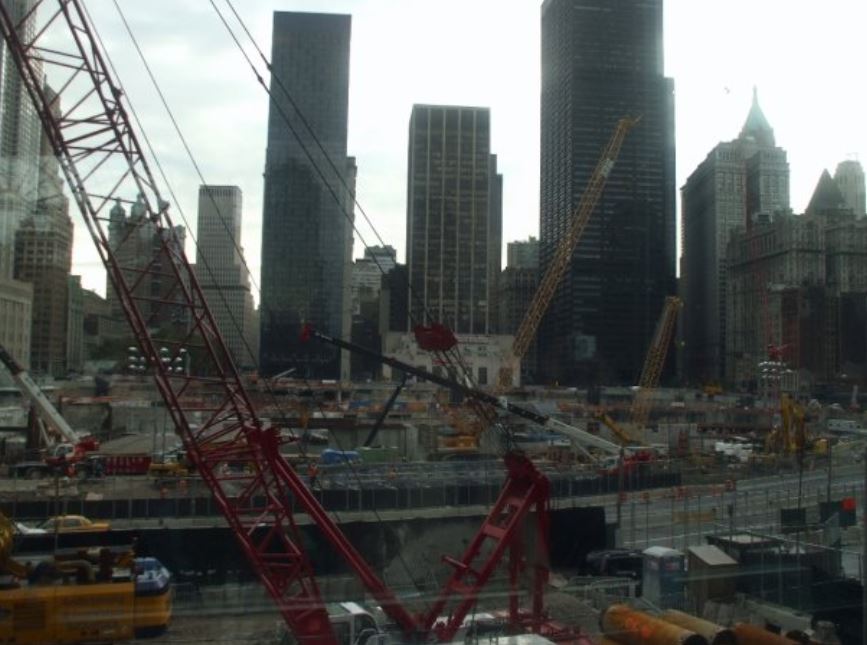
By the time we arrived in October 2008, Ground Zero — the name given almost immediately after the September 11th attacks — had existed for seven long years.
And it still looked like a wound.
The site where the Twin Towers once stood was still largely a massive hole in the ground. Construction was underway, but the space felt suspended in time — heavy, unfinished, unresolved. The foundations of what would become the Freedom Tower (later renamed One World Trade Center) were taking shape, but the skyline still felt unnervingly incomplete.
Standing there, it was impossible not to remember exactly where I had been on September 11, 2001 — impossible not to feel the weight of absence. This wasn’t just a construction site. It was sacred ground. A place where nearly 3,000 lives were taken, where families were shattered, and where the world collectively lost its sense of invulnerability.
I wanted my daughter to see that.
Not just the buildings, but the space they left behind.


2014: A Changed Skyline, an Unchanged Weight
The next time I visited New York City was Canadian Thanksgiving in October 2014. This time, I travelled with my youngest daughter — it was her birthday.
So much had changed.
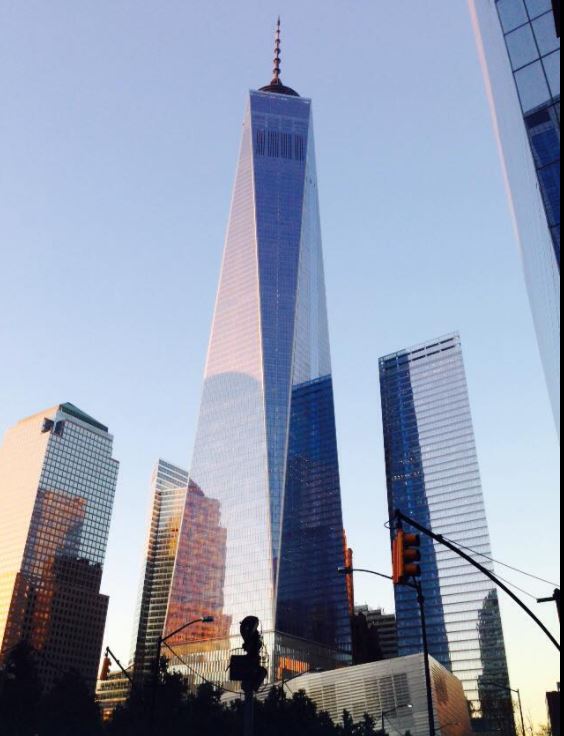
The Freedom Tower stood tall, complete and unmistakable, ready to open the following month as One World Trade Center on November 3, 2014. The super-tall skyscraper carried the same name as the North Tower of the original World Trade Center — a deliberate act of remembrance and continuity.
The new tower rises from the northwest corner of the 16-acre World Trade Center site, built on the footprint of the former 6 World Trade Center. Where once there had been absence, there was now vertical defiance — steel and glass reclaiming the skyline.
We visited the 9/11 Memorial Plaza, a space that feels both solemn and strangely peaceful — a tribute to the past and a quiet statement of hope for the future.
At the heart of the plaza are the twin reflecting pools, set precisely within the original footprints of the Twin Towers. Each pool spans nearly one acre, making them the largest man-made waterfalls in North America. Water cascades endlessly into a central void, disappearing into darkness — a visual echo of loss that words can’t fully capture.
Encircling the pools are bronze panels engraved with the names of every person who perished in both the February 26, 1993, World Trade Center bombing and the September 11, 200,1 terrorist attacks.
We ran our fingers along the names.
Strangers — yet not strangers at all.
Standing there with my daughter, I felt the full arc of time: devastation, absence, rebuilding, remembrance. The skyline had healed, but the memory had not faded — nor should it.
Some places are meant to be remembered exactly as they are felt.
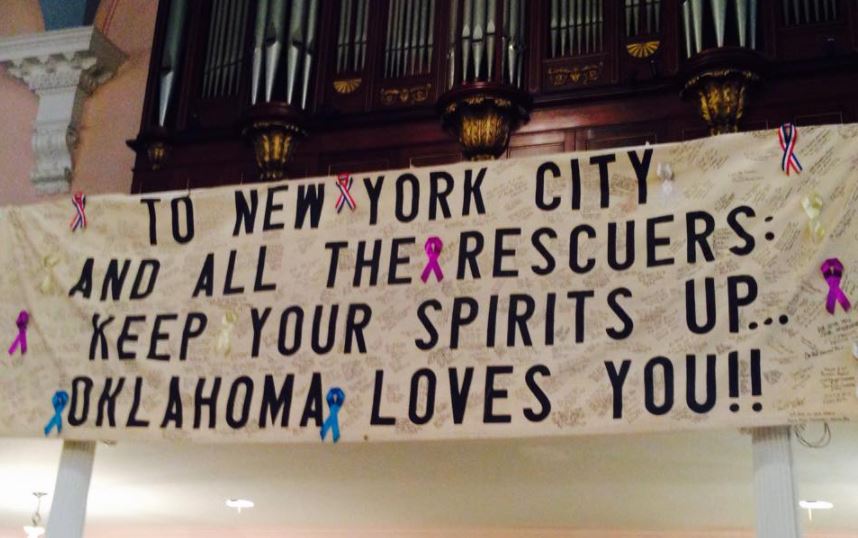

Kitchener’s Living Link to 9/11
Most people know the heartbreaking stories from September 11, 2001 — the coordinated terror attacks that brought down the Twin Towers in New York City, struck the Pentagon, and caused the crash of Flight 93 in Pennsylvania, killing nearly 3,000 people. But few know that here in Kitchener, Ontario, we carry a tangible connection to that day, rooted in shared respect, remembrance, and community.
In Firefighters Memorial Park (located between Centre In The Square and the Kitchener Public Library) stands a rusted steel beam from the World Trade Center — a real artifact from the 9/11 wreckage.
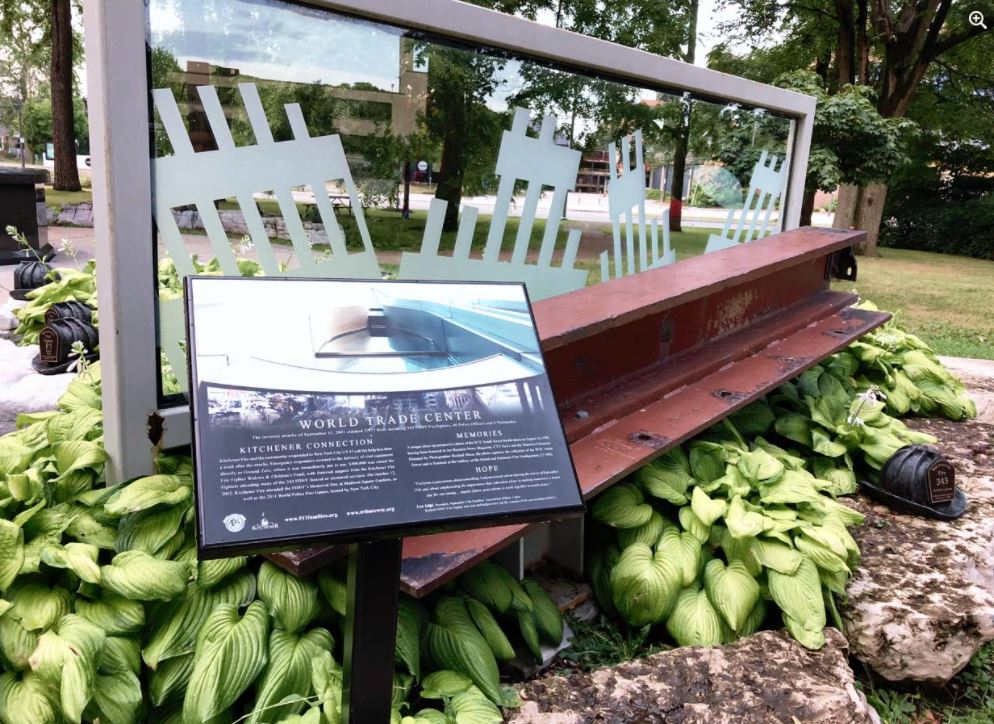
This isn’t just any piece of metal. The beam is 3.43 metres (11 feet, 3 inches) long, and its size was chosen deliberately. The number 3.43 powerfully echoes the 343 New York City firefighters who gave their lives on 9/11 while rushing into danger to save others. That tragic toll is one of the most remembered figures from that day, representing the ultimate sacrifice of first responders.
As Kevin Schmalz, former chair of the Kitchener Fire Memorial Committee, observed, “There were 343 firefighters killed on that day, so we asked for something that was 3.43 metres.” That symbolic measurement makes the beam more than a relic — it is a living reminder of courage, loss, and solidarity.
Why It Matters Here
The memorial isn’t just an object; it’s a place of reflection, community gathering, and education:
- Each year on September 11, members of the Kitchener Fire Department, City Council, and local residents come together at the memorial to pause, share stories, and honour not just the fallen of 2001, but also the spirit of service and unity that followed.
- The memorial also emphasizes the broader Canada–U.S. bond, referencing moments like the heroic hospitality shown by communities such as Gander, Newfoundland, which sheltered thousands of stranded passengers after airspace closures — a powerful example of cross-border compassion in the wake of tragedy.
- Beyond the beam itself, the park is part of a larger firefighter tribute space that honours those who died in the line of duty locally and globally.
A Symbol That Transcends Distance
While the beam came from 2,300 km away at Ground Zero, its presence in Kitchener connects our city directly to that moment in history. It’s a physical reminder that 9/11 wasn’t just “an American tragedy,” but an event that impacted the world, including Canadians who lost loved ones, first responders who travelled to assist in recovery, and everyday citizens who remember where they were when it happened.
Some memorials in other places even use World Trade Center steel to symbolize similar sacrifices — from small town parks to fire stations across North America — showing how artifacts from that day now serve as beacons of memory far beyond New York City itself.


 My Tiny World Corner
Leave a reply to Leigh Cancel reply