
Who Are the Filles du roi?
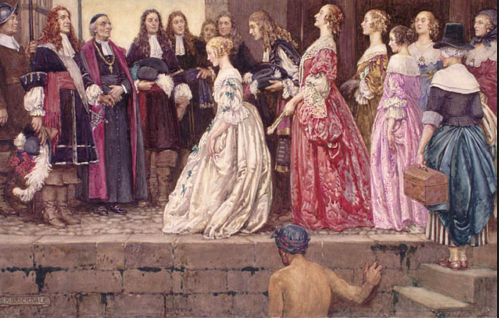
Most Canadians are familiar with the King’s Daughters’/Filles du roi, especially those of French descent. If you aren’t familiar, they were about 700 women who arrived in the colony of New France (Canada) between 1663 and 1673, under the financial sponsorship of King Louis XIV of France. Most were single French women, many of whom were orphans. Their transportation to Canada and settlement in the colony were paid for by the King. Some were given a royal gift of a dowry of 50 livres for their marriage to one of the many unmarried male colonists in Canada.
Colonization of New France
The first “settler” was brought to Quebec by Samuel de Champlain, the apothecary Louis Hébert and his family, of Paris. They came expressly to settle, stay in one place to make the New France settlement function. Waves of recruits came in response to the requests for men with specific skills, like farming, apothecaries, blacksmiths. As couples married, cash incentives to have large families were put in place and were effective.
To strengthen the colony and make it the centre of France’s colonial empire, Louis XIV decided to send single women, aged between 15 and 30 known as the King’s Daughters/Les Filles du Roi, to New France, paying for their passage and granting goods or money as a dowry. Approximately 700 arrived during 1663–1673. The King’s Daughters found husbands among the male settlers within a year or two, as well as a new life for themselves. They came of their own accord, many because they could not make a favourable marriage in the social hierarchy in France. By 1672, the population of New France had risen to 6,700, from 3,200 in 1663.
At the same time, marriages with the indigenous people was encouraged, and indentured servants, known as engagés, were also sent to New France.
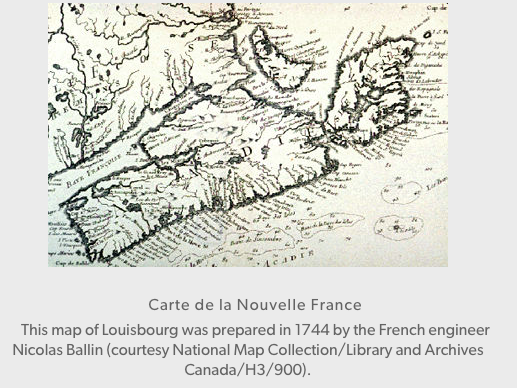
The women played a major role in establishing family life, civil society, and enabling rapid growth. There was a high demand for children, for they contributed to the prosperity of the farm from an early age, and there was plenty of food for them. Women bore about 30% more children than comparable women who remained in France. Canadians had an exceptional diet for their time. This was due to the natural abundance of meat, fish, and pure water; the good food conservation conditions during the winter; and an adequate wheat supply in most years.
Besides household duties, some women participated in the fur trade, the major source of cash in New France. They worked at home alongside their husbands or fathers as merchants, clerks, and provisioners. Some were widows who took over their husband’s roles. A handful were active entrepreneurs in their own right
I also want to take a moment to be clear, the indigenous peoples had been living on this territory for millennia. That is, well before the Vikings ventured so far East or the French “colonized” it, or the English took over. They did not discover a new territory; the indigenous people were here long beforehand. The French colonized it in their own name, in the name of the King of France. This was/is native land.
Who is Jeanne-Claude de Boisandré?
I actually descend from several Filles du roi and Filles a marrier. However, today I am going to focus on Jeanne-Claude de Boisandré (1644-1671) the daughter of Sieur Jacques Deboisandré the Ormelée, and Mary de Vieuville.
When Jeanne Claude de Boisandré was born in about 1631 in Caen, Calvados, France, her father, Jacques, was 51, and her mother, Marie, was 46.
She married Pierre Rancourt in Saint- Jean, Caen, France. This IS the line from which I descend …
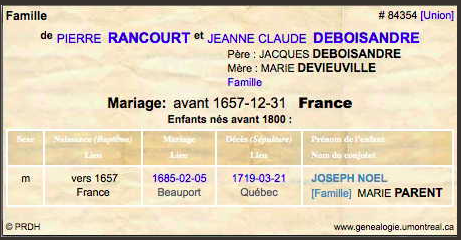
After the passing of her first husband, Pierre, on or about July 24, 1667, in Caen, Basse-Normandie, France, she became a widow, and as a Filles du roi made passage to Canada with her two sons to help settle the new colony of La Nouvelle France.
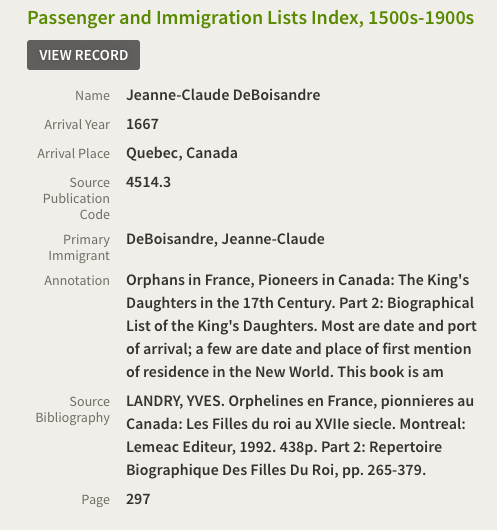

Louis De La Chaise was the son of Louis and Marie De la Chaise George. Although he is the husband of my 7x GGM, I have a lot of respect for him and his choices. He chose to marry her even though she was widowed and had two children from her previous marriage, which was quite a significant commitment during that time. His decision to embrace not only his wife but also her children speaks volumes about his character and the values he held dear. For a time, he provided them with shelter, a warm home, and all the care they needed, demonstrating a deep sense of responsibility and compassion. His dedication to supporting a family that was not entirely his own shows a remarkable sense of empathy and strength, qualities that have left a lasting impression on our family legacy. His willingness to take on such challenges in life not only made a profound impact on their lives but also set an example for future generations about love, resilience, and the importance of family.
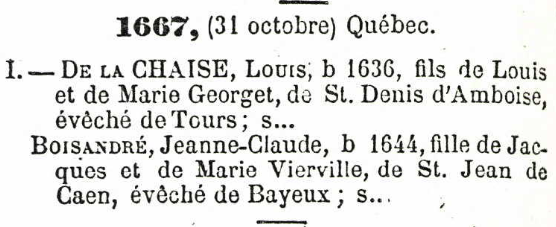
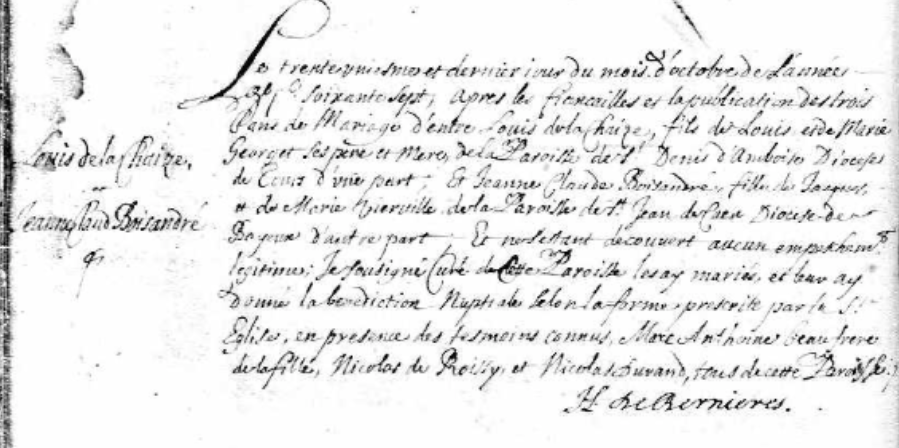
Paroisse Notre Dame church record of the marriage between De La Chaise and de Bboisandré
Jeanne Claude married Jean Létourneau, son of David Létourneau and Sébastienne Guery, on January 15, 1668, in Ile d’Orleans, Québec shortly after De La Chaise died.
Most of the millions of people of French-Canadian descent today are descendants of one or more of these courageous women of the 17th century, who played a pivotal role in shaping the cultural and social fabric of the region. These brave women ventured into unknown territories, facing numerous challenges such as harsh climates, scarce resources, and the trials of establishing new communities. Their resilience and determination laid the foundation for future generations, ensuring that their rich heritage would endure through the centuries. The stories of these women resonate today, reminding us of their significant contributions and the indelible mark they left on history.
Jeanne Claude died on July 24, 1671, in Ste-Famille, Québec, when she was 41 years old. Her life, though cut short, was marked by significant contributions to her community, where she became known for her resilience and dedication to her family. Born in France, Jeanne traveled to New France in search of a better life, facing numerous challenges along the way. In Ste-Famille, she established deep roots, nurturing not only her own children but also supporting her neighbors through various hardships in the burgeoning settlement. Her legacy lives on through the stories and memories shared by those who knew her, reflecting the strength of women in early colonial society.
Fast forward: as we all know, New France will lose the Seven Years’ War to Britain and will fall, relinquishing power to the Brits, then commences the dawn of British North America. This significant power shift fundamentally altered the cultural and political landscape of the region, ushering in an era of British governance and colonial aspirations. The Québécois, a resilient people with a rich history, will mark the event on their license plates with the phrase “je me souviens,” a poignant reminder of their heritage, struggles, and the enduring spirit of a community that has faced numerous challenges throughout history. As they traverse the landscapes of a once-French-dominated territory, this inscription serves not only as a declaration of identity but also as a tribute to the complexities of their past, intertwined with the narrative of both triumph and loss.
My Lineage
Jeanne-Claude Deboisandré+ Pierre Rancourt
|
Joseph Noel Rancourt + Marie Parent
Joseph was born in 1655 in Saint-Jean-de-Lizieux, Normandy, France and arrived in New France in 1685
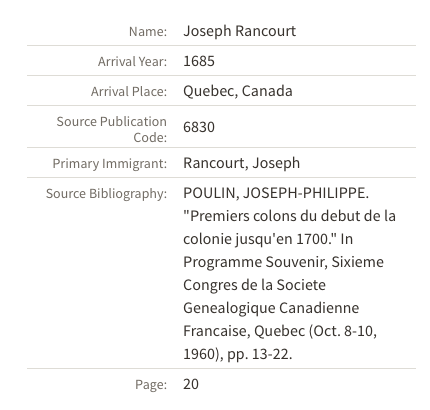
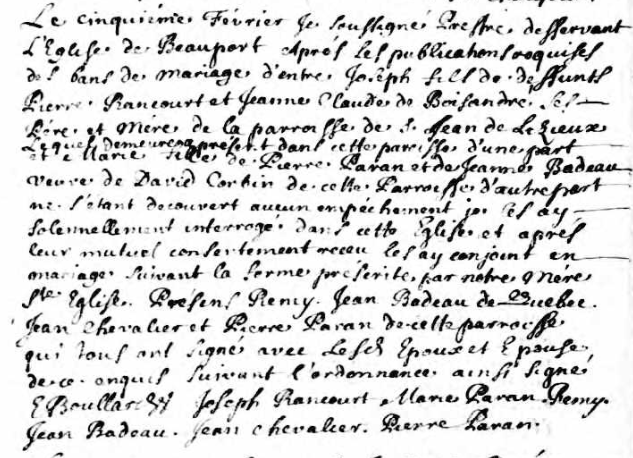
He married Marie Parent, daughter of Pierre Parent and Jeanne Badeau on February 5, 1685, in Beauport, Capitale-Nationale, Québec, Canada.
He married Françoise Davaux , daughter of Charles Davaux and Marguerite Aubigny September 18, 1701, in La Visitation -de -Notre- Dame, Chateau- Richer, Capitale-Nationale.
He died March 21, 1719, at Notre-Dame, Québec. He was buried March 21, 1719, in Notre- Dame, Québec. |
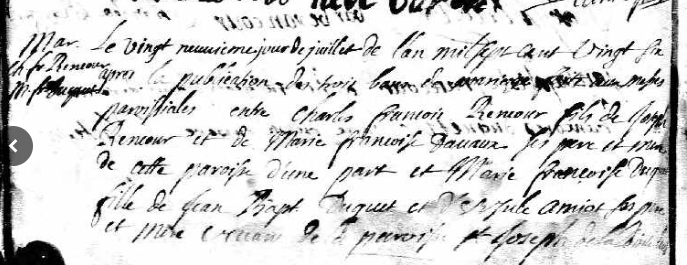
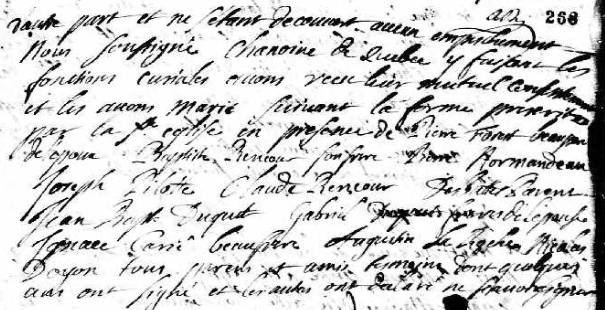
Charles François Rancourt + Marie Françoise Duquet dit Durochers
|
Charles Alexandre Rancourt + Marie Joséphe Montmigny
Charles BIRTH 15 JUL 1729 • Québec, Canada
Charles DEATH 26 MAR 1774 • St-Joseph De Beauce, Chaudière-Appalaches, Québec, Canada
|
Louis Rancourt + Emelie Terre (Thare/Therre)
Louis was born on November 26, 1807, in Québec City, Québec
Louis died on March 25, 1847, in Calumet, Québec, when he was 39 years old.
|
Olive Rancourt + Patrick James Mullen
PJ was born on 22 Dec 1825 in County Londonderry, Ireland, UK, his date of birth was taken from his death certificate.
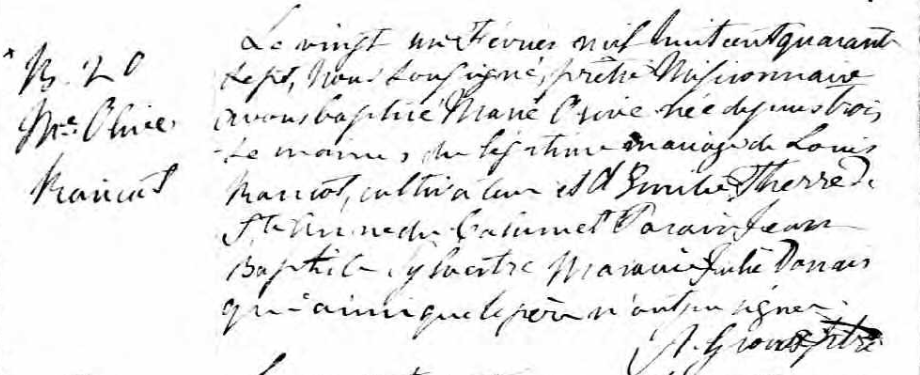
His lineage has been particularly difficult to find information on. We know little about his parents; whom I have listed as Michael Mullen and either Nancy McGinnis or Mary McGanus according to the Pontiac Records.
He is said to have immigrated to Canada in 1861, per the census records.
It is family folklore that Patrick James left Ireland because he did not want to be a priest as his family wished. In Canada he became a schoolteacher (this is confirmed on the census’) and married Olive Rancourt on March 5, 1867. He is also my dad’s namesake – whose name is Patrick James Richards.
For more information on PJ Mullen see this blog here.
|
Angelina Mullen + Ambrose Richards (Great Grand Parents)
I understand from Chicky (Mary Rowlands) that Angelina’s mother died when she was quite young (I looked at the records, she was 8 years old) and she then lived with another family in Calumet (this may be, but I cannot find any proof of this because by the next census, her dad was a widower and living with the Lee Family). She knew that her father came from Ireland and that it had been intended that he would become a priest and that he was a schoolteacher. Other than these facts we know very little about PJ Mullen.
|
Benjamin Richards + Sarah Lee (Grand Parents)
Refer to my blogs on each of my grandparents – Grampa Benny’s WWII blog and The Lee Side of Me … about Gramma Sally’s side of the family from Yorkshire, England.
|
Patrick Richards + Mona Lamothe (Parents)
Patrick was born on Jan 15, 1954, in Témiscaming, Québec, Canada and passed away November 18, 2014, at his home in Témiscaming at the age of 60.
Mona was born on January 20, 1956, in Bonfield, Ontario, Canada.
|
MOI
Yet another interesting find and lineage in my genealogy search. I’m really loving ALL of the interesting things I’m finding out on my genealogy journey.
Genealogy is a fascinating and compelling activity that demands the same kind of persistence and deductive reasoning as detective work. Tracing ancestors is really about solving a series of mysteries. I wonder where my search will lead me next.



 My Tiny World Corner
Leave a reply to mybetterlifeca Cancel reply