My Ancestor, and a Founder of Religious Liberty in America
Ok, it’s safe to say we all know that I’m a genealogy NUT, I won’t even try to deny it. I love learning, and I love history, especially when it comes to MY OWN. They say to know where you’re going, you’ve got to know where you’ve been. I believe in knowing the trials, tribulations, and successes my family has gone through, endured, surmounted, and overcome, I can better understand a part of myself, and mainly teach this to my own children and to my family. I believe I’m the first in my family to have undertaken such an in-depth look at ALL lines of our family. Sometimes I get so excited about where each branch goes, I don’t know where to go next after I’ve followed one to something exciting.
Yesterday I wrote about my familial connection to the Salem Witch Trials, and I could have and likely should have stayed with that line as original settlers to the new colony, but something else piqued my interest in another line, and off I went …
In going through my photo and story hints on my Ancestry.ca site, I came across a photo that someone had posted about a distant relative by the name of Obadiah Holmes. Being Canadian, I’m astounded to see such American roots and the importance that some of my ancestors/colonial descendants have. I had NO IDEA who Obediah Holmes was before starting this research and this blog. A quick check online and up came a litany of information, videos, articles, and movies/documentaries on HIM. In all honesty, I was going to write this blog about one of Obadiah’s famous descendants, but as I researched him and his significance to American history and the Baptist church, I felt it was worth writing about.
My Direct Line of Descent from Rev. Obadiah Holmes
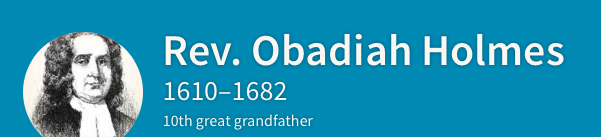
Rev. Obadiah Holmes 1610–1682
10th great-grandfather
Martha Holmes 1640–1711
Daughter of Rev. Obadiah Holmes
Hannah Audley 1643–1685
Daughter of Martha Holmes
Abigail Devol 1695–1719
Daughter of Hannah Audley
Job Milk II 1725–1804
Son of Abigail Devol
Sarah Milk 1749–1830
Daughter of Job Milk II
Roger Moore 1775–1860
Son of Sarah Milk
Olive Moore 1821–1898
Daughter of Roger Moore
George Howard Richards 1859–1942
Son of Olive Moore
Ambrose Richards 1887–1957
Son of George Howard Richards
Benjamin George Richards 1916–1977
Son of Ambrose Richards
Patrick James Richards 1954–2014
Son of Benjamin George Richards
ME
Identity and Vital Information
Name: Rev. Obadiah Holmes
Born: c. 1606 (baptized March 18, 1610)
Place: Didsbury Chapel, Lancashire, England
Parents: Robert Holmes and Katherine Johnson Holmes
Died: October 15, 1682
Place of Death: Newport, Rhode Island
Burial: Holmes Cemetery, Middletown, Rhode Island
Records vary on Obadiah Holmes’s exact birth year. Many genealogical and historical sources cite 1606, while his baptism is recorded in 1610, a discrepancy not uncommon in early parish records and compounded by calendar changes of the period.
It is said that Holmes attended Oxford University, though there is no conclusive evidence that he graduated.
Marriage and Children
Spouse: Katherine Hyde (1608–1682)
Marriage: November 20, 1630
Place: Manchester Collegiate Church, England
Children (known):
- John
- Jonathan
- Mary
- Martha
- Samuel
- Obadiah
- Lydia
- John (second son of the same name)
- Hopestill
At the time of his death, Obadiah Holmes reportedly had nine living children and forty-two grandchildren, indicating a substantial and enduring family line in early New England.
Immigration to New England
During the Great Puritan Migration of the 1630s, England’s religious climate drove thousands of dissenters to seek a “purer” faith in the New World. Puritans and other dissenters faced fines, imprisonment, and social pressure under Charles I and Archbishop Laud’s crackdown on nonconforming churches. For families like the Holmeses, emigration offered both religious freedom and the hope of establishing a new life in a society guided by conscience.
Obadiah Holmes and his wife, Katherine Hyde, emigrated from England to New England in 1638. Obadiah, born in 1610, was 28 years old, and Katherine, born in 1608, was 30. They were newly married when they undertook this perilous journey. They likely departed from Preston, Lancashire, traveling down the River Ribble, crossing the Irish Sea, and entering the Atlantic. Contemporary accounts describe an extremely stormy voyage, which delayed their entry into Boston Harbor for more than six weeks.
After landing in Boston in the summer or early fall of 1638, Holmes first settled in Salem, Massachusetts, later removing to Rehoboth in Plymouth Colony, and eventually to Newport, Rhode Island. Holmes’s skills in surveying and later in glassmaking would make him a valuable settler, contributing both to town planning and industry in Salem and Newport.
Occupation and Civic Contributions
While living in Salem, Obadiah Holmes was an active and contributing member of the community.
First Glass Factory in North America
The young Salem settlement encouraged Holmes and his associates in developing what is believed to have been the first glass factory in North America, producing common window glass for colonial use. This places Holmes among the earliest industrial contributors to the New World economy.
Civic Duties
In addition to his trade, Holmes fulfilled several public responsibilities:
- He surveyed land and set boundary lines for other settlers.
- He served frequently on juries during his time in Salem.
- In February 1643, and again by appointment in September 1644, he was tasked with cutting and gathering firewood for church elders, a duty reflecting both trust and standing within the community.
Religious Development and Conflict
Initially aligned with the Puritan church, Holmes became increasingly dissatisfied with its rigidity. His theological journey led him to Anabaptist (Baptist) beliefs, particularly the conviction that adult baptism by immersion was the only valid form of baptism.
This belief directly conflicted with Massachusetts law.
Before his most famous persecution, Holmes had already experienced significant religious conflict. He became embroiled in a doctrinal dispute with Rev. Samuel Newman of Rehoboth and was formally excommunicated from the church. This marked a decisive break from New England’s established religious order.
Holmes eventually aligned himself with Dr. John Clarke and the growing Baptist movement centered in Rhode Island, where religious tolerance was far more developed.
The Fateful Trip to Lynn, Massachusetts (1651)
On July 16, 1651, Dr. John Clarke (pastor of the Baptist church in Newport), John Crandall, and Obadiah Holmes walked approximately 80 miles from Newport, Rhode Island, to Lynn, Massachusetts. The journey would have been grueling: roughly 80 miles on foot, through forests, rivers, and uneven colonial roads, all while carrying the materials and items necessary for administering the Lord’s Supper and baptism.
The immediate purpose of the journey was to provide spiritual comfort and communion to William Witter, a blind and elderly Baptist who had invited them to his home. The broader purpose was evangelical: to preach Baptist doctrine and administer believers’ baptism. At the time, Massachusetts law prohibited the practice of non-Puritan worship, and the 1645 law against Anabaptists made such gatherings illegal. Holmes, Clarke, and Crandall risked fines, corporal punishment, and imprisonment simply by attending a private service.
On Sunday, July 20, 1651, while Clarke was reading Scripture during a private worship service in Witter’s home, two constables entered with a warrant. The men were arrested for conducting unauthorized religious services in violation of Massachusetts law. The formal charges, as recorded in colonial court documents, included: conducting a private worship service at the same time as the town’s public worship; disturbing the public meeting in Lynn; “seducing and drawing aside” others after their erroneous judgment and practices; and refusing to provide security for their appearance at the next court session.
They were held overnight at the Anchor Tavern and then sent to Boston for trial. Holmes’s willingness to face arrest rather than compromise his beliefs demonstrates the courage and steadfastness that would define his life and legacy, both as a minister and as an ancestor.
Trial and Sentencing
At trial before the General Court of Massachusetts Bay—presided over by magistrates In the summer of 1651, Obadiah Holmes, Dr. John Clarke, and John Crandall were brought before the General Court of Massachusetts Bay, presided over by magistrates including Governor John Endicott, Deputy Governor Thomas Dudley, and Increase Nowell. The defendants were not permitted to present a defense, reflecting the strict and uncompromising legal environment for dissenters in the Massachusetts Bay Colony.
They were charged with:
- Holding private worship services during public worship hours
- Disturbing the peace of Lynn
- “Seducing and drawing others” to erroneous doctrines, including the rejection of infant baptism
- Refusing to provide security for their appearance at the next county court session
Under the 1645 law against Anabaptists, all three men were fined:
- Dr. John Clarke: £20
- John Crandall: £5
- Obadiah Holmes: £30
The court offered an alternative to paying the fines: public whipping. Holmes steadfastly refused to allow friends to pay his fine, explaining that doing so would violate his conscience and constitute an admission of guilt. As a result, he remained imprisoned from July until September 1651, enduring weeks of confinement rather than compromise his beliefs.
Holmes’s trial highlights the severity of colonial enforcement against religious dissenters, and it sets the stage for the extraordinary public punishment he would later face in Boston. His steadfastness at trial not only demonstrated his personal courage but also became a defining moment in his legacy as a man of conscience and principle.
The Whipping of Obadiah Holmes
After spending more than six weeks in the Boston jail, Obadiah Holmes was brought before the authorities to face the consequence of his refusal to pay the £30 fine imposed under the 1645 law against Anabaptists. On September 5, 1651, Holmes was taken from his cell to the public marketplace at the corner of Devonshire and State Streets in Boston. Here, he would endure one of the most infamous acts of religious persecution in early colonial America.

Magistrate Increase Nowell directed the executioner to strip Holmes naked to the waist. Holmes refused, declaring with unwavering conviction:
“For all Boston, I would not give my bodie into their hands to be bruised upon another account; yet upon this I would not give the hundredth part of a Wampon Peaque to free it out of their hands, and that I made as much conscience of unbuttoning one button, as I did of paying the £30 in reference thereunto.”
Holmes was then tied to the whipping post. The sentence called for 30 lashes with a three-cord whip, one for each pound of the fine he had refused to pay. Accounts emphasize the severity: the whip was thick and rough, designed to tear the skin. Remarkably, Holmes reportedly did not cry out or groan, instead uttering the words:
“You have struck me as with roses.”
This calm, almost serene endurance astonished those present and left a lasting impression on the community. Several onlookers, moved by his steadfastness, stepped forward to offer sympathy and even to shake Holmes’s hand. Among them, John Spur and John Hazel were subsequently arrested for showing such solidarity, highlighting the tense climate of fear and persecution in Massachusetts.
After the flogging, Holmes returned to Newport, Rhode Island, where he resumed his ministry. In 1652, he succeeded Dr. John Clarke as pastor of the First Baptist Church in America, a position he held for more than thirty years. The ordeal in Boston became a defining moment in his life, illustrating his unwavering commitment to conscience, faith, and religious freedom.
Holmes’s experience also contributed to the broader legacy of religious liberty in colonial America. His willingness to endure public humiliation rather than compromise his beliefs stands as an early example of the principle that conscience cannot be coerced — a principle that would later underpin Rhode Island’s role as a haven for dissenters and a model for religious freedom in the United States.
Influence and Aftermath
Holmes’s testimony deeply affected Henry Dunster, the first president of Harvard College, and its significance cannot be overstated. Dunster was not a marginal figure; he was one of the most influential intellectual and religious leaders in the Massachusetts Bay Colony. Appointed Harvard’s first president in 1640, he was a committed Puritan and instrumental in shaping the early mission of the college as a training ground for orthodox Congregational ministers.
The brutal public whipping of Obadiah Holmes in 1651, carried out solely for his Baptist beliefs and refusal to submit to infant baptism, forced Dunster into a profound moral and theological reckoning. Holmes’s calm endurance, his refusal to recant, and his unwavering conviction under extreme physical punishment exposed the harsh contradiction between Puritan claims of godliness and their actual practices of coercion and persecution. For Dunster, this was not an abstract theological debate — it was a living testimony to conscience, liberty, and the cost of dissent.
In the years following Holmes’s punishment, Dunster began to openly question and ultimately reject infant baptism, adopting views aligned with the very Baptist principles that had led to Holmes’s suffering. This placed Dunster in direct conflict with the governing religious authorities of Massachusetts, for whom infant baptism was a cornerstone of both church membership and civil order. His refusal to conform made his position untenable.
In 1654, Henry Dunster resigned the presidency of Harvard College — an extraordinary and rare outcome in colonial New England. His resignation stands as one of the clearest examples of how Obadiah Holmes’s witness reverberated far beyond the whipping post, influencing the highest levels of colonial religious leadership and contributing to the slow, painful emergence of religious liberty in America.
That the suffering of one Baptist minister could unsettle the conscience of Harvard’s first president speaks volumes about the moral force of Holmes’s stand. His testimony did not merely endure persecution; it changed minds, redirected institutions, and exposed the limits of enforced religious uniformity in early America.
Holmes returned to Newport, Rhode Island, where religious liberty was protected.
Later Life and Ministry
In 1652, following years of religious persecution in Massachusetts, Obadiah Holmes returned to Newport, Rhode Island, where he succeeded Dr. John Clarke as minister of the First Baptist Church in America. Clarke, a co-founder of the church, increasingly devoted his energies to colonial diplomacy and political advocacy—most notably his efforts in England to secure and protect Rhode Island’s charter guaranteeing religious liberty. Holmes thus became the church’s primary resident pastor, assuming responsibility for its spiritual leadership during a critical period in its early history.
Holmes would serve in this role for more than thirty years, guiding the congregation until his death in 1682. His long tenure provided stability and continuity to a church that stood at the forefront of religious freedom in colonial America. Under his ministry, the Newport church became a refuge for those who rejected enforced religious conformity and sought freedom of conscience—principles Holmes had personally suffered for and embodied.
Beyond his pastoral duties, Holmes was also recognized as a trusted and respected member of the civic community. In 1656, he was made a Freeman, a designation that carried both legal rights and social standing in the colony. From 1656 to 1658, he served as a Commissioner, reflecting the confidence placed in his judgment and integrity despite — or perhaps because of — his earlier persecution in Massachusetts.
Death and Legacy
Obadiah Holmes died on October 15, 1682, in Newport. He was buried on his own land, in what is now Middletown, Rhode Island, where a tomb was erected to his memory. His wife, Katherine, did not long survive him. At the time of his death, Holmes left behind a large and well-established family, a thriving congregation, and a legacy deeply woven into the foundations of American religious liberty.


Obadiah Holmes’ Last Will and Testament (1681)
I also found his Last Will and Testament, which provides remarkable insight into his faith, family structure, and the extent of his estate late in life.
These are to signify that I, Obadiah Holmes of Newport on Rhode Island, being at present through the goodness and mercy of my God of sound memory; and, being by daily intimations put in mind of the frailty and uncertainty of this present life, do therefore — for settling my estate in this world which it has pleased the Lord to bestow upon me — make and ordain this my Last Will and Testament in manner following, committing my spirit unto the Lord that gave it to me and my body to the earth from whence it was taken, in hope and expectation that it shall thence be raised at the resurrection of the just.
Imprimis, I will that all my just debts which I owe unto any person be paid by my Executor, hereafter named, in convenient time after my decease.
Item. I give and bequeath unto my daughter, Mary Brown, five pounds in money or equivalent to money.
Item. I give and bequeath unto my daughter, Martha Odlin, ten pounds in the like pay.
Item. I give and bequeath unto my daughter, Lydia Bowne, ten pounds.
Item. I give and bequeath unto my two grandchildren, the children of my daughter, Hopestill Taylor, five pounds each; and if either of them decease, the survivor to have ten pounds.
Item. I give and bequeath unto my son, John Holmes, ten pounds.
Item. I give and bequeath unto my son, Obadiah Holmes, ten pounds.
Item. I give and bequeath unto my grandchildren, the children of my son Samuel Holmes, ten pounds to be paid unto them in equal portions.
All these portions by me bequeathed, my will is, shall be paid by my Executor in money or equivalent to money.
Item. I give and bequeath unto all my grandchildren now living ten pounds; and ten shillings in the like pay to be laid out to each of them — a bible.
Item. I give and bequeath unto my grandchild, Martha Brown, ten pounds in the like pay.
All [of] which aforesaid legacies are to be paid by my Executor, hereafter named in manner here expressed: that is to say, the first payment to [be] paid within one year after the decease of my wife, Catherine {sic} Holmes, and twenty pounds a year until all the legacies be paid, and each to be paid according to the degree of age.
My will is and I do hereby appoint my son Jonathan Holmes my sole Executor, unto whom I have sold my land, housing, and stock for the performance of the same legacies above. And my will is that my Executor shall pay unto his mother, Catherine Holmes, if she survives and lives, the sum of twenty pounds in money or money pay for her to dispose of as she shall see cause.
Lastly, I do desire my loving friends, Mr. James Barker, Sr., Mr. Joseph Clarke, and Mr. Philip Smith, all of Newport, to be my overseers to see this my will truly performed.
In witness whereof, I have hereunto set my hand and seal, this ninth day of April, 1681.
Obadiah Hullme [Holmes] [Seal]
Signed, sealed and delivered in the presence of
Edward Thurston
Weston Clarke
(Edward Thurston, Sr., and Weston Clark appeared before the Council [of Newport], December 4, 1682, and did upon their engagements [pledges] declare and own that they saw Obadiah Holmes, deceased, sign seal and deliver the above written will as his act and deed; and, at the time of his sealing hereof, he was in his perfect memory, according to the best of our understandings. Taken before the Council, as attested. Weston Clarke, Town Clerk.)
Why This Matters to Me
As a descendant of Obadiah Holmes, I do not view his story as distant history. His refusal to surrender conscience for comfort helped shape the freedoms many now take for granted. His courage runs through my family line — and through the very foundations of American liberty.



 My Tiny World Corner
Leave a reply to mybetterlifeca Cancel reply