Some memories stay with you forever, not because they are monumental, but because they are extraordinary
Looking back at events in your life, you sometimes gain a whole new appreciation for things you didn’t truly understand at the time. For me, one such moment happened in 7th grade.
A Classroom Encounter Like No Other
We had a split class—grades 7 and 8 together—at a French elementary school in Kitchener, Ontario. For a project and presentation, each student was assigned a topic. I can’t even tell you what mine was, nor can I remember most of the others. But there was one presentation I never forgot—something that still fascinates me to this day.
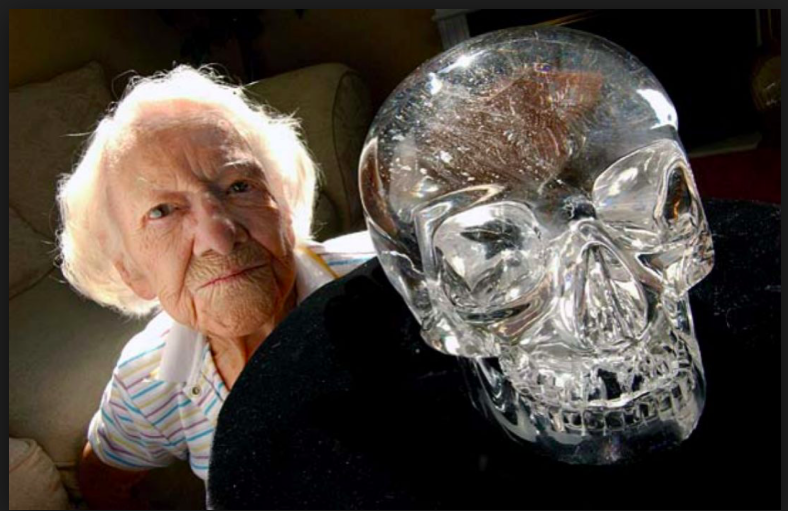
Geneviève Lambert, who was in grade 8, brought a guest to our classroom. This lady, with whitish hair, told us about the day she found a crystal skull in Belize during an expedition with her father. On a black velour cloth in front of the class sat the skull, alone on a desk. As she spoke, she described the day she found it, its meaning, and the powers it was said to hold.
The room was silent. I remember staring at it, mesmerized—the light catching the crystal, the smoothness of its surface, and the almost lifelike accuracy of its features. It looked like ice, but somehow solid, eternal. Even then, I felt like I was standing in front of something extraordinary, something not just beautiful but charged with mystery.
The Famous Mitchell-Hedges Skull
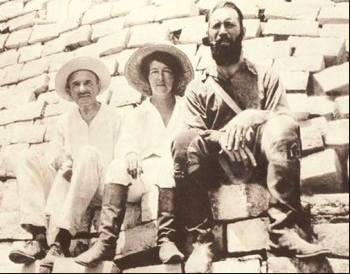
The skull in question is probably the most famous of all—the Mitchell-Hedges Skull. Allegedly discovered in 1924 (or perhaps 1925–1927, depending on the account) by Anna Mitchell-Hedges, the adopted daughter of British adventurer Frederick Mitchell-Hedges, it was said to have been found beneath the altar of a Mayan temple in Lubaantun, Belize, on Anna’s 17th birthday. Frederick had rediscovered the city in 1924 and is even thought to have inspired the character of Indiana Jones.
About Lubaantun
Lubaantun is an ancient Maya city known for its unusual architecture. Unlike other Mayan cities, it was built without mortar, with large, carefully cut stone blocks. It was a place of mystery even before the skull’s discovery, with some archaeologists speculating about its ritual significance. The skull’s location beneath an altar suggests it may have been intended for ceremonial purposes, though its true origins remain unknown.
Of the 13 crystal skulls supposedly found in Mayan and Aztec ruins, the Lubaantun skull stands out for its clarity and precision. Many believe crystal skulls hold special abilities—enhancing psychic powers, healing the sick, or even wielding influence over life and death. People who spent time alone with the Mitchell-Hedges skull described a glowing aura and bizarre, almost cinematic images appearing within it.
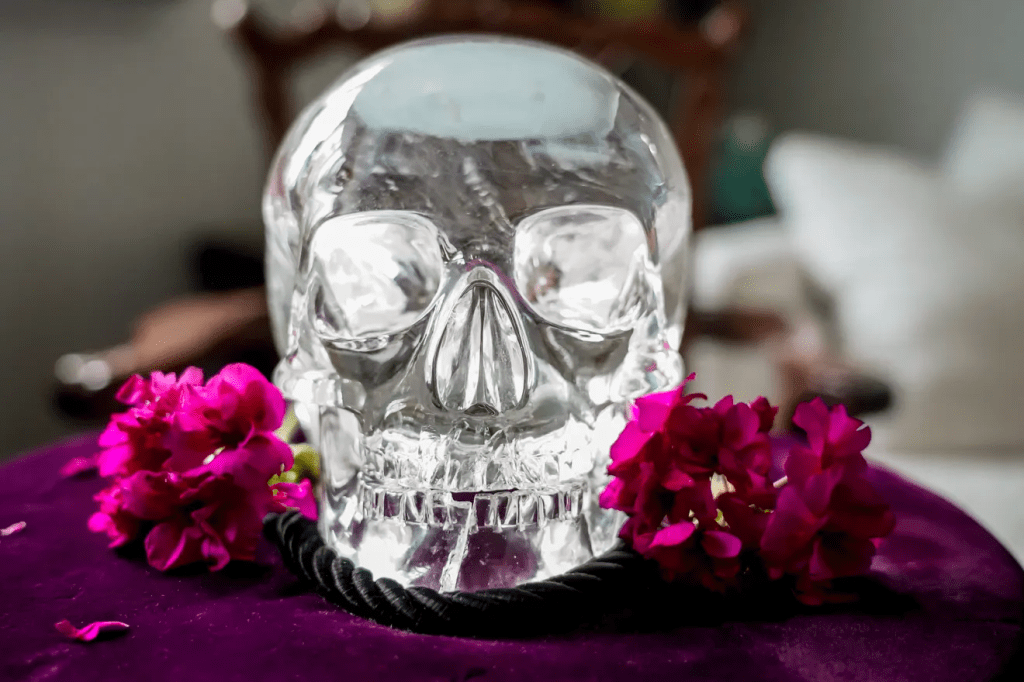
Comparatively, other famous crystal skulls include the British Museum Skull and the Paris Skull, but the Lubaantun skull’s clarity and craftsmanship have made it the most legendary.
Anna Mitchell-Hedges: Keeper of the Skull
Anna inherited the skull when her father died in 1959. She toured with it, giving talks and interviews, though most of the time it was locked away in a bank vault. Before moving to the United States, Anna returned to Canada and lived in Kitchener, Ontario, where she had spent much of her early and adult life. During her time in Kitchener, she maintained local connections, sometimes showing the skull to friends, neighbours, and local schools, and even operating a small motel that drew public interest. She eventually moved to the U.S., where she lived with friends until she died in 2007 at the age of 100.
She never wavered from her story, despite skepticism and the passage of decades. To her, the skull was not just an artifact—it was a link to history, a spark of the unknown, and a mystery that deserved reverence.
Her dedication to preserving and sharing the skull’s story helped it capture the imagination of generations, inspiring curiosity about archaeology, history, and unexplained phenomena. She actively promoted the skull for decades, giving lectures and public exhibitions, and offered varying accounts of its discovery, sometimes claiming ceremonial significance and mystical powers. Even with requests for scientific verification, she maintained the story’s mystery. Later, she moved to Chesterton, Indiana, where she lived with her longtime partner and later husband, Bill Homann, who retained the skull after her death.
A Moment Frozen in Time
Back in 1987, after Anna’s presentation, we were invited to get close and touch the skull. It was stunning—anatomically precise, pure, and clear, like ice or glass, though it was solid crystal quartz.
I’m sure Geneviève got an A+ on that project. Years passed, and the skull faded from my day-to-day thoughts until around 2014, when I was binge-watching National Geographic and saw an episode on crystal skulls. Naturally, the Mitchell-Hedges skull caught my eye, and I thought, “Wow, I actually got to see this in real life.”
(MATHEW MCCARTHY / KITCHENER-WATERLOO RECORD FILE PHOTO)
Perhaps it was the thrill of discovery, the unknown, or the hint of magic in the world that drew me in. That day sparked a curiosity that has followed me ever since, history, exploration, and the mysteries that linger just beyond our understanding.
Continuing Fascination
Just yesterday, I watched Portal to the Unknown (S1, Ep. 10, Mysteries From the Past), and once again, there it was—the Mitchell-Hedges skull.
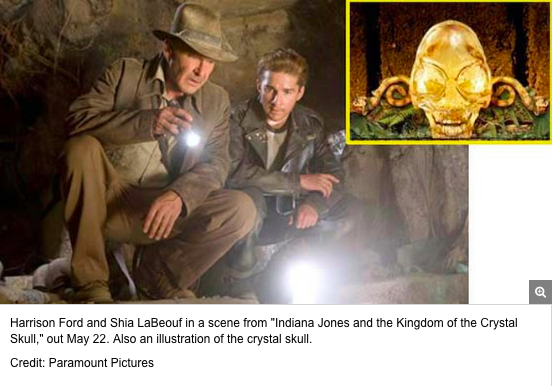
Its fame only grew with the 2008 release of Indiana Jones and the Kingdom of the Crystal Skull, the 4th instalment in the action/adventure franchise, revolving around a fictional story on crystal skulls, specifically mentioning the Mitchell-Hedges skull. It has become a cultural icon, appearing in TV shows, books, documentaries, and pop culture.
Scientific Skepticism and Mystery
The authenticity of the Mitchell-Hedges skull has often been challenged. Microscope studies and modern research suggest that some crystal skulls, including this one, may have been carved using tools unavailable to the ancient Maya. The British Museum conducted studies indicating modern tool marks on some skulls. Despite this, believers maintain that the skull holds mystical properties, a symbol of energy and mystery.
Whether or not you accept its supernatural claims, it remains a fascinating artifact that captures the imagination and blends history, legend, and human curiosity.
Even with modern skepticism, the aura of mystery around the skull reminds us how much we are drawn to the unknown.
A Personal Treasure
Whether you believe in its mystical properties or not, it’s a fascinating piece of history. And for me, it’s a cherished memory: seeing Anna Mitchell-Hedges and her legendary skull up close in a little Franco-Ontarian elementary school classroom in Kitchener.
Even now, I think about the light reflecting off its smooth surface, the whispers of classmates as they saw it, and the sense that we had glimpsed something extraordinary.
Update: I reached out to Geneviève to see if she had any photos from that day, but she doesn’t. The memory, however, is crystal clear.
Fun Facts About the Mitchell-Hedges Skull
- Allegedly discovered on Anna’s 17th birthday beneath a Mayan altar in Lubaantun.
- Believed by some to enhance psychic powers or healing.
- Inspiration for Indiana Jones and the Kingdom of the Crystal Skull.
- Anna Mitchell-Hedges kept it mostly locked in a bank vault and never denied its story




 My Tiny World Corner
Leave a reply to Kathy Cancel reply