Welcome to story #2 of my family tree.
Today, I’m going to share with you the story of my paternal grandmother’s father’s brother – my Great Grand Uncle, George Victor Lee, who was killed in action (KIA) in The Great War.
Researching George’s Story
For this story you’re going to have to stretch your memory all the way back to History class, WWI and trench warfare. I was able to access his troop’s War Diaries and his personal military records. I was able to track his regiment from deployment to the day Pte. Lee was KIA. I did a lot of research and spent countless hours trying to understand exactly what was going on during the war as he was progressing through it so I could make the story more 3 dimensional and personal to me and our family.
Some of the historical parts of this story were “borrowed” from other storytellers well-versed in history and the Great War. Some is me being an amateur historian, war buff and genealogist. I don’t purport this blog to be 100% factually accurate (about the details of the war). I am not a professional, just passionate.lly accurate (about the details of the war). I am not a professional, just passionate.
The Outbreak of War
The deadline was 11:00 p.m. on August 4, 1914. If Germany did not remove their troops from Belgium, Great Britain would declare war. As Big Ben struck the hour across the Thames that night, Chancellor David Lloyd George wrote, “The big clock echoes in our ears like the hammer of destiny.” Germany remained silent and Great Britain was at war!
(Note: Herbert Asquith was Prime Minister at the time; Lloyd George was Chancellor of the Exchequer.)
At the time that Britain declared war, George Victor Lee was living at 3 Shady Row, Meltham Mills, Yorkshire, England with his wife Agnes (nee Dickenson). He was the son of Tom Lee and Hannah (nee Crabtree).
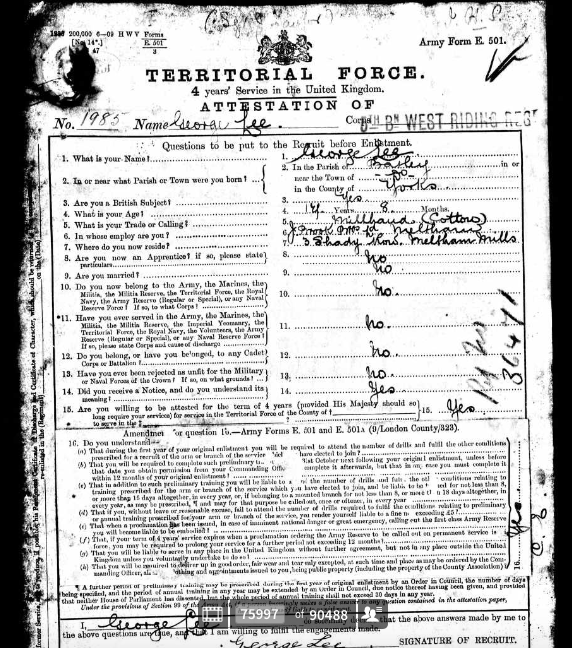
George enlisted on March 24, 1912, when he was 17 years old. His Territorial Force Attestation Papers indicate that he worked as a Millhand (Cottons) with J. Brook Bros Ltd.
A bit of research and I found out that Jonas Brook and Brothers was a silk mill complex in Meltham that employed over 1,000 workers during that time.
He was a member of the 1/5th Battalion, The Duke of Wellington’s (West Riding Regiment), part of the Territorial Force — a volunteer reserve unit originally intended for home defense, but many, including George’s battalion, volunteered for overseas service. (Learn more about the 49th West Riding Division)
Regimental Number: 1985
Mobilization
The Duke of Wellington’s (West Riding Regiment) (Territorial Force) was mobilized on August 4 1914 at Huddersfield, Yorkshire, England, later that month the troop was deployed to coastal defences near Hull and Grimsby. On November 5 1914 it moved to Doncaster in billets and the regiment was assigned to the 147th (2nd West Riding) Brigade in the 49th (West Riding) Division in April 1915 for service on the Western Front, they served together until the Armistice in November 1918.
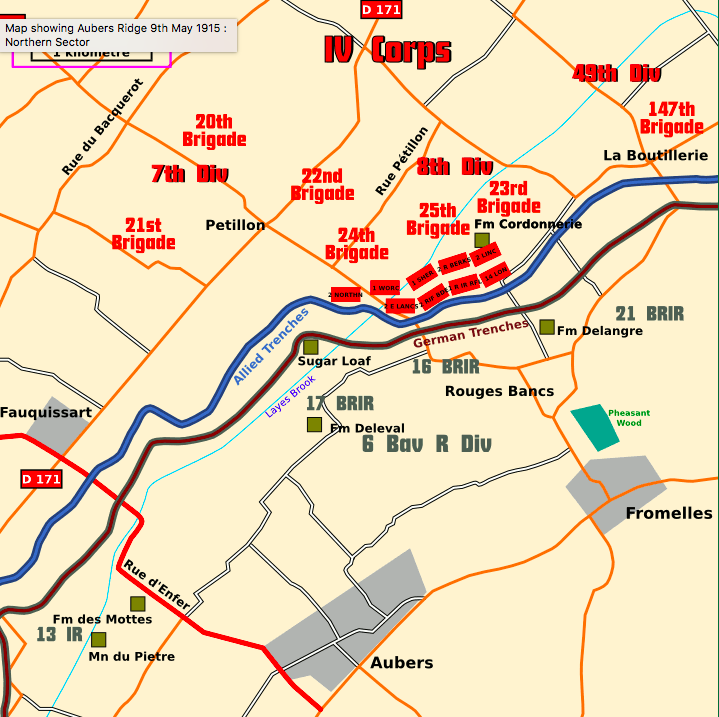
They were gearing up to take their place in history in what is now known as The Battle of Aubers Ridge (May 9-10 1915), which was a disastrous attack that cost 11,000 British casualties for no material gain: it was a supporting operation to a much larger French attack.
The British attack was to be launched by General Sir Douglas Haig’s First Army. It was intended to attack on two fronts, to the North and South of Neuve Chapelle, with the hope that the two attacking forces could meet up behind the German front lines. Haig had requested extra artillery to increase the strength of the 40 minute bombardment planned for the morning of 9 May, but all available artillery reserves had been sucked into the fighting at the second battle of Ypres, still raging just to the north.
Arrival in France & Early Conditions (April 1915)
From the army records I obtained, we know that on April 14 1915 The Duke of Wellington’s (West Riding Regiment) embarked for France and Flanders, landing at Boulogne. After which they traveled through Estaires in intense cold.
The War Diaries report that on April 16 1915, 2 days after disembarking, breakfast was late as the cook crew had a tough time recovering from the night prior. They marched off around 10:00 a.m., the road was very bad. Orders were given that every man must have a new pair of boots before they go out – they were only issued a few days before they left Doncaster.
At Estaires on April 19 1915 there was some reported shelling & artillery action.
On April 21 1915, some German shells were noted to have hit the trenches and an order was received to move to billets.
On April 28 1915 a shell hit 4Q, there were reported casualties. The next day, a report was received from another trench that the enemy had been heard under his trench mining.
There was rain in the trenches and some shelling according to the War Diaries. This coincides with the reports of the battle that heavy rain on May 6 and dense mist on May 7 caused a French postponement of the main attack; it would now go in on May 9 and the subsidiary attacks would happen at the same time, not a day later in accordance with the original strategy.
May 9, 1915 – The Battle of Aubers Ridge
May 9 was a fine, sunny day. The Battle of Aubers went ahead. It was fought over the same ground as the battle of Neuve Chapelle, 10-13 March 1915.
Excerpt from the War Diaries – May 9, 1915
Except from the troop diaries:
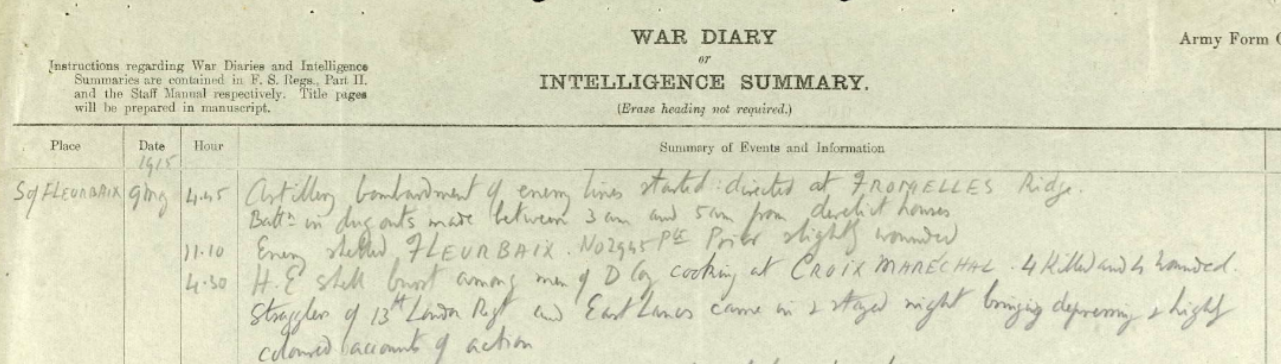
(transcription)
May 9 1915: South of Fleurbaix:
May 9 was a fine, sunny day. The Battle of Aubers went ahead. It was fought over the same ground as the battle of Neuve Chapelle, 10–13 March 1915.
War Diary Excerpt – May 9, 1915:
4:45 a.m. – artillery bombardment of enemy lines directed at Fromelles Ridge. Batt’n in dugout move between 3 a.m. and 5 a.m. from derelict houses
11:10 a.m. – enemy shelled Fleurbaix, no 2945 Pte Prier slightly wounded
4:30 p.m. – an HE (high explosive) shell burst among men of D Company @ Croix Marechal killing 4 and wounding 4.
War Diary Entry – May 10, 1915

May 10 1915: 4:35 p.m. Nine shells fired at Fleurbaix. Batt’n still in dugout.
Outcome of the Battle
The British attack on 9 May was a total failure. The Germans had greatly strengthened their lines around Neuve Chapelle after they had been overrun during Neuve Chapelle, and the British artillery bombardment was simply not heavy enough to destroy the new German lines. The British troops went over the top early on the morning of 9 May and were cut down by German machine gun fire. No significant progress was made, and early on 10 May Haig ended the offensive. The British suffered 11,000 casualties in one day of fighting on a narrow front.
George came through that battle. The British casualties in the Northern pincer on 9 May 1915 were as follows:
- 8th Division: 4,682 of which 192 were officers
- 49th (West Riding) Division: 94 of which 2 were officers
- 7th Division: 25 of which 1 was an officer
(Battle of Aubers Ridge – Wikipedia)
Autumn 1915 – North of Ypres
We are going to fast forward a few months. In October 1915 – the troop is stationed at Canal Bank, North of Ypres taking over from the 1/8 West Yorks. There was considerable activity with the enemy (trench mortars and bombs). There was some 50 casualties of the 4th battalion after a bombardment by the Germans.
November 1915:
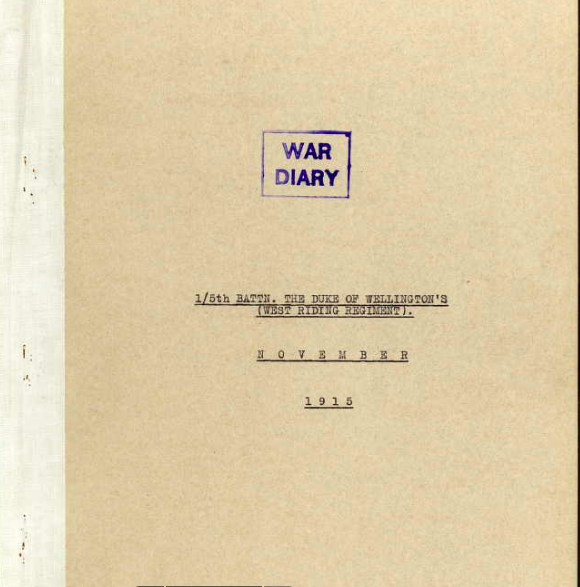
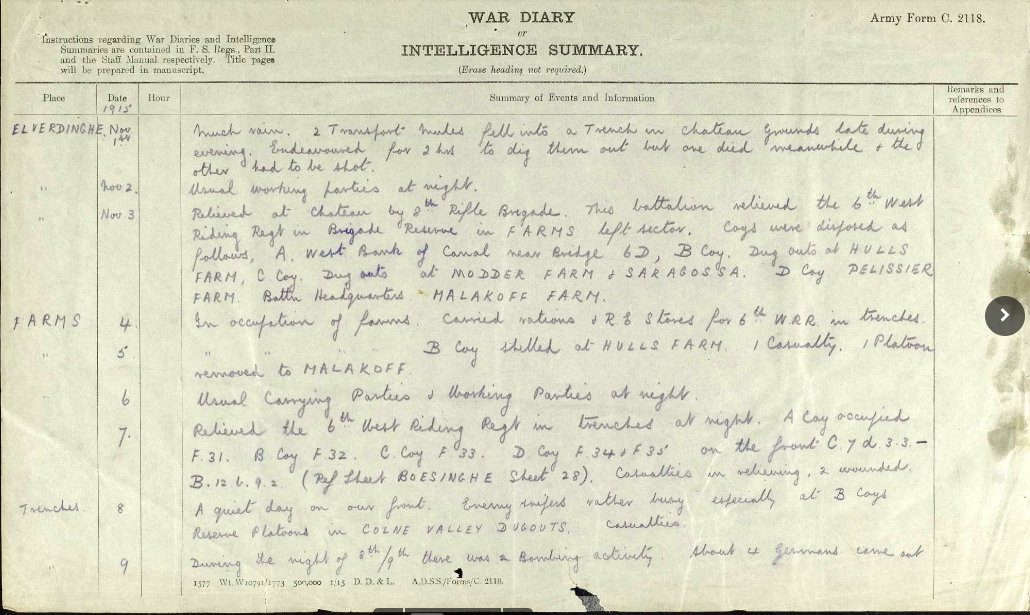
If you find the diaries difficult to read, I’ve transcribed them for you:
Nov 1: Much rain, transport mules fell into a trench in chateau grounds late during the evening. Endeavoured for 2 hours to dig them out, one died meanwhile and the other had to be shot.
Nov 2: Usual working parties at night
Nov 3: Relieved at chateau by 8th Rifle Brigade. This battalion relieved the 6th West Riding Regiment in Brigade Reserve in Farms left sector. Coys were disposed as follows: A – West Bank of Canada new bridge 6D, B Coy (company) dug outs at Hulls Farm, C Coy dug out at Modder Farm & Saragossa, D Coy Pelissier Farm Batton Headquarters Malakoff Farm.
Nov 4: In occupation of farms. Carried rations and stores for 6th W.R.R. in trenches
Nov 5: In occupation of farms. B Coy (company) shelled at Hulls Farm 1 casualty, 1 platoon removed to Malakoff.
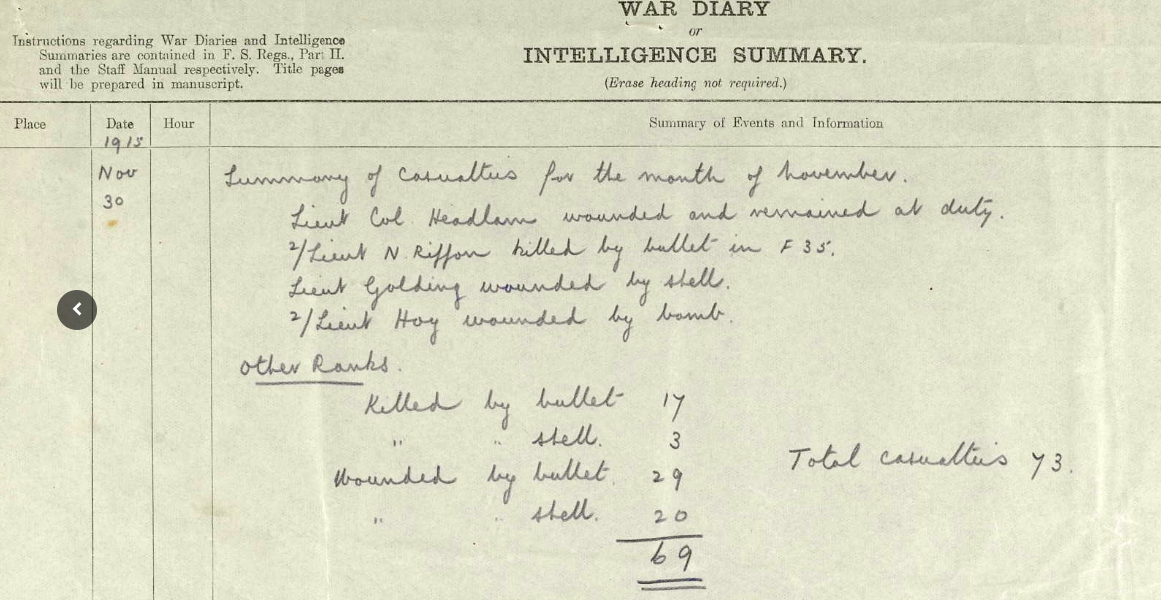
That one casualty as a result of B Company being shelled was my great grand uncle, Pte George Lee.
Death & Burial
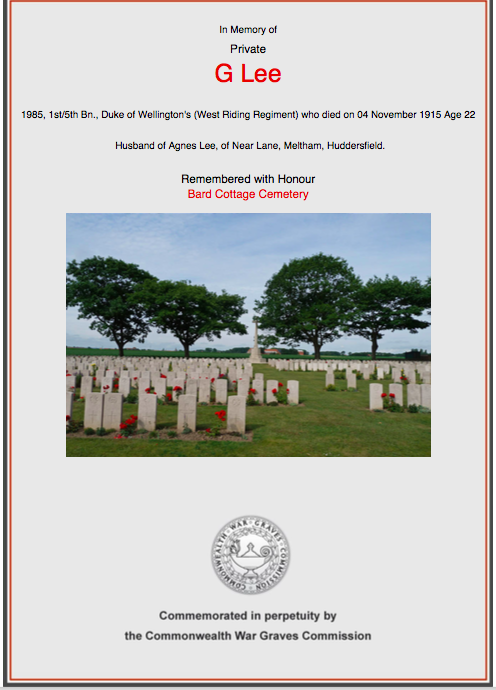
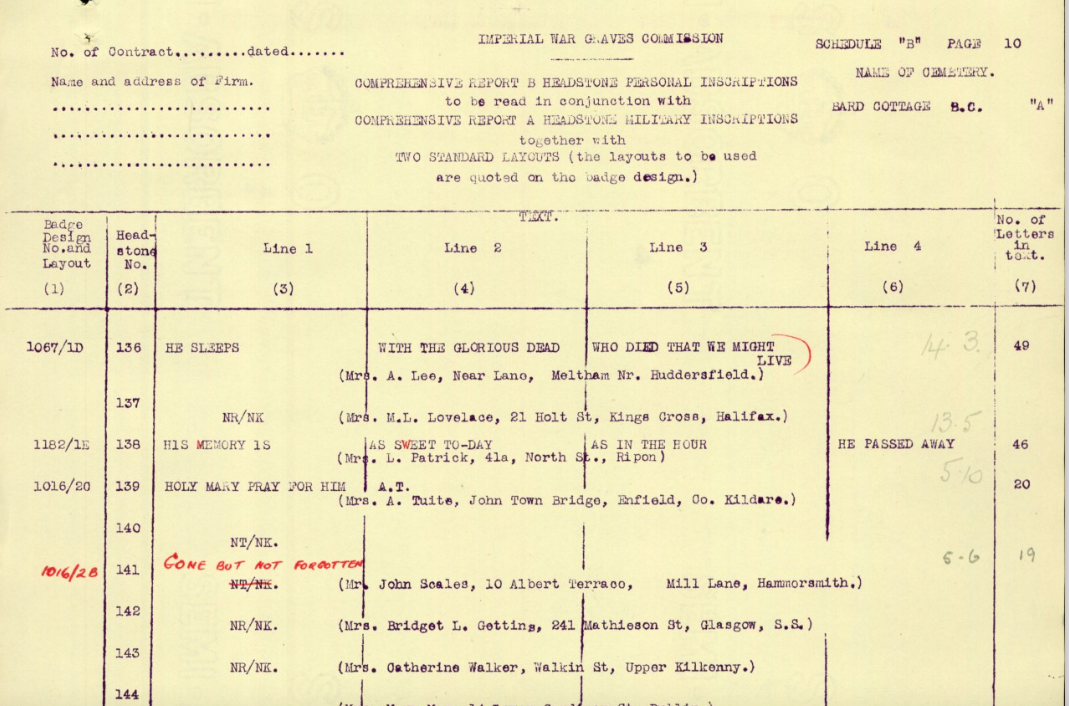
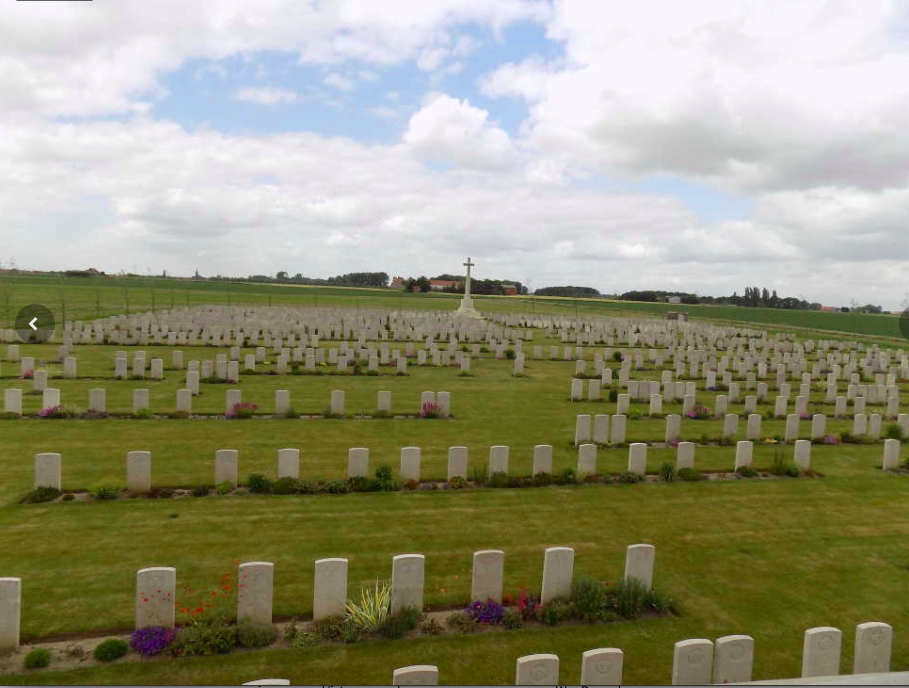
He is buried at Bard Cottage Cemetery, a British military cemetery located in the Belgian village of Boezinge, a town in Ypres . There are 1,643 dead commemorates, of whom 40 could not be identified. Boezinge made up the largest part of the war in the area occupied by the Allies, just opposite the German lines across the Ieper league between Ypres and the Iron . There are 1622 British, 15 Canadians, 2 South Africans and 4 Germans (1 of which are not identified).
Photographs & Family Connections
I haven’t been able to locate any photos of him. I wish their war records came with their military photo. I am going to try and connect with some of my extended family who still live in England to see if they may have some.
I have a photo of his brother (my great grand father), Joseph Lee.
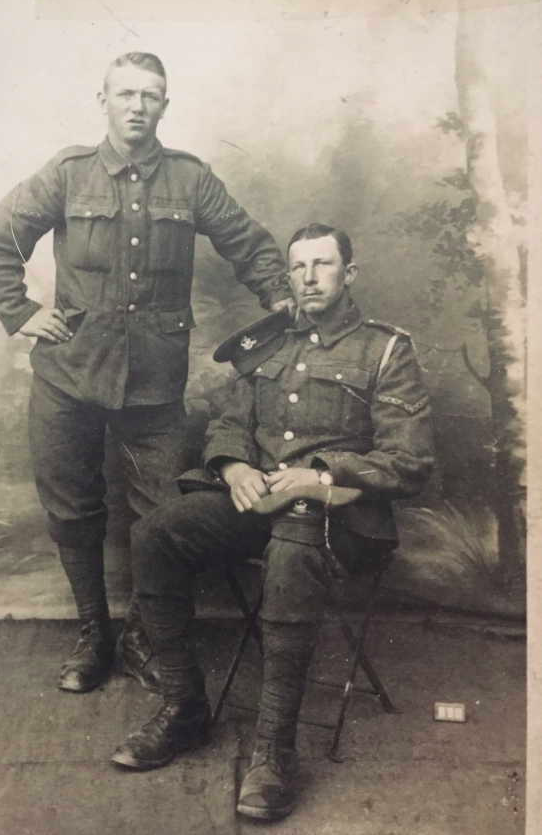
Which is particularly frustrating, because I do have a photograph of him. The image was passed down to me identified simply as “Joseph Lee & friend.” Joseph Edward Lee—my great-great-grandfather—is confirmed as the man on the left. The identity of the second man, however, is unknown.
Given the timing, the uniforms, and the family context, I can’t help but question whether the man on the right is truly just a friend. Both men are wearing British WWI-era Service Dress, and Joseph’s brother, George Victor Lee, enlisted in the same period and was killed in action in 1915. It is entirely plausible that this photograph was taken before George went overseas and that the two men are, in fact, brothers.
What complicates matters is that I have been unable to locate any military records for Joseph—despite extensive searches through Ancestry, Forces War Records, the UK National Archives, and other databases. This absence does not necessarily mean Joseph never served. A significant number of British Army service files were destroyed during the 1940 Blitz in what is now known as the “Burnt Records,” leaving many soldiers’ histories permanently incomplete.
If Joseph is wearing a British Army uniform—as this photograph clearly shows—then he must have enlisted or trained with the military at some level, even if he never deployed overseas. Unfortunately, without surviving service papers, his military story remains elusive.
If anyone has insight into identifying soldiers from studio photographs, recognizing regimental details in early WWI uniforms, or alternative sources for tracing British Territorial Force service, I would be grateful for your thoughts.
“They shall grow not old, as we that are left grow old. Age shall not weary them, nor the years condemn. At the going down of the sun and in the morning We will remember them.”
~ Laurence Binyon
Of Note
George Victor Lee’s death is noted in the article, Shady Row, Meltham Mills. “At least three men from Shady Row were killed in action during the First World War:
- Private Joseph Crabtree of Shady Row was “killed instantly by a shell while stretcher bearing at the Front”
- Private George Lee of 3 Shady Row, serving in the 5th Duke of Wellington’s Regiment, was killed in action by a shell on 4 November 1915
- Private W. Stokes (aged 21), son of F.W. and Rosa Stokes, of 11, Shady Row, was killed on 3 September 1916″



 My Tiny World Corner
Leave a reply to mybetterlifeca Cancel reply