I heard Wind of Change today on YouTube, and it pulled me straight back to high school, to a time when history wasn’t just something we studied in a textbook; it was happening all around us, as it continues to.
I’m writing about this not just because what happened is recorded in history books, but because I want to share what it felt like to be alive inside history while it was unfolding, for my kids. There’s something completely different about living through a moment, knowing that the world is changing right in front of you. What an absolute moment to witness after such a long, tense Cold War era.
In November 1989, the Berlin Wall fell.
That sentence is easy to write now. It was not easy to imagine then.
The Wall had been there since 1961, built by East Germany to stop people from fleeing to the West. It wasn’t just concrete. There were guard towers, barbed wire, armed soldiers, and a shoot-to-kill border. Families were split overnight. Friends became unreachable. A city, and an entire country, was cut in two.
Germany had been divided since the end of the Second World War. West Germany aligned with the United States and other Western democracies. East Germany fell under Soviet control, governed by a communist regime that tightly controlled movement, speech, and opportunity. For nearly three decades, the Wall was proof that ideology could imprison people in their own lives.
By the late 1980s, the communist system in Eastern Europe was starting to crack. The Soviet Union was economically strained and politically weakened. Under Mikhail Gorbachev, policies like glasnost and perestroika loosened the grip of authoritarian control. Across Eastern Europe, people began to protest; first cautiously, then in massive numbers. Poland, Hungary, Czechoslovakia, and East Germany all felt the pressure.
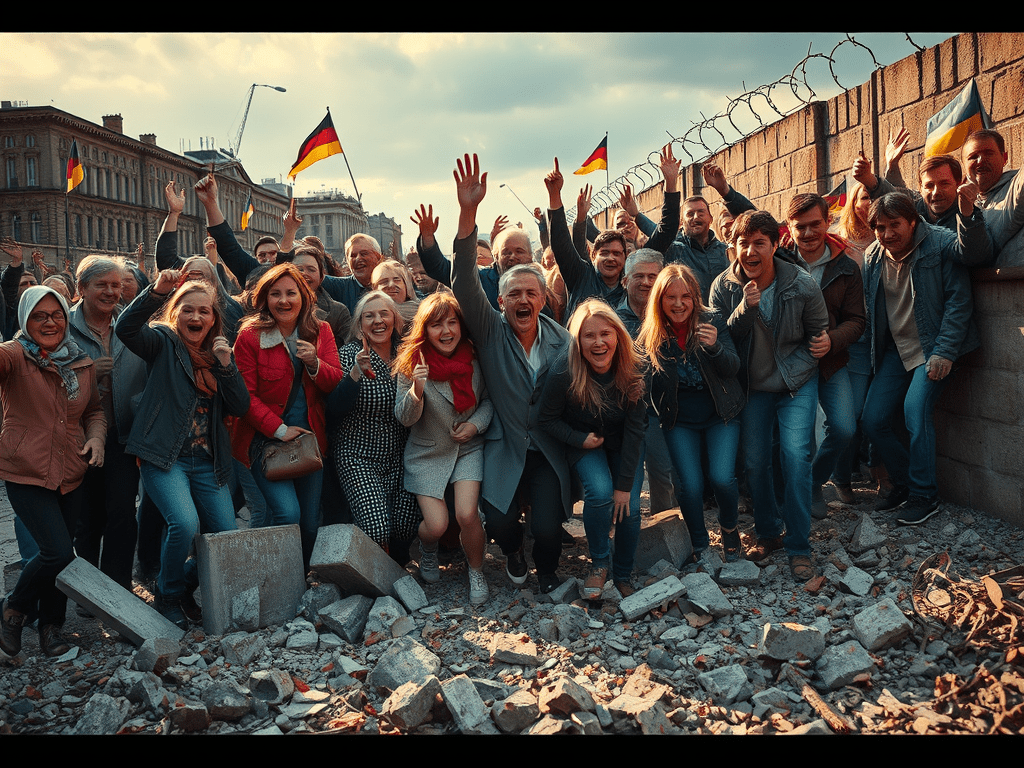
Then, on November 9, 1989, a government announcement went wrong, and East German border guards opened the checkpoints. No tanks rolled in. No orders came. People simply crossed. Then climbed. Then tore the Wall apart with their hands.
For Germany, it was a historic repair. Reunification meant more than geography. It meant confronting decades of separation, economic inequality, and trauma, but also reclaiming a shared national identity. The fall of the Wall began the process that formally reunited Germany less than a year later, ending one of the most visible scars of the post-war world.
For communism in Europe, it was the beginning of the end. The Wall’s collapse showed that the Soviet Union would no longer use force to maintain control. Within two years, the USSR itself would dissolve. The Cold War, a decades-long standoff defined by nuclear threat, proxy wars, and constant tension, was effectively over.
For the world, this moment changed everything.
Living with the Cold War in Canada
In Canada in the 1980s, we lived with a renewed nuclear scare. The U.S. and USSR dramatically increased nuclear arsenals, NATO prepared for escalation in Europe, and Canada’s proximity to the U.S. and NORAD facilities made us a potential target.
For me, this showed up in classrooms, on the news, and in the quiet worry that hung over the adults around me.
It also shaped a lot of movies I watched on Pay-Per-View. I remember watching WarGames. Matthew Broderick plays a high school student who accidentally hacks into a U.S. military supercomputer and nearly triggers World War III. The film dramatized the fear of nuclear war and showed how easily technology could escalate tensions.
A few others I remember from that time were The Day After, a made-for-TV movie that aired the same year and showed the devastating effects of a full-scale nuclear attack. Broadcast in Canada too, it terrified viewers and sparked debates about nuclear weapons, defence policies, and the morality of MAD. Then there was Red Dawn, about a Soviet invasion of the United States, where high school students became guerrilla fighters. It captured the fear of communist expansion and the idea that war could reach “our backyards.”
All of these came out in 1983–84, when I was just ten-ish. At that age, this wasn’t just entertainment. It felt like real life, and it left a mark that stayed with me; it scared me.
“The world is closing in and did you ever think that we could be so close, like brothers? The future’s in the air, I can feel it everywhere — blowing with the wind of change.”
Wind of Change – Scorpions
And Then the Wall Fell
And somehow, a song captured it.
Wind of Change by the Scorpions came out just as these events were happening. Written by a German band who had lived the division firsthand, the song reflected the thaw between East and West; referencing Moscow, shared humanity, and the hope that the world could finally change direction.
I was a Canadian teenager by this time, far from Berlin, but not untouched by it. This was the first time I really understood that global events weren’t abstract. They shaped futures. They reshaped borders. They changed the emotional climate of a whole generation. I was old enough to grasp it, and young enough to believe that it could mean a better world.
And I didn’t experience it alone. That song is inseparable from my friend April Star. We listened to it constantly. Now, it’s my strongest memory of her.
That’s why I’m writing this. Living through history isn’t just about dates and facts. It’s about how those moments land in ordinary lives. It’s about where you were, who you were with, and how the world felt when something irreversible happened.
The Berlin Wall fell. Communism in Europe unraveled. The Cold War ended.
And I was there, listening to a song with a friend, as the wind changed.
What were your experiences in this historic moment?

 My Tiny World Corner
Leave a comment