Hey, hey, hey, awesome readers!
So … I’m running a wee bit behind on posting Part III of my blog series—turns out, time flies when you’re busy juggling life, coffee, and trying to remember where you left your keys. But fear not! I’ve got something SUPER exciting lined up for the next post, and trust me, it’ll be worth the wait. I’ve been up to big things over here … in addition to moving to a new city, trekking to Mount Everest Base Camp, and renovating our new house top to bottom. So hang tight, stay tuned, and prepare to be dazzled (or at least mildly impressed). Thanks for sticking with me—I promise, the wait will be worth it!
Back to my own personal Outlander series, let’s recap …
In Part I, we covered my 6x great-grandfather, Edward Hicks Sr., in detail and touched on my 5x great-grandfather, Joseph Hicks, and 5x great-grand-uncle, Edward Hicks Jr. – Loyalists who supported King George III during the American Revolution. Edward Hicks Sr. served in Butler’s Rangers, a Loyalist militia, and was captured by the Patriots and executed as a traitor at Minisink, New York. Edward Hicks Jr. and Joseph Hicks also fought for the Crown.
In Part II, we focused on Edward Hicks Jr., who joined Butler’s Rangers in 1777. In 1779, he was captured by the Patriots, tried as a spy by the Rebels, imprisoned with his father, and after his father was hanged as a traitor, he fooled his guards and escaped to New York, fleeing back to British forces. He fought in nine subsequent battles for the British. After the war, Hicks Jr. resettled in Canada as a United Empire Loyalist (UEL), securing land and posthumous recognition for his father, Edward Hicks Sr., which led to compensation for the family. He settled in Marysburgh, Ontario, where he lived with his wife, Deborah Pringle, until he died in 1832. He left a legacy tied to his loyalty to the Crown and his resilience in the face of adversity.
“The Loyalists were not rebels; they were patriots to the last. They chose loyalty to the Crown, and this decision defined their sacrifice.”
– John Adams, American Founding Father (paraphrased)
Timeline: Joseph Hicks, My 5x Great-Grandfather
Here’s what I’ve pieced together so far about Joseph Hicks:
1767: Born in Albany, New York, the fifth child of Edward Hicks Sr. and Levina, and the fourth son.
1776: American Revolution begins. Joseph is 9 years old.
1778: Joseph’s father, Edward Hicks Sr., is executed by hanging in Minisink, NY. Joseph is just 11.
1781: I hypothesize Joseph enlisted on/about November 12, 1781, when Governor Frederick Haldimand appointed Edward Jessup as major commandant of a new corps of Loyal Rangers. Joseph was 14.
1783: The American Revolution officially ended on September 3, 1783, with the signing of the Treaty of Paris. This treaty recognized U.S. independence and established the boundaries of the new nation. Joseph served in Major Edward Jessup’s Corps until the reduction in 1783. He was 16.
1783–1786: Where was he? Did he return to living in the U.S.? Did he meet Elizabeth during this time? The records aren’t clear.
1786: Joseph marries Elizabeth Losee in Clifton Park, Schenectady, NY, at 19.
1794: Joseph is living in Kingston, Upper Canada, and Elizabeth files a land claim as a descendant of Loyalist Joshua Losee. Joseph was 27.
1815: Joseph dies in Kingston, Ontario, at age 47–48.
Loyalist and Settler
Born in 1767 in Albany, New York, Joseph Hicks was the fifth child of Edward Hicks Sr. and Levina. He was their fourth-born son.
At the onset of the American Revolution, Joseph was just 8 years old. By the time his father and older brothers enlisted as Loyalists, Joseph was only 10, while his brother David was 11. This age difference explains why they did not enlist alongside their father and older siblings—they were still too young to participate in military service at that time.
As we know, his father, Edward Hicks Sr., met a traitor’s end in the small town of Minisink, New York, around 1778. At only 11 years old, the weight of this loss must have been heavy on Joseph’s young shoulders. The memory of his father’s death would have lingered for years, a constant reminder of both personal and political injustice. It must have been unimaginably difficult for a young boy to endure. I wonder if he, like his brother Edward Jr., “did not forget the death of his father … and decided to … fight the rebels … because he … still owes them a grudge.”[1]
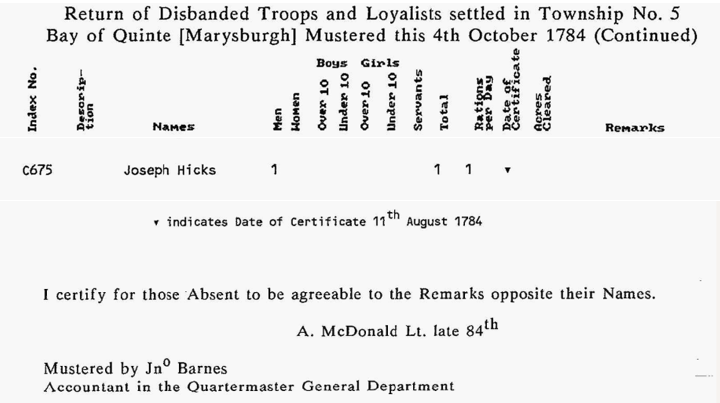
At some point, Joseph enlisted because he appears on a list of disbanded British troops victualled as Loyalists at the fifth township, Bay of Quinte (Marysburgh), mustered on October 4, 1784, at 17 years old, with one man (himself) receiving one ration per day.
In a document I can no longer locate, I noted the following statement:
“I do certify that Joseph Hicks named in the annexed Certificate served last war as a Soldier in Major Edward Jessup’s Corps until the reduction in 1783 – Thos. Fraser.”
From this statement, I hypothesize that he enlisted on or about November 12, 1781, when Governor Frederick Haldimand appointed Edward Jessup as major commandant of a new corps of Loyal Rangers. The Loyal Rangers were formed from several smaller military formations, including the Loyal Americans, and soon became known as Jessup’s Rangers.[2]
Although Joseph could have enlisted earlier, Jessup was attached to the King’s Loyal Americans, who for the next four years operated on a semi-independent basis under Johnson’s regiment. They spent most of their time building, repairing, and garrisoning forts around Montreal, Sorel, and lower Lake Champlain, and also took part in several raids into New York. Edward Jessup led Loyalist units during major raids in the fall of 1780 and 1781.[3] Thomas Fraser noted that Joseph was with them until the “reduction” in 1783, which I suspect corresponds with the disbandment of the corps at the end of the Revolution.
I have been unable to locate Joseph on the official list of Jessup’s Loyal Rangers, nor could I locate Joshua Losee.[4] Perhaps the lists are incomplete? I am also puzzled because the History of the Settlement of Upper Canada by Wm. Caniff, M.D. states that Joseph, as well as his brothers Joshua and Edward, belonged to Butler’s Rangers, not Jessup’s Rangers.

Marriage and Family
On August 30, 1786, Joseph married Elizabeth Losee of Clifton Park, Schenectady, NY, at the age of 19. Dutch Church records indicate beyde van Clifton Park, meaning both were from Clifton Park.

New York, Schenectady, Aug 30, 1786
Later, in 1794, a document shows that Joseph was living in Kingston, Ontario, when Elizabeth filed a land claim as a daughter of Loyalist Joshua Losee, who had served in Jessup’s Corps. [More to come on that line.]
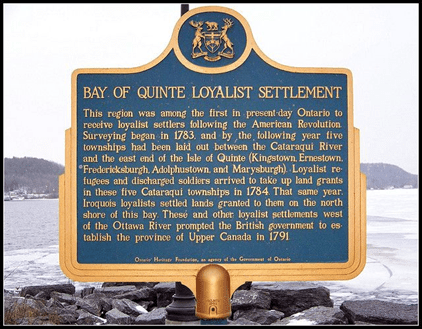
After the war, Jessup’s Rangers were allotted townships number 6 (Edwardsburg), number 7 (Augusta), and part of number 8 (Elizabethtown), all along the St. Lawrence, as well as No. 2 (Ernestown), west of Cataraqui (Kingston).

In 1802, Joseph appears on the lists for the Surveyor General, York, of disbanded Troops, Loyalists, etc., formerly victualed at Kingston. It does not say to which company or troop he fought with. I was hoping to confirm Butler’s Rangers or Jessup’s Corps.
Death and Burial
Joseph passed away in 1815 in Marysburgh, Prince Edward County, Ontario, Canada, at the age of 47 or 48. He is buried at South Bay Cemetery, South Bay, Prince Edward County, Ontario.
Honouring the Legacy: A United Empire Loyalist’s Sacrifice and Service
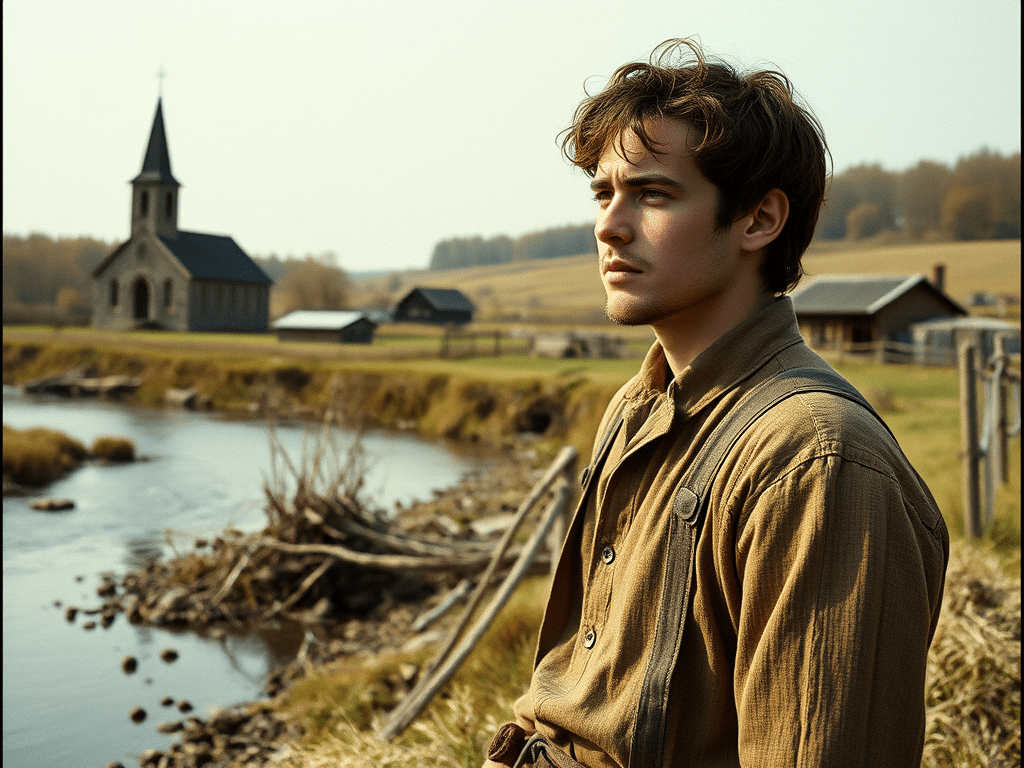
My 5x great-grandfather, Joseph Hicks, was a United Empire Loyalist who played an important, if often overlooked, role during the American Revolutionary War. As a young boy of just 11 years old, he endured the loss of his father, Edward Hicks Sr., who was tried and hanged as a traitor in New York. The weight of this loss must have been immense, shaping his character and perhaps instilling a lifelong sense of duty and loyalty to the Crown.
Joseph’s military service likely involved participating in raids and skirmishes, contributing to the broader Loyalist effort to support British forces. While he did not hold leadership positions or fight in the most famous battles, his steadfast loyalty played a crucial role in undermining the American revolutionary cause, alongside countless other ordinary soldiers and young men like him.
After the war, like many Loyalists, Joseph received a land grant in Upper Canada (now Ontario) as compensation for his service. In 1786, he married Elizabeth Losee, and together they had several children. I plan to share more about Elizabeth and my Losee ancestors in a separate blog. Joseph passed away in 1815, leaving a legacy of loyalty, resilience, and settlement that helped shape the early communities of Ontario.
Though his contributions may not be widely recognized, Joseph Hicks’ service was vital to the Loyalist movement and, by extension, the early development of Canada. Without the sacrifices of him and his family, our own story—our place in history—would be markedly different. His legacy lives on in us, as a reminder of courage, endurance, and commitment to principle.
As I reflect on Joseph’s journey and the lands he helped settle, I also acknowledge and pay respect to the Indigenous peoples whose ancestral territories he—and later settlers—inhabited, including those of Marysburg.
This past summer, I traveled to Niagara-on-the-Lake and gathered information that may shed further light on this story. There’s more to uncover—perhaps a trip up to Prince Edward County is in order. Who knows what stories and surprises still await discovery?
References
[2] The Canadian Encyclopedia. Article – Edward Jessup. Last edited Feb 25, 2021.
[3] The Canadian Encyclopedia. Article – Edward Jessup. Last edited Feb 25, 2021.
[4] An American Family History: Leeds County Jessup’s Loyal Rangers.
[5] Signed 12 May 1802. List of Loyalist sufferers to have settled at Cataraqui and its Vicinity at the Peace.


 My Tiny World Corner
Leave a comment