I feel like I’m living a very personal version of Outlander in researching and writing this series. Such an exciting part of my ancestry.
If you’re new to my blog, welcome to part 2 of this 3-part series on my 6x GGF, my 5th great-grand uncle, and my 5x GGF, who were loyal to King George III during the American Revolution.
If you haven’t read Part I of this exciting series, you may wish to do that; it’ll help give you a background of relatedness for this blog.
If we’re related via this exciting line, please comment below or message me. I’d love to connect with you.
In part I, we left off that my 6x GGF, Edwd Hicks Senr, was hanged at Minisink, New York as a Spy.
So, what about his son, Edwd Hicks Junr? What became of him?
Timeline: What Became of Edwd Junr?
To put all of the various information together, I created the following timeline, which really helped me put things into perspective (see footnotes for sources):
1775: His father, Edwd Senr, had 600 acres on the Susquehanna River, at the mouth of the Sugar Run (across from present-day Wyalusing, PA), and had 25 acres cleared.
1777: Butler’s Rangers headquarters was established at Fort Niagara.
1777 March-April: Left his father’s house and went to Niagara in the company of about 60 Tories …
I’ve also seen it documented that before the breakup of the ice in the Susquehanna, Edwd Junr and his father and brother “joined with other Loyalists along the river to travel from their homestead at the mouth of the Sugar Run (across from present-day Wyalusing, PA) with horses to Fort Niagara (Near present-day Lewiston, NY)”.
1777 May-June: (continued from quote above) … where he continued for about 2 months (presumedly May-June)
1777 July-Aug-Sept: He says in his court martial that he entered into the Batteaux Service to carry provisions from Niagara to Oswego, where he continued for about 6 weeks.
Batteaux Service is one of the least-known civilian services performed. Although they were not considered soldiers and they received higher pay than soldiers, they did perform military duties and fought in battles, and many of them were either killed, wounded, or taken prisoner. This may make sense since we don’t see him on payroll until Dec 25, 1777.
25 Dec 1777: The first day listed on payroll as a Private in Captain Walter Butler’s Coy.
10 Dec 1777: Col. Nathan Denison, commanding the 24th Regiment of the Connecticut militia, sent a detachment of 11 men, under the command of Lieut. Asa Stevens, who came up as far as Meshoppen and took five suspected persons prisoners, but deemed their force insufficient to advance further, returned to Wyoming. On hearing their report, Col. Denison, Dec. 20, sent up a larger force consisting of one captain, five subalterns, seven sergeants, five corporals, and ninety-three rank and file, in all 111 men, under the command of Lieut.-Col. Dorrance, who marched up the river as far as Sheshequin. A prominent Indian chief, whom the English called Hopkins, who had received from the British government a captain’s commission, and was then residing at the foot of New Sheshequin (the old Gore place), it was reported, was keeping several prominent Tories. The soldiers were directed not to bother the Indians, but, hoping to capture some of these white people, a party entered Hopkins’ house, made him prisoner, and commenced their search for the persons they were seeking. Hopkins, attempting to escape, was shot through the body by Rufus Baldwin, who was placed to guard him. Hopkins, however, recovered and was present at the Battle of Wyoming.
The results of this expedition are stated in the memorial of Col. Denison to the Connecticut Assembly, dated January 1778: “The men marched up the river about eighty miles, and took sundry Tories, and happily contented the Tioga Indians and entirely disbanded the conspirators.”
The Assembly resolved “that Richmond Berry, Philip Buck, Thomas Silk, Edward Hicks, Edward Hicks, Jr., John Young, Jacob Bowman, Adam Bowman, Jr., Jacob Bruner, John Henry Short, Henry Hover, Nicholas Phelps, Nicholas Phelps, Jr., John Phelps, Jacob Anguish, George Kentner, Frederick Frank, who were taken in arms against the United States by the militia of Westmoreland, and sent to the deputy commissary-general of prisoners of this State, are ordered to be received and treated as prisoners of war, provided that nothing in the aforesaid order shall be construed to excuse said prisoners from any treasonable offense against the laws of other States.”
About the same date is a bill from Isaac Underwood to the Committee of Inspection of Westmoreland for boarding and tending “Hicks” (I’m assuming Hicks Sr, since there is no mention of Jr) and Waldreck in jail for eight days. The document states that “these men were released in time to engage in the battle of Wyoming. Did one of the Edwards participate in this battle, which took place in the Wyoming Valley of Pennsylvania on July 3, 1778?
????? 1778: He went to Boston in 1778 in the character of a spy and was detected by the Americans and taken prisoner. He represented himself as a young man in search of his mother, who had been removed from the country, but it was supposed that his captors considered him a rather smart-looking young man to be lost and took him, and at trial, he was condemned as a spy to be dealt with accordingly.
????? 1778: To help us understand Edwd Hicks Junr’s capture, a pension claim document of Wilhelmus Kuykendall who in his application made on October 9, 1832, states that he “Entered the service of the United States under the following named officers and served as herein stated; he resided in the town of Minisink, Orange county, and state of New York, and in 1778 went into service under Lieutenant Martyn Decker; went in pursuit of Robert Land and Edward Hix, who were sent from New York to carry dispatches to the Indians at Niagara, and captured said Land and Hix and delivered them over to Lieut. Bull, belonging to Spencer’s regiment, afterwards to General Pulaski, in New Jersey state …”
Lt. Decker, being sworn at the Rebel Court Martial of Robert Land, said that the 14th Inst. went towards Coshithton with a party of men, after a number of Tories that were on their way from New York to Niagara. That about three O’clock P.M., he fell in with them and took LAND and HICKS. He further says that LAND told him after he was made prisoner that he was going to the Enemy at Niagara.
???? to Sept 1778: Taken by some of the Militia and carried to Hartford, Connecticut, and there kept confined till September. ’78.
Sept 1778: From thence sent to New York as a Prisoner of War and entered into the service of the enemy in the Commissaries Department.
Oct 14, 1778: Last day listed as a Private in Captain Walter Butler’s Coy.
Feb 29, 1779: Escaped from the Commissaries Department in New York.
On his way to Niagara, he was taken by a party of Militia near Coshithton (cannot find anything online as to where this is – did they mean Coschoton, Ohio?). Also, this contradicts what he said at court martial that “Upon hearing that General (George) Washington had issued a Proclamation Offering pardon to all those who had joined the Indians if they would Return to their Homes, he immediately set off to return home, but coming in too late to receive the Benefit of the Proclamation.” It makes sense that he may have falsified the truth to save his life at the court-martial.
17-19 March 1779: At the rebel Court Martial of edward hicks jr held at Minisink, (New York), by order of Brigadier General Hand.
Prisoner: Edward HICKS Brought before the Court charged with being a Spy, and carrying Intelligence to the Enemy Pleads Not Guilty.
Evidence: Lieut. Bennet being sworn saith that about two years ago he heard the prisoner say that he would as willingly kill a Man that fought against the British Troops as kill a Dog. Captain Spalding being Sworn saith at the Commencement of the present War he was acquainted with the prisoner, and that he had a Mind to engage in the Service of the United States, which he thinks he would have done, had he not been persuaded to the Reverse by his Father, and some other evil-minded People.
I omitted the defence phase for brevity, as I’ve added it to the timeline. If you’d like to read his court-martial, feel free to do so here.
Sentence: The Court considering the Case of the Prisoner, the Evidence for and against him, and his Defence, are unanimously of Opinion that he is Guilty of being a Spy and do Sentence him to be kept in Close Confinement during the War.
March 31, 1779: It is said that Edwd Snrr was hanged outside his son’s cell from an apple tree, so he plotted his escape. That night, feigning a stomach ailment, he was let outside for some fresh air, and he overpowered his guard, sticking him in the head. He darted to a stream and hid there until the following night. He crept out and escaped to the woods. After 9 days of not eating, he reached the British Army.
April 5, 1779: The news of Edwd Junr’s escape must have sent some sort of a ripple of apprehension through the Rebel camp. I imagine Brigadier General Edward Hand’s face etched with concern when he was left with no choice but to inform General George Washington on April 5, 1779.
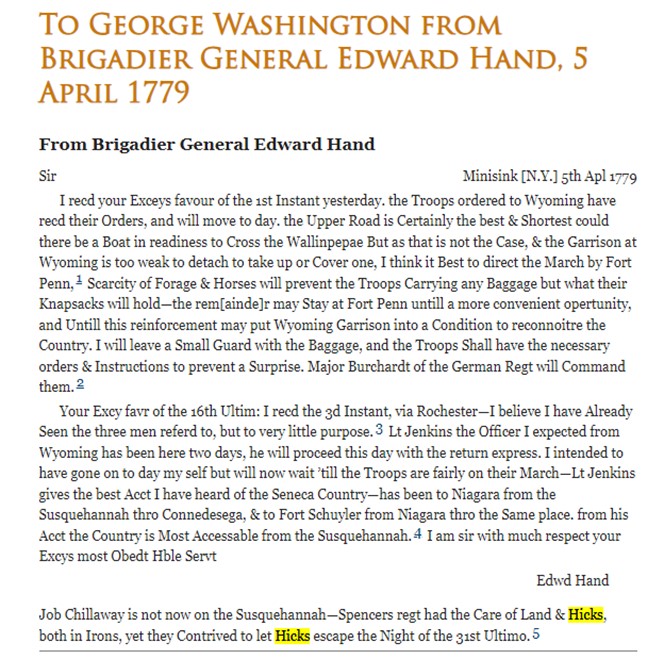
Edwd Junr did not forget his father and fought the Rebels in 9 battles afterward.
And as for General Washington, as we know, 10 years later, he would become a founding father and the first President of the United States of America.
We know from records that his mother, Levina, and the younger siblings were able to flee to Canada. Did my family members who were loyal to the Crown escape to Canada, too?
Who Are the United Empire Loyalists?
American colonists who remained loyal to the British Crown were known as Loyalists. Often referred to as Tories, Royalists, or King’s Men. These individuals chose to support the British cause despite the opposition of the Patriot movement. Following the defeat of their cause, approximately 15% of the Loyalists, totaling 65,000–70,000 people, sought refuge by fleeing to various parts of the British Empire, Britain itself, or British North America (Canada).
Northern Loyalists predominantly migrated to regions such as Ontario, Quebec, New Brunswick, and Nova Scotia, where they referred to themselves as the United Empire Loyalists. In recognition of their loyalty, many Loyalists received compensation in the form of Canadian land or financial support from the British government, which was distributed through formal claims procedures. This resettlement and support provided a foundation for their integration into the fabric of Canadian society, contributing to the diverse historical tapestry of the nation. For comprehensive information about the United Empire Loyalists, you can refer to the following link.
In 1789, Lord Dorchester, governor-in-chief of British North America, proclaimed that the Loyalists and their children should be allowed to add “UE” to their names, “alluding to their great principle, the Unity of Empire.” As a result, the phrase “United Empire Loyalist,” or UEL, was applied to Loyalists who migrated to Upper and Lower Canada. In determining who among its subjects was eligible for compensation for war losses, Britain used a fairly precise definition:
- Born or living in the American colonies at the outbreak of the Revolution
- Rendered substantial service to the royal cause during the war
- Who left the United States by the end of the war or soon after?

Thousands of settlers appeared before magistrates in district courts and made declarations under oath for their claim.
20 July 1784: Edwd Junr’s name appears on a list of persons in order to settle and cultivate the Crown Lands opposite to Niagara with one man (himself), one ration per day.
He appears on a list of settlers at township no. 5 (Marysburgh) above Cataraqui, 1785, muster roll no. 16.
1 July 1786: He appears on a list of disbanded British troops victualled as Loyalists at the fifth township (Marysburgh) above Cataraqui with one man (himself), one ration per day.
31 Aug 1786: He appears on a list of disbanded British troops victualled as Loyalists at the fifth township (Marysburgh) above Cataraqui with one man (himself), one ration per day.
March 6, 1788: This is a verbatim transcript of the land claim made at Montréal by Edwd Junr, on behalf of his father Edwd Senr.
“Claimt (son, Edward Jr.) Sworn: Says he was in Butlers Rangers in 1783 & sent a claim to England by Capt. Gummersal. He is a native of America. In 1775 he lived on the Susquehana with his Father. He joined the British Army in 1777 & served the War in Butlers Rangers. He now resides at Bay of Quinty. The Claim is for his Father’s Property. He died 1780 at New York & had served in Butler’s Rangers. There are 5 Boys & 2 Girls alive, all in Canada. His Mother is alive & married to Joseph Wright in the Bay of Quinty. He had 600 Acres on the Susquehana. He bought it of the Pensilvania & Connecticut Claimts before the War. He had 25 acres cleared. He can not tell who has it now. Lost his Stock, Farming Utensils, Furniture.”
Wits. WILLIAM FRANKS Sworn: Remembers Ed. Hicks Lands. He had a farm on the Susquehanna. He had considerable Clearance & a pretty large Stock of Cattle. The rebels took greatest part.
Wits. G. KENTNER Sworn: Hicks deceased, was always Loyal; on the same title as the others there. He had 20 acres cleared & had a good Stock of Cattle & Horses. Claimt. is a good soldier.
April 25 1788: Edwd Junr produced a paper signed by 2 of his brothers, Daniel and Joseph, agreeing that they should receive what is due to them and also answering for the younger brothers and sisters.
May 24, 1797: Collections Canada Upper Canada Land Petitions (1763-1865) archive. The document confirms that he served in The Butler’s Rangers and was granted 200 acres of land in Marysburgh. It also notes that he is requesting His Honour to grant him a lot known as Nº7 situated at the mouth of the Black River in the Township of Marysburgh.
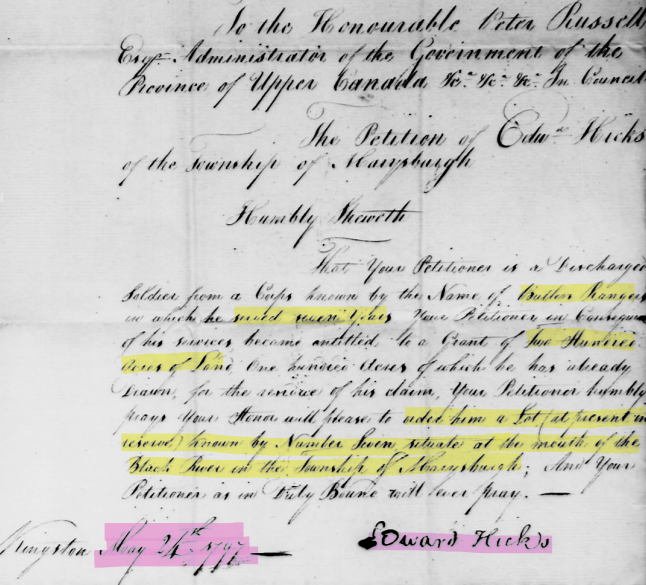
In the book called Ontario People under Part of Marysburg, I find Joseph Hicks UE, Edward Hicks UE, and Benjamin Hicks UE as numbers 3661-3662-3663. Further down, I find Daniel Hicks UE and David Hicks UE as numbers 3674 and 3675.
In a book about the settlement of Upper Canada, these paragraphs serve as background to his arrest, how he escaped, what he did in the time that he escaped, and how he became a UEL and moved to Lower Canada. It’s interesting because it also describes his physical characteristics, which helps give some real-life vision to my 5th great-granduncle. He seemed like a hulk of a man. No wonder they say he was able to escape his guard.
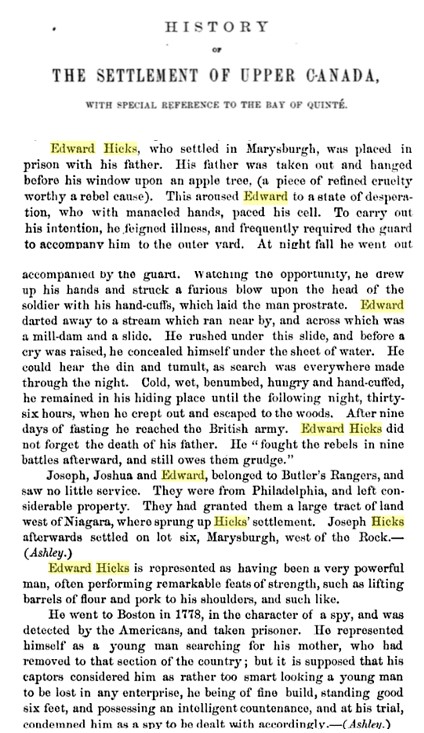
Thanks to the efforts of Edwd Junr, Edwd Senr was posthumously acknowledged as a UEL. This recognition ensured that his widow and children received compensation for their hardships in the form of extensive land grants, which became the foundation of the Ontario Hicks line.Edwd Junr wisely utilized the UEL land grant and established his residence in Marysburg, Prince Edward County, Ontario.
Most Loyalists were neither rich nor particularly high in social rank. Most were farmers, labourers, tradespeople, and their families. They were of varied cultural backgrounds. Free black people and escaped slaves who had fought in the Loyalist corps, as well as about 2,000 Indigenous allies (mainly Haudenosaunee from New York State), also settled in Canada. Tens of thousands of Loyalists migrated to British North America during and after the war. This boosted the population, led to the creation of Upper Canada, and heavily influenced the politics and culture of what would become Canada.
Edwd Hicks Junr married in about 1793 at North Marysburgh, Prince Edward County, Ontario, to Deborah PRINGLE. Born: 28 Aug 1772 at Skenesborough, Whitehall, New York. Her father was Sgt. Timothy PRINGLE, Sr (Loyalist), and her mother was Huldah WELDON.
My 5th great-granduncle died on 11 Nov 1832 at North Marysburgh Twp, Prince Edward County, Ontario. What an incredible man, who lived an incredible life, loyal to the Crown.
In summary, my 5th great-granduncle was captured during the Revolutionary War and faced a rebel court-martial. Despite being captured, he managed to escape to the British lines. After the war, he settled in Ontario (Canada) and obtained official recognition as a United Empire Loyalist, securing land grants for his family.
So what happened to my direct bloodline? What happened to my 5x GGF Joseph Hicks?
Stay tuned for part III. I promise it won’t take as long this time.
Sources and Notes:
Quinte Branch of the UEL Assn, Newsletter for Spring 1995 (Vol. 6 No. 4), Contributor: Elaine Lawlor.
Job Chilloway, Indigenous interpreter, born and raised at Egg Harbor, N.J.; served the British during the French and Indian War.
Dale Halliday, UEL Library, Toronto.
Sic: ‘Susquehannah, Pennsylvania’. Cataraqui was the old name for Kingston, Ontario, the nearest town to Marysburgh.
Second Report of the Bureau of Archives for the Province of Ontario, 1904, Claim #441.
Ontario People 1796–1803, transcribed by E. Keith Fitzgerald, Genealogical Publishing Co., 1993.
History of the Settlement of Upper Canada (Ontario), Wm. Caniff, M.D., Toronto: Dudley & Burns Printers, Victoria Hall, 1869, pp. 104–105.
Pay Rolls of Butler’s Rangers, 1777–1778.
The Rebel Court Martial of Edward Hicks, held at Minisink, New York.
History of Bradford County, PA 1770–1878, David Craft.


 My Tiny World Corner
Leave a comment