I’m researching my Irish roots via my 2x grandfather, Patrick James Mullen.
My updated DNA origins have provided me with some further insight into my Irish roots. The recent update has really narrowed the percentage of Irish I have in my DNA; my current ethnicity estimate is 6%, but it can range from 0-14%, the range comes from making multiple comparisons of my DNA to the Ancestry reference panel.
I have this incessant need to find out about my Irish side of the family … and no matter how much I dig I came up empty.
I have connected with distant relatives who have nothing more to offer than similar tidbits of family lore. I have spent countless hours researching and emailing and my problem may well be the one that nearly all people tracing their Irish ancestry eventually face. I just don’t know enough about my Mullens to make any real dent. Add that to the fact that the Mullen name O’Mullen, with its many variants, is among the seventy most numerous names in Ireland, among the first forty in Ulster, one of the first ten names in County Derry, and one of the first five in County Tyrone, yeah, I’m already set up behind the eight ball.
Inconsistency in the spelling of surnames is well known to those who have conducted research into their Irish family history. I find that in the context of Irish historical records there are many spelling variations of the same name. The anglicization of Gaelic names, together with illiteracy, resulted in numerous spelling variations of the same name and, in some cases, the adoption of inappropriate surnames. Many surnames in historic documents are based on a phonetic spelling of what the record compiler heard.
And on top of this many records were made by officials with no knowledge of Gaelic speech. Hence, the surname Mullen can be variously recorded as O’Mullen, Mullan, Mullen, Mullin, etc. in record sources in Ireland.
The other thing is that there are very few surviving Roman Catholic baptismal or marriage registers of any parish in County Derry predating 1825 (the exceptions being Long Tower RC, Derry city with baptism records from 1823; Lissan RC with baptism registers from 1822 and Dungiven RC with baptism registers from 1825). Hence, it is quite possible that a birth record of Patrick James Mullen or any of his ancestors has survived in a County Derry church baptismal register. But I am not done going down this road yet. I will press on.
I NEED HELP!
I set out to put together all the information I know on my 2x great-grandfather, my dad’s namesake, and hope this lands in the hands of someone who can offer any other nugget of information to Patrick James Mullen’s life story.
If you know anything about this line, are a distant relative, or know where I can direct my search and move it forward, I’d love to hear from you. Please message me or comment below!
Patrick James Mullen’s Timeline
* I am accepting all the information prima facie and will change it as it is clarified or dispelled.
** In the records, the name Mullen is also spelled Mullin and Mullan interchangeably throughout, even by PJ himself.
22 Dec 1825 or 1836? • Birth: County Londonderry, Ireland?
- WE HAVE AN ISSUE WITH HIS DOB
- IT VARIES BETWEEN 2 YEARS: 1825 and 1836 – see discrepancies below. THIS DOB cannot be entirely relied upon.
- In the 1881 and 1891 censuses’ PJ was the enumerator and entered his own age. I would assume he knows his own age and entered them as he knew them to be.
- 1825 comes into play on his death certificate, this cannot be relied upon as it was not entered by him (clearly) and his last census of 1901 when he was of advanced age and was NOT the enumerator and maybe the Lees’ whom he was living with gave the info and it was incorrect?
- DOB is listed as December 24, 1824, in the 1901 census. Yet another year!?
- He was born to Mary McGanis (the actual spelling on PJ and Olive’s marriage certificate, it could also be McGinnis or McGuinness) and Michael Mullen. We know his parents’ names as they are listed on the marriage certificate, this is the only place they are listed.
- His date of birth is as per his death certificate – again not entirely reliable as it does not appear to have been a family member who gave the death details, even if it was as we well know, family members in those days did not know all facts and details as we do now.
- His death certificate states that he is from County Londonderry, Ireland – again this is coming second-hand and not from him.
- At this point, I’m not even sure that we can rely on County Londonderry since it was noted on his death certificate – who provided this information?
- Derry is an anglicization of the old Irish Daire meaning “oak-grove” or “oak-wood”.
- Unlike the city, however, there has never been a County Derry. County Londonderry was formed mostly from the old County ColerainBritish authorities use the name “Londonderry”, while “Derry” is used by the Republic of Ireland.
- The only thing we can rely on with some degree of accuracy is that he is from Ireland.
1840-1850 • Irish Immigration to Calumet Island
- For historical relevance – around 1836, former employees of the Hudson’s Bay Company began settling on Calumet Island. This was followed by three waves of Irish immigration between 1840 and 1850, bringing many Irish families to the region. These immigrants were drawn by opportunities in timber, farming, and trade along the Ottawa River, and they laid the foundations for a small but vibrant Irish Canadian community. By the time Patrick James Mullen arrived in ~1861, this established Irish presence would have provided a familiar and supportive environment for a newcomer, making it easier for him to settle, find work.
1847-1852 • The Great Potato Famine and Irish Immigration
- For historical relevance: by far, the largest immigration of the Irish to Canada occurred during the mid-19th century. The Great Irish Potato Famine of 1847 was the cause of death, mainly from starvation, of over a million Irish. It was also the motivation behind the mass exodus of hundreds of thousands of Irish to North America.
- Because passage to Canada was less expensive than passage to the United States, Canada was the recipient of some of the most destitute and bereft Irish. The passage was difficult for those making the 4,828 km voyage from Ireland.
- Crammed into steerage for over six weeks, these “coffin ships” were a breeding ground for many diseases.
- The primary destination for most of these ships was the port of Québec and the mandatory stop at the quarantine island of Grosse Île.
- By June 1847, the port of Québec became so overwhelmed, that dozens of ships carrying over 14,000 Irish queued for days to make the landing.
- It is estimated that almost 5,000 Irish died on Grosse Île, and it is known to be the largest Irish burial ground exclusive of Ireland.
1851 • Poor Law Union of Ballycastle, Ballintoy, Antrim, Ireland
- THIS IS NOT CONFIRMED – I NEED TO INVESTIGATE THIS FURTHER. I HAVE RUN UP AGAINST A BRICK WALL with nowhere else to go.
- During my research, I came across a note suggesting that a Patrick James Mullen may have been recorded at the Ballycastle Poor Law Union in Ballintoy, Antrim, Ireland, in 1851. Poor Law Unions contained workhouses that housed orphans, the destitute, and those without family support. Given that Ballycastle is only about 1–1.5 hours from Londonderry, it is geographically plausible that PJ could have been there.
- At the time, PJ would have been approximately 15–19 years old—an age consistent with someone appearing in a workhouse register. However, the surname Mullen, and the combination “Patrick James,” were very common in Ulster, so it is impossible to confirm that this entry refers to my 2x great-grandfather without additional evidence.
- It’s also worth noting that the workhouse record should not be interpreted as evidence of criminal activity. Many young people ended up in workhouses simply due to poverty or lack of family support. Similarly, family lore suggesting that PJ left a seminary may or may not intersect with this record.
- For now, this is a tentative lead—interesting and plausible, but unconfirmed. I plan to continue searching parish records, ship manifests, and other sources to see if this Ballycastle connection can be verified.
Workhouse registers 1843-1948 Public Record Office of Northern Ireland (PRONI) | nidirect
1860 • Ireland – Seminary: Family Lore OR Fact?
- The year 1860 is being used as a date stamp to document the possibility that he was in the Seminary.
- I have chosen 1860 as it was the year immediately preceding his “immigration” to Canada and since it is said he left the seminary for life in Canada.
- It is alleged that PJ was in the Seminary studying to become a Priest before coming to Canada or at least this is the lore passed to me via Mary Rowlands, who is my 2nd cousin who heard it from her daughter, Gramma (Ange)lina Mullen.
- Paul Podstawka is a distant cousin who has also been trying to help figure out more about PJ. In an email to me Paul says: “in the meantime … family lore was PJ was in the seminary (maybe in Ireland, maybe in Québec) he left the seminary eventually. So, the lore is consistent at least.
Paul then emailed me the following … on Mar 1, 2021, at 7:11 PM, pods wrote:
“Hi Tina, Life is full of coincidences. Today a local historian referenced a near-drowning in 1955 and I’m quite sure I was involved (my friends were the culprits) so I went to look for the news story but was enjoying looking through the numerous photo albums. I found a note from my mother which I’ve never seen before giving her genealogy”.
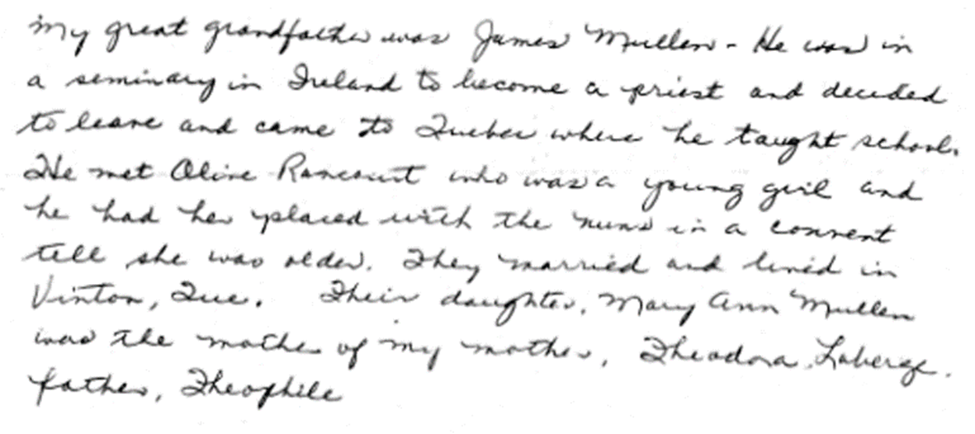
Here’s what I glean from this little note, even though Paul said in his email to me that it offered ‘nothing new’, there are a few new takeaways here:
• She referred to him as James Mullen, is that what she heard people called him … not Patrick, Pat, or PJ? Did they call him James? The census’ where he was the enumerator, he wrote his name as PJ?
• This lore closely aligns with what Mary Rowlands said that Lina told her about her father (PJ) leaving Ireland for Canada to teach and leave the seminary. However, it can still be considered as lore –big lore, but lore, nonetheless.
• She says that Olive was quite young when they met, and he had her placed in a convent “till she was older”. This was also passed down via Lina to Mary Rowlands as well. However, this too can only be considered lore.
In specific reference to family lore OR fact about him being in the seminary in Ireland prior to coming to Canada, I’m still not sure. However, it is the same story coming from two different lines of the family and from different generations.
I will leave the year as 1860 for now, and continue researching …
*Feb 21, 2022 – I emailed the Special Collections and Archives at Maynooth in Ireland as students for the Priesthood did not train within local Parishes, they attended a central seminary at Maynooth. Maynooth College archives are the administrative records of St Patrick’s College, Maynooth, which was founded in 1795 as the National Catholic Seminary in Ireland. Surviving sources of information for each student provide the diocese, date of matriculation, and date of ordination.
*March 1, 2022 – Response from Anna Porter, Archivist at St. Patrick’s College, Maynooth.
“I searched the website and Hamell’s book for Patrick Mullen/Mullins, etc., and found a few slim possibilities:
- Patrick Mullen, Dublin diocese, matriculated into the Rhetoric class in 1854, no ordination date given. If this were your Patrick, he would have been twenty-nine upon entering the college; usually students started at around eighteen years of age.
- Patrick Mullen, Armagh diocese, matriculated into Rhetoric on 20 Dec 1843 and was ordained in the college on 25 May 1850. This man would be the right age for your Patrick, but I gather your grandfather was not ordained? Your grandfather’s place of birth, Londonderry, is situated within the Derry diocese which borders Armagh diocese, so the location would be plausible for this man to be your Patrick.
- Patrick Mullen or Mullins, Clonfert diocese, matriculated on 27 August 1857 and was ordained externally in 1865/66
Anna notes that “from the probable ages (usually ca. 18 years old at matriculation) of the above-listed men, the most likely candidate would be the middle one, the problem being that he was ordained. If you would like to pursue this line of enquiry perhaps the Armagh Diocesan archives might be able to tell you if he left the priesthood sometime before he emigrated. I also checked the database of seminarians who studied at All Hallows College in Dublin but did not find anyone who matched your grandfather’s details.“
1861 – Immigration and Meeting Olive Rancourt: Separating Fact from Family Lore
- Patrick James “PJ” Mullen’s immigration to Canada remains partially shrouded in mystery, complicated by inconsistencies in records and family lore. According to the 1901 census, PJ arrived in Canada around 1861, though passenger lists for this year are incomplete. Research suggests he may correspond to Patrick Mullen, age 33, arriving on the Peruvian at Québec on July 23, 1865—which fits closely with the estimated year he settled in Pontiac, Quebec, before his marriage in 1867.
- At the time of his arrival, PJ would have been approximately 33–36 years old, depending on which birthdate is used (census records suggest 1834–1836, while his death certificate indicates 1825). Olive Rancourt, the future Mrs. Mullen, would have been around 14 years old.
- Family lore has suggested that PJ placed Olive with a convent until she was old enough to marry. However, census records from January 1861 show Olive already living with the Laportes:
- Baptiste Laporte, age 57
- Victoria Laporte, age 52
- Victorina Laporte, age 5
- This predates PJ’s arrival, making it highly unlikely that he arranged her placement. Additionally, Olive’s father passed away the same year she was born, but, her mother, Emelie, was still alive, passing away in 1867 when Olive was 20, further suggesting that the arrangement with the Laporte family was likely for economic or practical reasons, not because of PJ. The notion that she was placed in a convent also does not align with historical records, as no evidence supports this.
- UPDATE (16 Nov 2025): I reviewed the LAC Grosse Île records. PJ may not have passed through Grosse Île. I found 2 Patricks – 1 was deceased at sea and the other was 10 years old.
- LAC Grosse Île database primarily recorded sick, quarantined, or deceased immigrants.
- Healthy adult immigrants, like a young teacher in 1861, often landed in Quebec City or Montreal directly and were never admitted to the quarantine station.
- Many ships bypassed Grosse Île entirely if the passengers were deemed healthy upon arrival. It’s not surprising that PJ doesn’t appear in the Grosse Île database.
- Given that he eventually settled in Pontiac, Quebec, he may have landed at Quebec City and traveled up the Ottawa River toward Pontiac, either via bateaux or small steamships — common in the 1860s.
- I’ve conducted a Collection Search of the Immigration & Citizenship records from 1865 to 1935 = nothing (I tried anyway, even though the only hint we have to go on is 1861).
- Passenger lists before 1865 –>British Regime, 1760 to 1865 lists are very incomplete: “There are no comprehensive nominal lists … very few of the surviving lists …”
- Could Patrick Mullen on the Peruvian be my PJ?
- Age: 33 → YOB ~1832
- Age is plausible if we use the census-based estimate of 1834–1836 rather than the death certificate 1825.
- Arrived ~1.5–2 years before his marriage in March 1867, which fits the timeline perfectly.
- Québec was the main immigration port for Irish going to Canada West (Ontario) or western Quebec.
- Likely Route from Ireland to Pontiac / Calumet Island: Embarkation in Ireland → Embarkation in Ireland (Ulster: Londonderry / Belfast / nearby coastal towns) ~Age 33, 1865 → Transatlantic voyage (~6 weeks in steerage) → Arrival at Québec, July 23, 1865 → Overland / river travel to Pontiac / Vinton / Calumet Island, late 1865 → Ottawa River route: Québec → Ottawa → Pontiac (steamship/canoe) → Settled locally, likely alone as unmarried, 1865–1866, Age 33–34 → Marriage to Olive Rancourt, March 5, 1867, Age ~35
1867 • Residence • Frankstown, Beckwith Township, Ontario
- PJ and Lina’s marriage certificate lists PJ as being “of St. Elizabeth of Frankstown.”
- Franktown, Ontario, is about 64 km south of Ottawa and began as a halfway stagecoach stop between Perth and Richmond, established in 1818–19.
- In 1819, the township population was only 229 people.
- Correspondence with Mike Lamothe (Dec 30, 2023) suggests that “Franktown was the original name for Vinton across the River from Grand Calumet Island. The priest from Grand Calumet serviced Franktown in the early years”.
- Parish and religious designations often covered broad areas, so names on historical records may reflect administrative or church boundaries rather than precise locations.
- The reference to St. Elizabeth of Frankstown serves as both a religious affiliation and a residence marker, clarifying earlier confusion about southern Franktown.
March 5, 1867 • Marriage • St Anne Parish – Ile-du-Grand-Calumet, Pontiac, Québec
- Marriage Certificate (Translated to English) “On the 5th of March, one thousand eight hundred and sixty-seven, the exemption from three banns having been amended in favor of special permission from the Bishop of Ottawa between Patrick James Mullen of St Elizabeth of Frankstown, adult son of Michael Mullen and Nancy McGanis and Olive Rancour, eldest daughter of the late Louis Rancour and the late Emèlie Terre of this parish. Having encountered no impediment, I, the undersigned priest, solemnly blessed their union after having had their mutual consent of marriage in the presence of Michel McLean [?] And F [?] Legault [?] Who were unable to sign”.
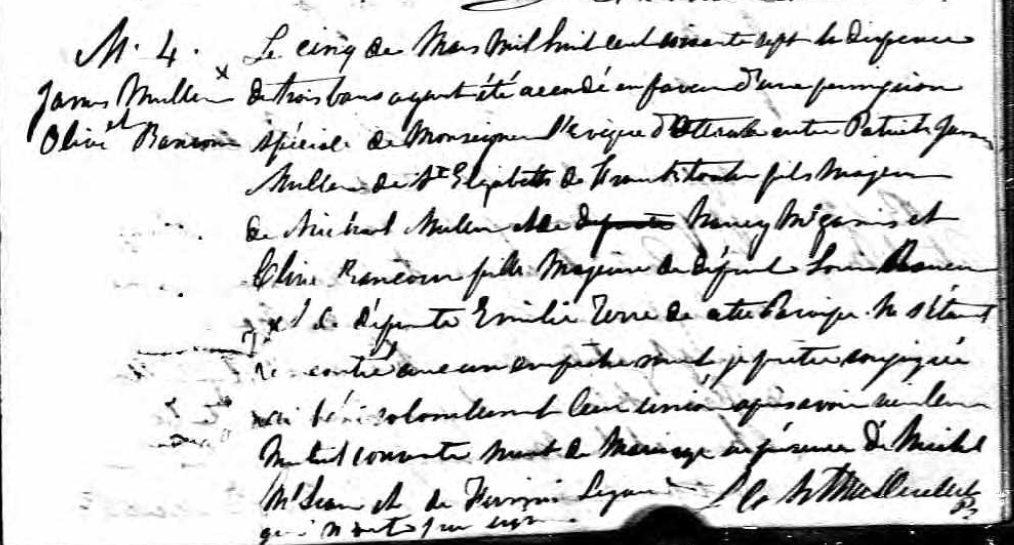
- The waiver might indicate urgency, distance, or practical difficulties in publishing the banns three consecutive Sundays.
- Sometimes bishops granted permission when one party had recently arrived from another parish or to accommodate mixed-language or mixed-nationality unions.
- St. Anne’s Church was the heart of the community on the island and served both Irish immigrants and Francophones, illustrating the intersection of two cultural groups.
- The church not only performed marriages but also functioned as a center of community life, education, and religious practice.
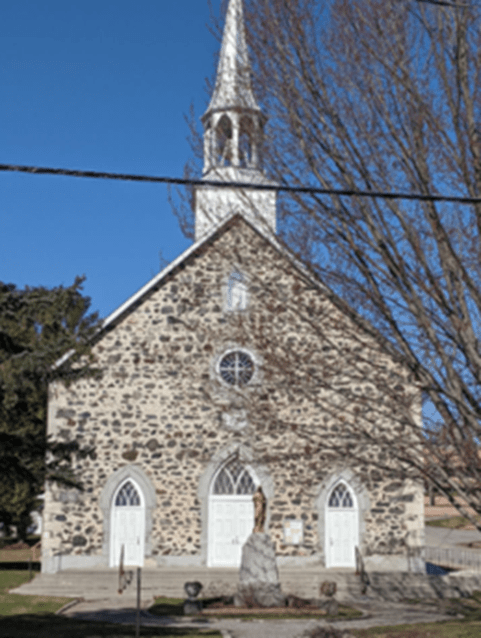
1869 – Daughter Mary Anne Was Born on February 27, 1869, In Vinton, Québec.
1871 • Residence – District of South Pontiac in the Township of Sheen, Quebec
- PJ and Olive were living in the South Pontiac district of Sheen Township, Quebec.
- The 1871 census was the first national census of Canada after Confederation (British North America Act, 1867).
- Only Ontario, Quebec, New Brunswick, and Nova Scotia were included, with results published in 1873 in both English and French.
- James (PJ) Mullen – age 33 → implies a birth year around 1838.
- Olive Mullen – age 28.
- Mayann – age 3.
- Married approximately 3–4 years by this time.
- PJ listed as a school teacher, aligning with family lore about his work in Canada soon after arrival.
- Birthplace: Ireland; Nationality: Irish; Religion: Catholic.
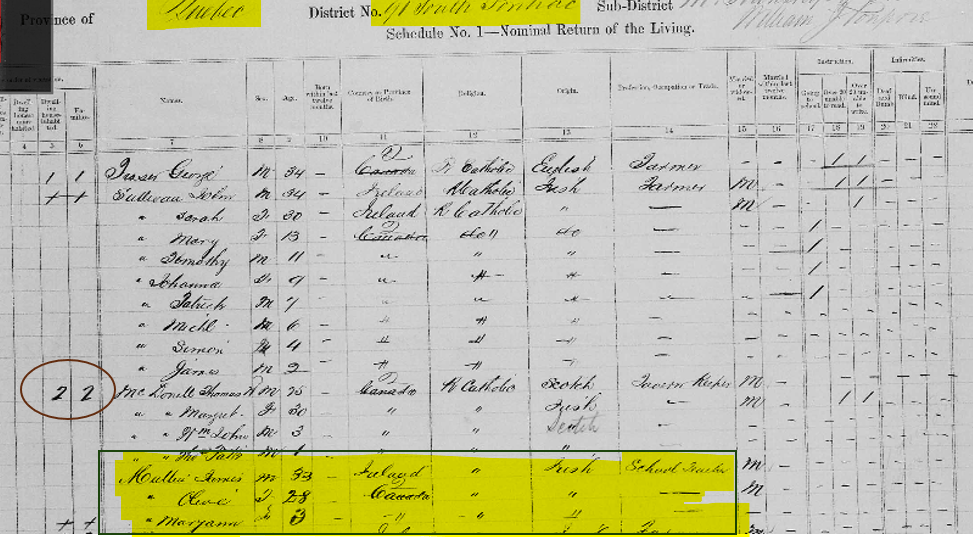
- The census may indicate they were living with Thomas McDonell, as there is no dwelling separator between his family and the Mullens.
- Suggests shared housing or extended household arrangements, common among rural Irish settlers in Pontiac/Sheen during the 19th century.
1872 – Son Patrick James was born on January 18, 1872, in Vinton, Québec.
1879 – Son William Henry was born on January 17, 1879, in Vinton, Québec.
1881 – Daughter Catherine Anne was born on March 25, 1881, in Vinton, Québec.
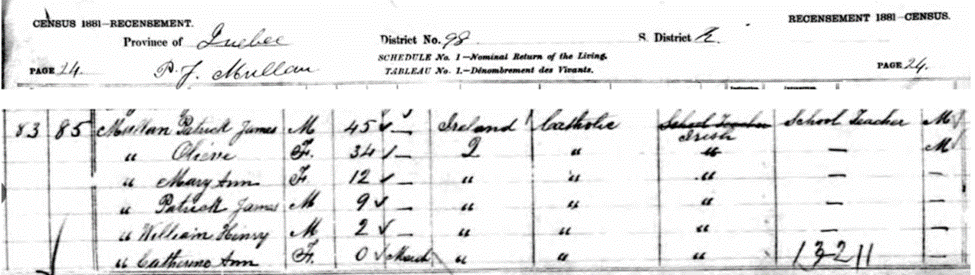
1881 • Residence – Bryson Village and Litchfield Upper Pontiac, Québec
Census
Birthplace / Nationality / Religion / Occupation:
- Born in Ireland, Irish nationality, Catholic religion
- Occupation: School Teacher
- Lists age as 45 → implies YOB ~1836 – conflicts with death certificate (1825)
- Census spells the name MULLAN. PJ IS the census enumerator as his name is on the top of each of the 68 pages in handwriting. So, HE spelled HIS OWN name MULLAN.
- In the census in which HE IS THE ENUMERATOR, he says he is 45 years old – meaning his DOB would be 1836, not 1825! I would suspect he would know his own DOB (wouldn’t he?). The YOB on the death certificate that we have been using for his DOB could be incorrect given it does not appear to be given by himself (clearly) or a family member – even that could be incorrect info, however. Let’s see what the 1891 census says – he should be 56 in that census.
- He is living with Olive (he spells her name Olieve – he is a teacher, and her husband, wouldn’t he know how to spell her name correctly?)
1885 – Son John F was born in 1885 in Pontiac, Québec.
1887 – Daughter Bridget Angelina was born on January 3, 1887, in Vinton, Québec.
1889 – Daughter Christine was born on December 9, 1889, in Pontiac, Québec.
1890’s – Education in Canada
For historical relevance, as PJ was a teacher:
• By this point, children were expected to attend free compulsory education throughout most of Canada.
• Although still taught in one room school houses, children were taught at different grade or “book” levels, the standard eight levels of education became the norm.
• Physical education and health, manual training, nature and agricultural study, and household science are introduced to Canadian curriculums.
• Electricity was introduced to classrooms.
• The first Kindergarten education is introduced.
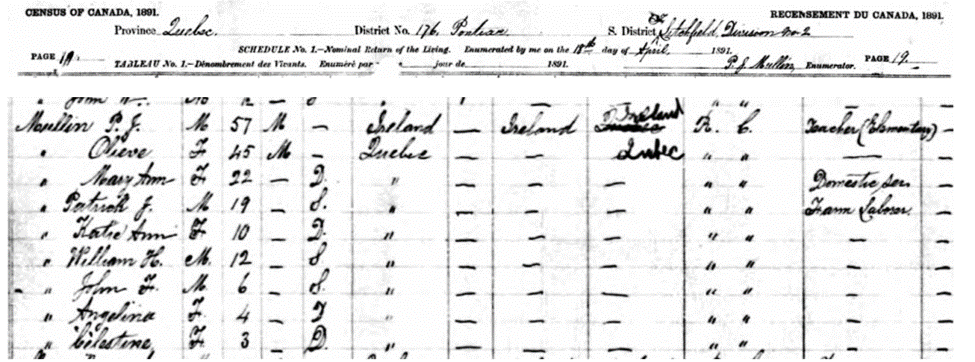
1891 • Residence – Bryson Village and Litchfield Upper, Pontiac, Québec
Census
- Census has him listed as PJ Mullin *NAME SPELLING CHANGE FROM MULLAN* in the 1881 census – odd given he is the enumerator of BOTH census’.
- So, he went from Mullin to Mullan, and we ended up with Mullen.
- Occupation: Elementary School Teacher.
- Religion: Roman Catholic
- Age: 57 – this is what we would expect based on his YOB in the 1881 census age of 46. Perhaps his YOB was wrong on the death certificate, but by 11 years?
- He again spells Olive’s name Olieve and living with them are: Mary Ann, Patrick J(ames), Katie Ann, William H(enry), John F, Angelina and Christine.
1892 – Daughter Minnie was born
1893 – Daughter Mary was born on June 6, 1893, in Pontiac, Québec.
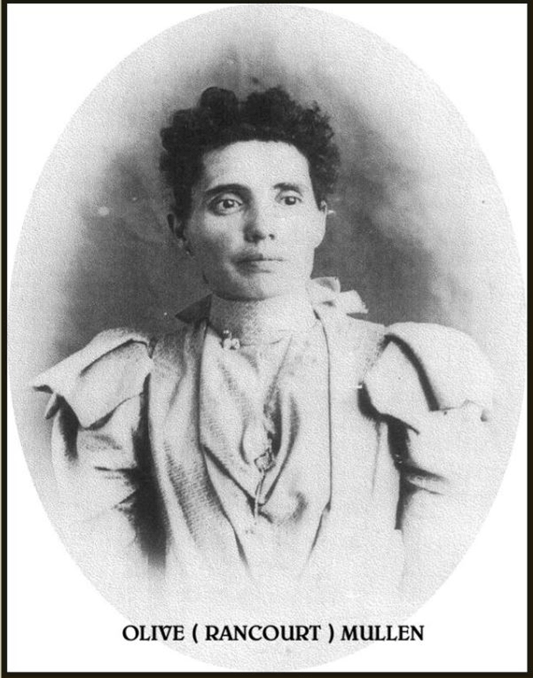
September 12, 1895 • Death of Wife Olive
- Olive passed away in Fort-Coulonge, Québec, at the age of 48.
- They had been married 28 years.
- Unable to locate a Death Certificate for her.
on Feb. 28, 2022
1901 • Residence – Fort-Coulonge, Pontiac, Québec
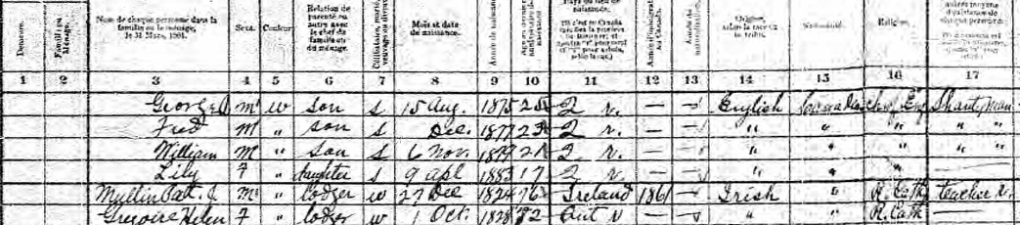
- PJ ‘Mullan’ is living in Fort-Coulonge, Québec
- Fort Coulonge is a village in the Pontiac Regional County Municipality in western Quebec, at the mouth of the Coulonge River. By the mid 1860’s, the town had a population of about 500. Fort-Coulonge became a municipality in 1888 when it separated from the Township Municipality of Mansfield.
- Census
- His name is written as “Patt J. Mullin”
- Census lists 1824, which conflicts with earlier records where his YOB ranged 1832–1838. This is a major inconsistency—could be a memory issue, a clerical error, or deliberate exaggeration/adjustment in age. As he is widowed, no one may have verified his age accurately.
- He lived 28 years married to Olive, who passed away in 1895, so by 1901 he had been widowed ~6 years.
- Depending on which source you trust, PJ would have been between 65 and 77 in 1901.
- He is listed as a lodger, not with children or relatives.
- He is staying with the family of Albert (52) and Marguerite Lee (52). Their children George, Fred, and William live with them, they are Shanty men for the Church of England. Their daughter Lily lives there. Helene Gregoire (2) also lives there, she is also listed as a Lodger.
- Why is he staying with the Lees? Why was he not staying with any of his children? Who are the Lees to him? Is he doing Labour/Farm work for them?
- Listed as Retired Teacher, consistent with prior census records and known career.
- Census indicates that he immigrated to Canada in 1861

1901–1909 • Fort-Coulonge to Sturgeon Falls – Later Years of PJ
In 1901, PJ was living in Fort-Coulonge, Quebec, lodging with the family of Albert and Marguerite Lee. By this time, he was a widower and retired from teaching.
However, by the time of his death in 1909 in Sturgeon Falls, Ontario, he had clearly left Fort-Coulonge, raising several questions:
- When did he leave Fort-Coulonge?
- Where did he go in the intervening years?
- Who was he living with between 1901 and 1909?
- At the time of his death, where was he residing and with whom?
- Some of his children were still relatively young; for example, his youngest, Mary Anne, would have been 16 in 1909. Where were his children living during this time?
These gaps highlight the challenge of tracing PJ’s movements in his final years. Understanding his living arrangements and family connections during this period could shed light on the circumstances of his later life and death.

1906 • Occupation Labourer?
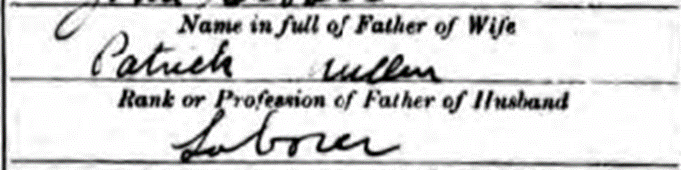
On Minnie Mullen and John Sloan’s marriage certificate, PJ’s occupation is listed as Labourer.
These records reflect the fluidity of late-life occupations for immigrants in early 20th-century Canada, especially widowers with grown children. PJ may have formally retired from teaching and taken on labor or farming work either for income, to stay busy, or to cover lodging. Differences in occupation across documents suggest that family members may not have known his precise employment history, or that PJ’s own work evolved over time.
June 17, 2025, Update: The death certificate for Mary Anne (now spelled with an E) Laberge (nee Mullin), who died on February 10, 1949, in Sturgeon Falls, ON, has been found. She was born in Vinton, QC, to parents Patrick James (Irish) and Olive (Quebec), and had been living in Ontario for the last 60 years. It’s possible that PJ moved to Sturgeon Falls to live with her.
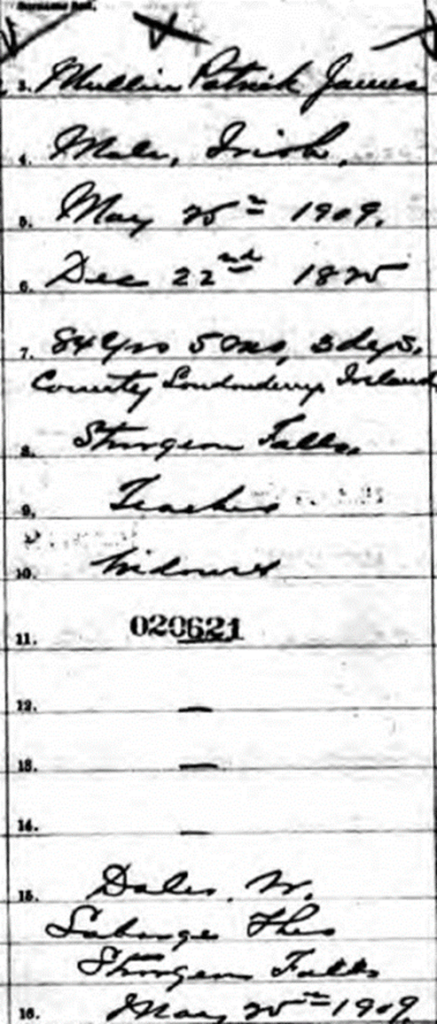
Death • 25 May 1909 • Sturgeon Falls, Ontario
- Age at Death: 84 years, 5 months, 3 days (DOB: Dec 22, 1825, County Londonderry, Ireland)
- Occupation at Death: Teacher (as per records)
- Marital Status: Widowed (spouse Olive Rancourt, deceased 1895)
- Attending Physician: Dr. Dales, last saw him alive on May 21, 1909
- Cause of Death: Chronic nephritis; immediate cause: cardiac failure and dropsy for 1 month
- Burial: May 27, 1909, Sacré-Coeur Parish Cemetery, Sturgeon Falls
- Raises questions: Who provided information to Dr. Dales? Was it one of his adult children or another local informant?

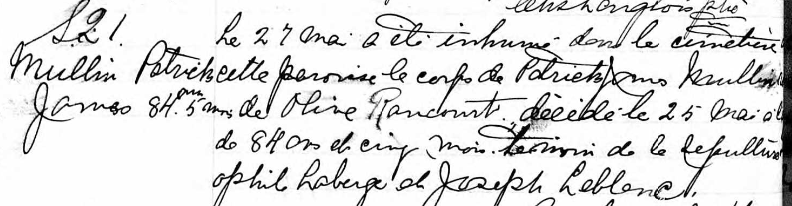
Burial • 27 May 1909 • Sacré Coeur Parish, Sturgeon Falls
- Patrick James Mullin – Le 27 mai a été inhumé dans le cimetière de cette paroisse le corps de Patrick James Mullin ép. d’Olive Rancourt, décédé le 25 mai âgé de 84 ans et cinq mois.
- English Translation: Patrick James Mullin – On May 27 was interred in the cemetery of this parish the body of Patrick James Mullin, spouse of Olive Rancourt, who died on May 25, aged 84 years and five months.
1912 • Occupation Farmer?
On Angelina and Ambrose’s marriage certificate, occupation is listed as Farmer. See above notation for Minnie Mullen and John Sloan’s marriage certificate.
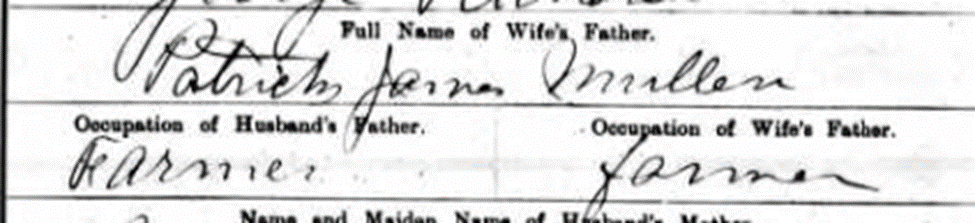
Angelina and Ambrose’s marriage certificate
We Hired a Genealogist in Ireland
At a certain point, we realized we had hit a brick wall. My cousin Mary Rowlands, Paul Podstawka, and I decided to hire a professional genealogist through Ulster Ancestry, hoping someone with local knowledge might uncover clues about PJ or his parents—Michael and Nancy (or possibly Mary).
After 20 hours of painstaking research, we hit dead ends. The genealogist combed through nearby church registers and Tithe Applotment Books, but there was no trace of our family. This strongly suggested that Michael and Nancy likely did not own land or property, which would have made tracking them in official records easier.
The sheer size of the task was staggering. County Londonderry alone has 52 Catholic parishes, and without a more precise birthplace, it was like searching for a needle in dozens of haystacks. PJ’s surname made things even trickier. In that region, Mullan is the usual spelling, while Mullen was rare, sometimes recorded by surveyors in the 1860s just as they heard it spoken. There are also variations like O’Mullan, O’Mullane, O’Mullen, Mullane, all tracing back to the Gaelic O’Madain, meaning “descendant of Maolain” or “monk.”
To make matters more complicated, the genealogist initially looked for Patrick Joseph (PJ) born in 1861—but that was actually the year he immigrated to Canada, not his birth. PJ was likely born around 1825. Michael, his father, was also elusive in the records, leaving us with frustratingly little to work with.
Even with professional help, we realized that piecing together PJ’s Irish past would require a combination of family stories, census data, church records, and local history. Sometimes, there just aren’t easy answers in genealogy—especially when names are common, spellings vary, and records are scarce. But every dead end taught us a little more about the life he left behind before starting anew in Canada.
I NEED TO LOOK AT THE MAILED REPORT HE SENT – THE DATES ABOVE ARE INCORRECT – he says he searched Michael born 1825, but it was Patrick who was born in 1825. He states that Patrick Joseph – not even his name it’s Patrick James and that he was born in 1861, I told him that was the year he immigrated to Canada!
MISC – STILL INVESTIGATING:
Can I see what was going on locally to get some idea? Are there local
records? Need to make a trek up that way – need to get in touch with the town historian prior.
Since we know PJ became a Teacher, I suspect I should be able to locate teaching records somewhere. Get some more details … where would I go for this? Maybe start with the genealogical society of the region? Where did he teach? Which school? Is this where he maybe met Olive? Was he, her teacher?
Mullen’s in Derry 1858-9 –> Mullen households in Derry (johngrenham.com)
Variants in Derry with total households:
McMullan: 11
McMullen: 72
McMullin: 7
Mullan: 51
Mullen: 220
Mullin: 27
Mullins: 38
O’Mullen: 3
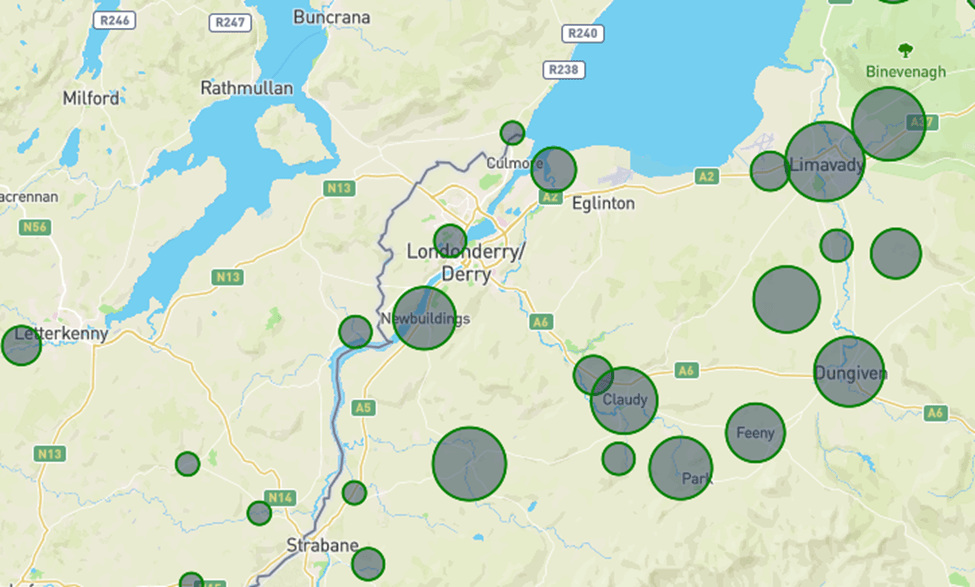
Mullen’s in Derry 1858-9



 My Tiny World Corner
Leave a comment