I had my heart set on finding the abandoned City of Paris Mine, also known as No. 7 Mine. Not Paris, France. Paris, British Columbia. Never heard of it? Neither had I—until I moved to Big White, BC, for the summer and started hunting my next urbex adventure.
The City of Paris Mine first began development in 1898, and by the end of 1900, the underground workings were already extensive:
- 5,214 feet of drifts and crosscut tunnels
- 702 feet of raises
- 387 feet of shafts
That’s a lot of underground digging for the turn of the century! The mine sits southeast of Greenwood, BC, at an elevation of roughly 4,521 feet (1,378 metres).
Despite hours of research, I found very little online about how to actually get there. Asking around Greenwood didn’t help much—some locals knew of it but had never visited; others had never heard of it at all. I was starting to wonder if I’d chase my own shadow up some forgotten ridge.
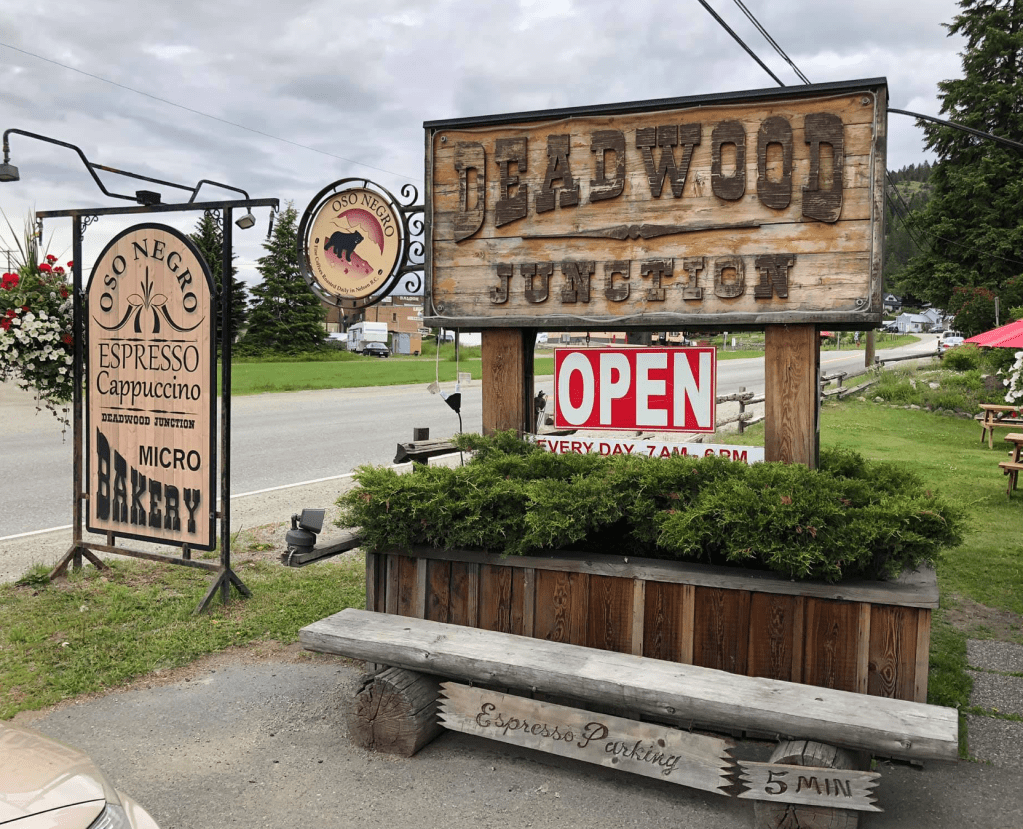
Then, luck intervened in the form of a barista at Deadwood Junction, where I was grabbing a coffee. She had been there the previous weekend and generously shared directions, one of those moments that make you love small towns and the people in them.
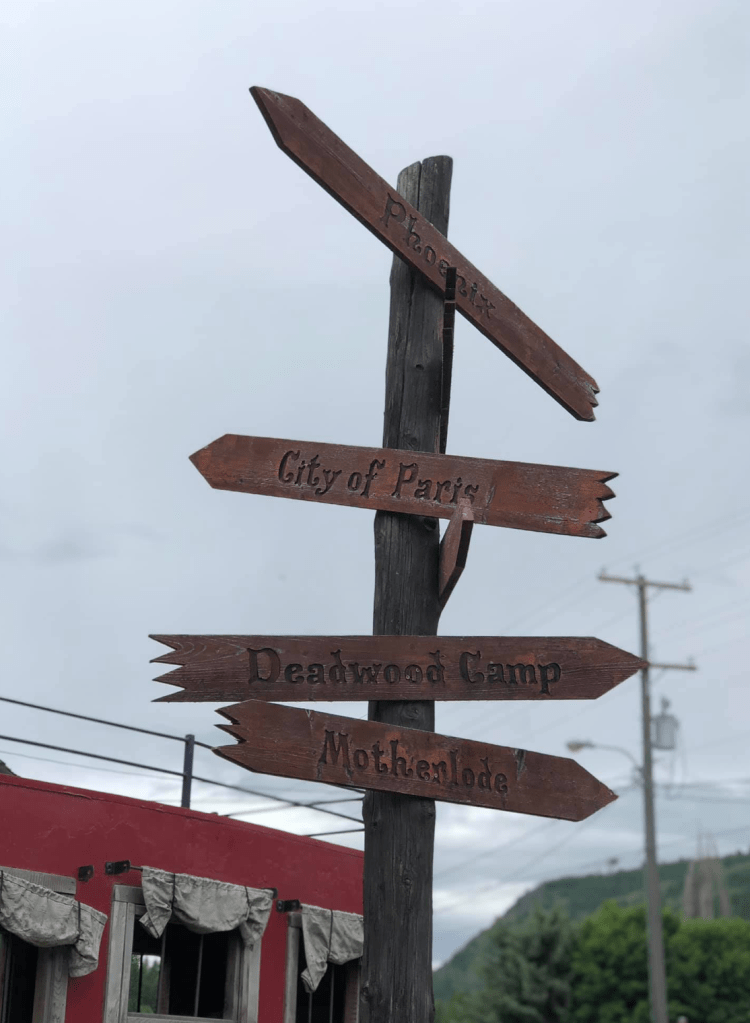
According to her, the No. 7 Mine sits on a ridge crest at roughly 1,370 metres elevation, about 3.3 km east of the confluence of McCarren and Gidon Creeks, and roughly 7.5 km southeast of Greenwood. To reach it, you travel 2.4 km uphill on a narrow, winding dirt road that branches from McCarren Creek Road. Not exactly the kind of road you want to tackle in a fragile, beaten-up Dodge Caravan on its last legs—but more on that later.
The mine once had an aerial tramway that transported ore from Paris down to the Greenwood/Anaconda smelter. That smelter has been abandoned for over a century, yet its remains are strikingly impressive, a testament to the industrial activity that once thrived here.
The journey in was … interesting, to put it mildly. The dirt road had grown over by mid-June, and our trusty Dodge Caravan was far from an off-road vehicle. My travel buddy made it clear he had no desire to be stranded in the middle of nowhere if the “beast” decided to give up. So, although I was eager to see the underground workings, we opted to explore just the tipple and its immediate surroundings. Even that hour spent wandering was enough to satisfy my curiosity—this place has a quiet, almost reverent kind of history.
Once we arrived at the tipple, I was immediately captivated. For being abandoned as long as it has been, the structure remains solid, its hand-sawn timber beams standing the test of time. This tipple had four chutes used to load ore into railroad hopper cars below.
What’s a Tipple, Anyway?
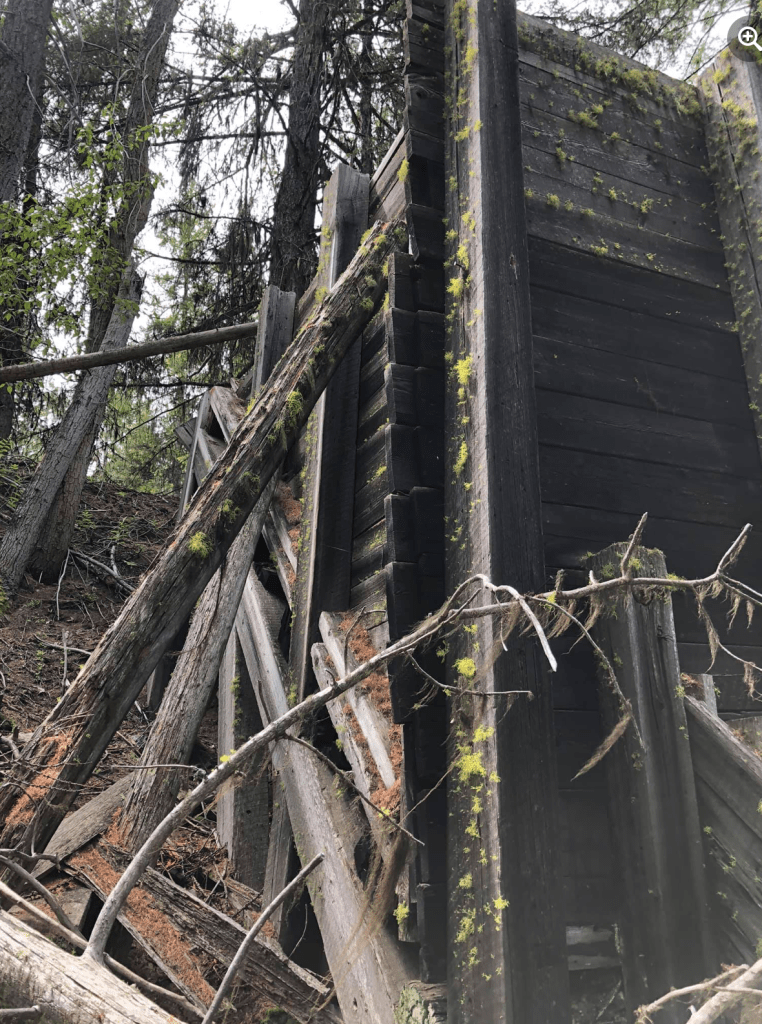

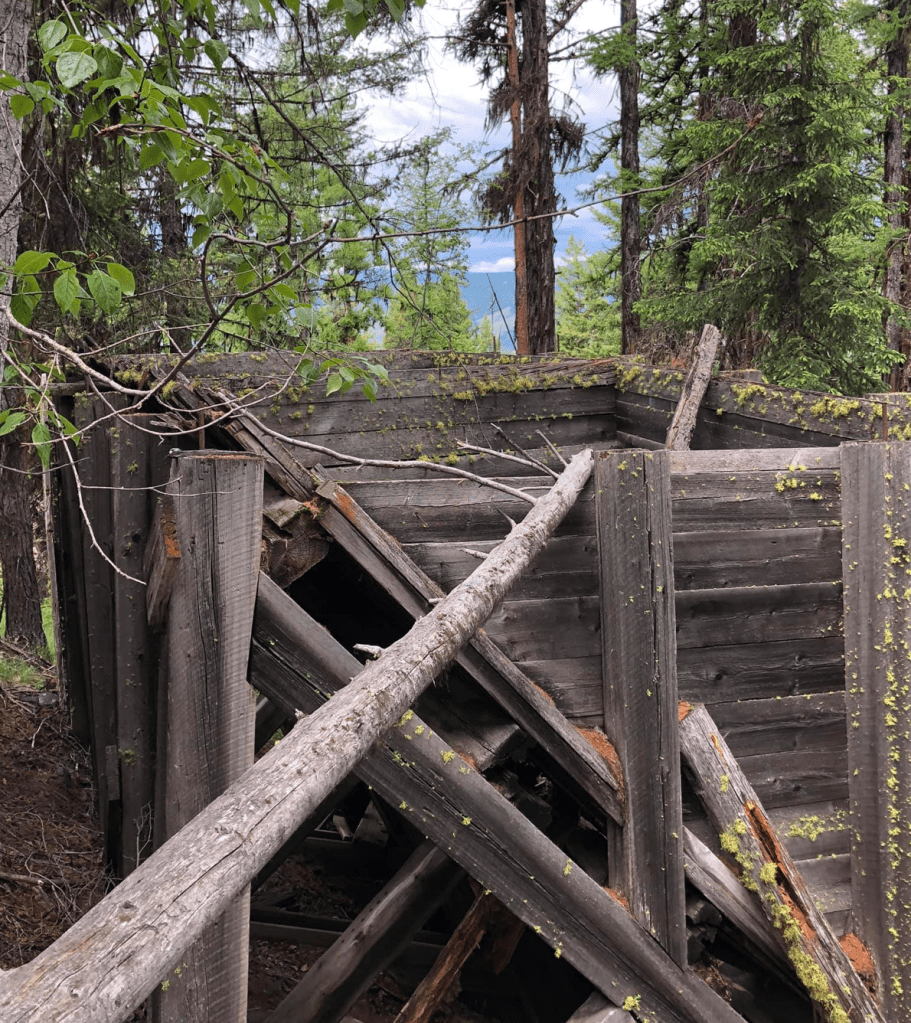
For those unfamiliar, a tipple is a structure used to load mined material for transport. In the early days, tipples worked with mine carts (also called tubs, tram cars, or mine cars) running on narrow-gauge rails. When a cart entered the upper level of the tipple, its contents were dumped—sometimes manually—through chutes into waiting railroad hopper cars below. That manual tipping process is where the term tipple comes from.
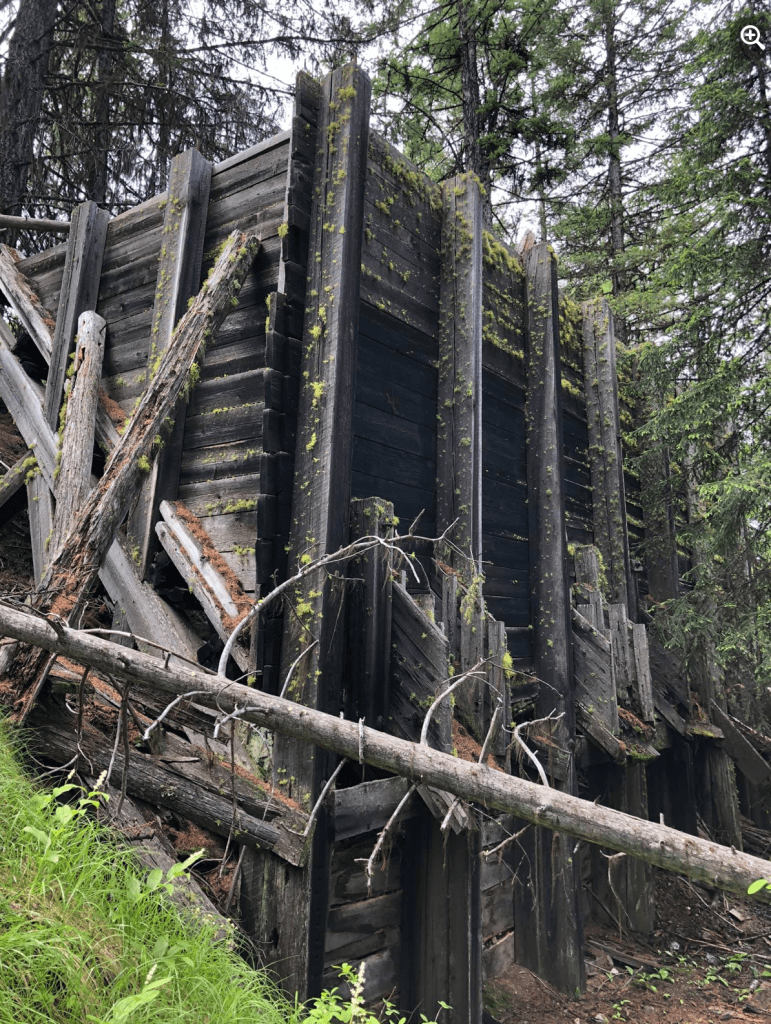
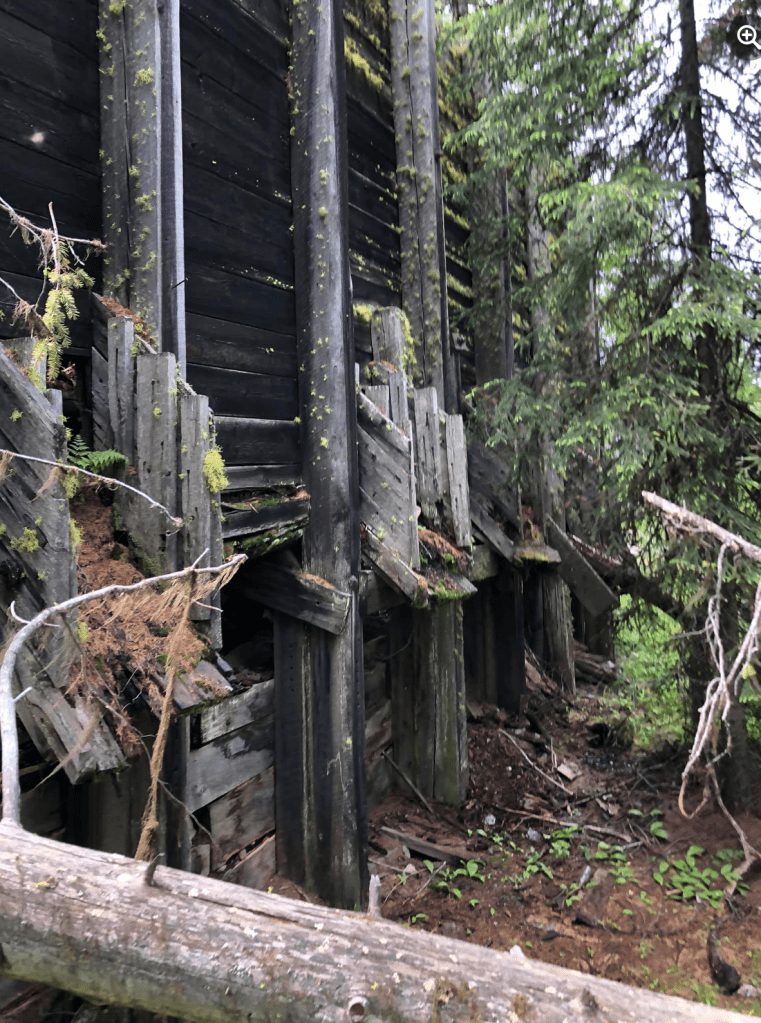
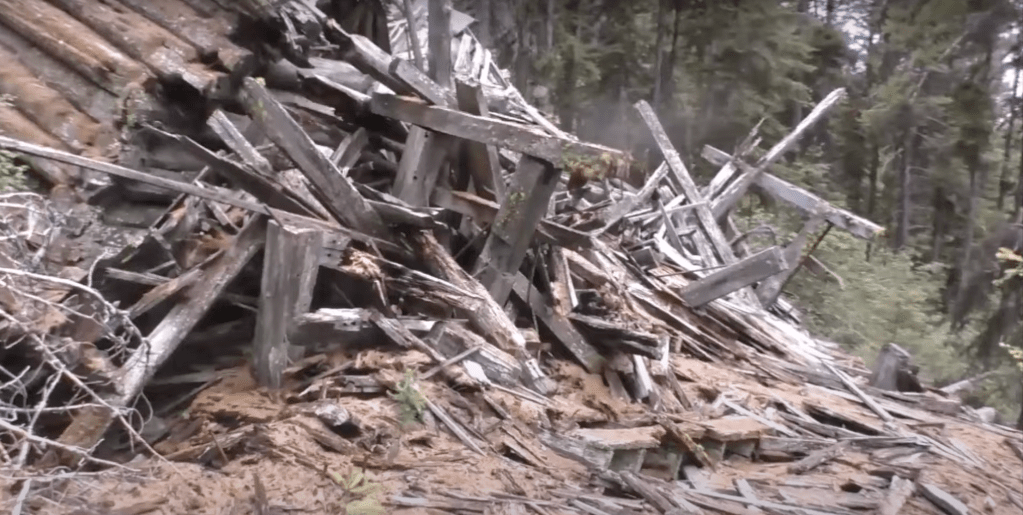
The video I watched to make me want to visit this awesome piece of history was posted by Exploring Abandoned Mines in July 2016.
I’ve taken a 41-second clip of his original 27:39-minute video relevant to the tipple. It remained relatively unchanged from when the video was recorded in 2016 to when I visited in June 2020, the exact same fallen tree trunk that was still present at the time of my visit.
Nearby, there were other structures, possibly a load-out facility or ore-handling platform. They hinted at the bustle this place must have had during peak operations.
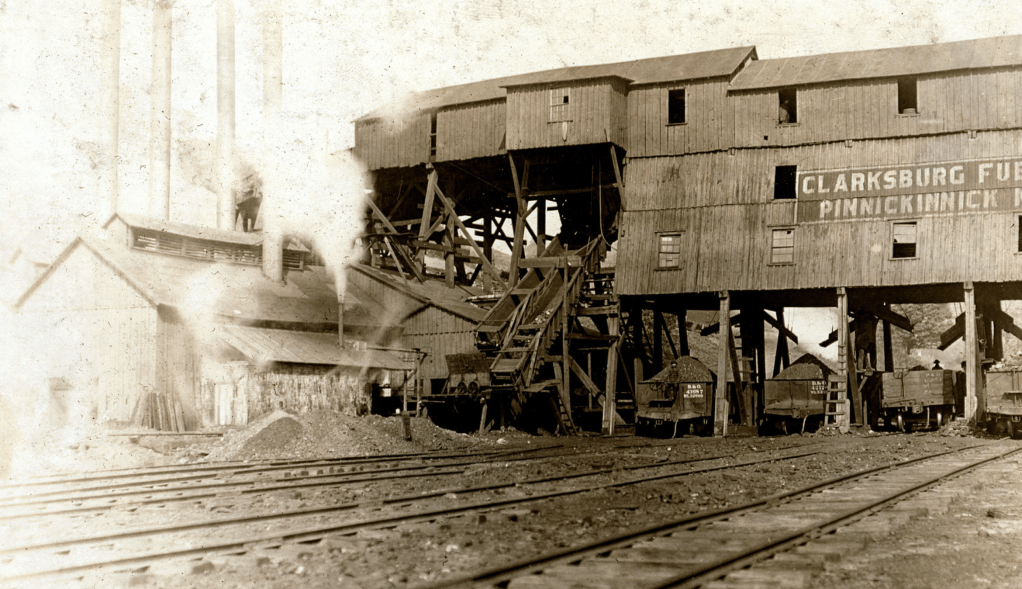
Unfortunately, I couldn’t locate any historic photos of the City of Paris Mine tipple itself. To give readers an idea, I’ve included an image of a 1908 American mining tipple, which closely resembles what still stands here today.
Between 1901 and 1945, the No. 7 Mine operated intermittently, producing a total of 13,748 tonnes of ore, which yielded:
- 92.4 kg of gold
- 3,110 kg of silver
- 97 tonnes of lead
- 6.2 tonnes of zinc
Impressive numbers for a remote mountain mine. The site’s history is tangible in every beam, chute, and remaining timber.
Even though we couldn’t push further up the mountain to the underground workings, my time at the tipple was mesmerizing. Part of what I love about exploring abandoned places is the research and history that come with them. You have to dig, read, and piece together the story—then walk through it in real life. Standing there, imagining the miners hauling ore, the carts rattling along rails, the aerial tramway humming as it carried ore down to the smelter—I felt like I was in the middle of history itself.
It’s adventures like this that make urbex more than just an adrenaline hobby. For me, it’s history, mystery, and a connection to the past, all wrapped into one unforgettable experience. Best hobby ever.
Interested in more of my urbex adventures?
- Check out my exploration of the well-known, eccentric Pastor Lee House! The follow-up to that blog tracking them in Dauphin, MB, is here.
- How about the time I explored the now-closed Schneider’s plant in Kitchener, ON?
- How about the time I explored an abandoned farmhouse with plastic murder curtains and a penis drawn on it?
- There’s the time that I explored an abandoned hotel up near North Bay, ON
- Can’t forget about the time I explored an abandoned strawberry farm and found a set of 4 deer hoofs and a dead bird in the antique wood stove.
There are plenty more Urbex blogs for you to enjoy on my site, too!


 My Tiny World Corner
Leave a comment