I’ve always suspected some Scottish blood in my veins. After all, two of my 2x great-grandparents were McKenzies and Leckies. Recently, Ancestry updated my DNA estimates: 21% Scottish! This confirmation sparked a renewed interest in documenting my Scottish lineage.
Scotland, in the northern third of Great Britain and historically extending to Brittany, France, is celebrated for its natural beauty, medieval architecture, folklore, and rich language traditions—Gaelic and Scots. Its national symbols—the Lion Rampant, clan tartans, and bagpipes—are recognized worldwide, along with traditional cuisine like whisky and haggis. I am proud to trace my roots to this remarkable country and deeply grateful to my ancestors for their perseverance, which allows me the life I enjoy today.
ORIGINATING SCOTTS
There are two originating lines of Scottish ancestry in my family:
1. The Leckies
2. The McKenzies
Genealogically, I was able to reach one generation further back on the Leckie side. Both lines intersect in Lanark County, Ontario, before branching into Renfrew County and eventually Northern Ontario.
THE LECKIE’S
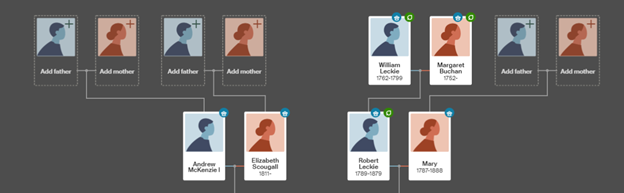
WILLIAM LECKIE and MARGARET BUCHAN
My journey into my family history takes me back to Lanark, Scotland, where my 5x great-grandparents, William Leckie (1762-1799) and Margaret Buchan (1752-?) lived in the late 18th century. While records about them are sparse, their story connects directly to the larger history of the Leckie Clan, a proud Lowland Scottish family that traces its roots to Lanarkshire, near Govan.
Govan was a historically important parish and industrial area in Scotland, known for its farming communities and later, its shipbuilding and textile trades. William and Margaret would have grown up during a period of both agricultural and early industrial change in the region, likely shaping the traditions, skills, and resilience that would be passed down through the Leckie family line. This region later became incorporated into the city of Glasgow.
The surname Leckie likely derives from the Gaelic Mac Leac, meaning “son of the flagstone,” a name that hints at the family’s connection to the land and its enduring presence in the region. In the 1700s, Lanarkshire was a mix of fertile farmland, small settlements, and early industry, so William and Margaret would have been part of a community that balanced rural life with growing economic and social networks.
The Leckie Clan itself may not have had the high-profile battles or castles of the Highlands, but its significance lies in its enduring presence and the values it carried—community, perseverance, and adaptability. These same traits can be seen in my Canadian ancestors as they navigated the challenges of pioneering life in Ontario, ultimately creating a legacy that stretches to the present day.
Though we don’t know precisely where in Govan or Lanarkshire William and Margaret lived, it’s easy to imagine them tending land, raising children, and participating in the rhythms of 18th-century Scottish life. Their legacy would eventually travel across the Atlantic, laying the foundations for families like the McKenzies who would intermarry with the Leckies in Ontario.
They had a son named …
ROBERT LECKIE and MARY HORN
**Immigrating Ancestor**
ROBERT LECKIE was born on 28 May 1792 in Govan, Glasgow, Scotland, while MARY HORN was born 30 October 1786 in Kincardine, Highland, Scotland, daughter of ALEX HORN.
They married in Glasgow on 1 November 1823 and immigrated to Canada around 1825–1826, settling in Ramsay Township, Lanark County, Ontario. At the time, Robert was in his early 30s and Mary nearly 40—a bold move for mature adults leaving everything familiar for the Canadian wilderness.
The Leckies were among the earliest settlers of Ramsay Township. They carved a farm out of the dense forest on the 7th line, which they worked for nearly six decades. This land later became home to their grandson, Robert McKenzie, linking the Leckie and McKenzie families in Ontario.
Census Records:
- 1871: Robert (82) and Mary (84) living with Robert McKenzie (33), Elizabeth McKenzie (35), and children Mary (11), Sarah (9), Andrew (5), and Robert (1).
- 1881: Mary (95) living with Robert McKenzie (44), Elizabeth (44), and children Mary (21), Sarah (19), Andrew (15), Robert (11), and Agnes (7). The family was affiliated with the Presbyterian Church.
Mary became renowned for her extraordinary longevity, passing away at 101 years and 3 months on 31 January 1888. She was buried in Auld Kirk Cemetery, Ramsay, Lanark County, Ontario (Range B, Plot 178). Her obituary in the Almonte Gazette celebrated her life in vivid detail:
“Mrs. Mary Leckie – the lady in Ramsay who attained local fame on account of her remarkable longevity – had succumbed to the grim visitor, death… She had thus attained the patriarchal age of 101 years and 3 months and had the pleasure a few weeks ago of seeing a descendant of the fifth generation – her great-great-grandchild – an extremely unusual occurrence. Mrs. Leckie was favoured beyond the ordinary lot of humanity. She was remarkable not only for the length of her days upon the earth, but also for the preservation and healthy activity of her physical, mental, and social powers almost to the last hour of her life… She had ever been happy in the possession of a simple and trusting faith in God, with Whom she lived in communion to the end of her days, drawing out cheerfully and hopefully her marvelously lengthened pilgrimage.”
Robert Leckie died on his 87th birthday, 28 May 1879, and was buried alongside Mary at Auld Kirk Cemetery.
Together, Robert and Mary embody the courage, resilience, and pioneering spirit of Scottish settlers in Ontario. Leaving Scotland as mature adults, they established a farm, raised a family, and contributed to the early development of Ramsay Township.
THE MCKENZIE’S
ANDREW MCKENZIE I and ELIZABETH (SCOUGALL?)
Andrew McKenzie I was born in Scotland (exact date unknown) and married Elizabeth, believed to be Elizabeth Scougal, born around 1811 in Scotland. Evidence for her surname comes from secondary records, but no primary birth or marriage record h been found.
Scougall is an unusual name and is of early medieval Scottish origin, and is a locational surname derived from the place called Scoughall in the old parish of Tyninghame, on the coast near North Berwick. Also spelled Scougal.
We do not yet know whether Andrew I and Elizabeth immigrated to Canada, or if it was their son, Andrew II, who made the journey. The most plausible explanation is that Andrew II immigrated to Canada on his own, before 1836, establishing the McKenzie line in Lanark County, Ontario.
THE LECKIES’ and MCKENZIES’ MERGE
ANDREW MCKENZIE II married AGNES LECKIE
Andrew McKenzie II, son of Andrew McKenzie I and Elizabeth, was born around 1810–1811 in Scotland. While the exact location in Scotland is unknown, we can estimate his birth year based on records later in life: his marriage certificate to his second wife, Janet Greville Toshack, dated January 8, 1877, lists him as 66 years old, and the 1891 Canadian census lists him as 71, placing his birth around 1810. The small discrepancies likely reflect differences between the month of his marriage and the month the census was taken.
Andrew immigrated to Canada before 1836, because that is when he first appears in Ontario for his marriage. He became one of the early settlers in Lanark County, Ontario — his obituary in the Perth Courier notably refers to him as “another old settler had gone to rest,” confirming that he was one of the original settlers in Lanark County, Ontario.
Marriage to Agnes Leckie
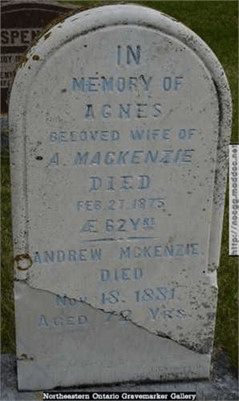
On 21 October 1836, Andrew married Agnes Leckie in Ramsay Township, Ontario. At the time, he was about 26 years old, and Agnes was approximately 23. Agnes was born around 1813 in Scotland. She passed away on 27 February 1875 in Pembroke, Renfrew County, Ontario.
The couple had eight children:
- Robert (1837–1875)
- Andrew (b. 1845; death unknown)
- William (1847–1920)
- Alexander (1850–1910)
- Agnes (1850–1921)
- Georgina (b. 1850; death unknown)
- Cecelia (1852–1921) – married George Richards
- Mary-Anne (b. 1854; death unknown)
Land records confirm that Andrew and Agnes were substantial landholders; on September 9, 1859, they were recorded as owning all of Lot 27, Seventh Concession, in Ramsay Township.
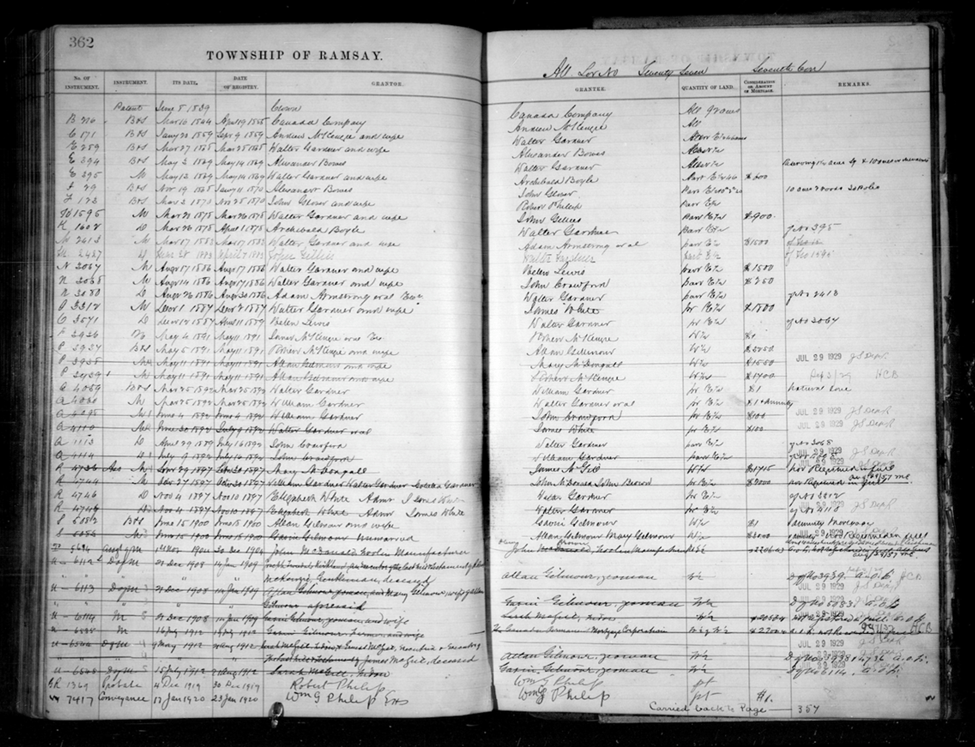
From the Library and Archives, I know that the 1861 census started on 14 Jan 1861, for Canada East and for Canada West. I locate them on the 1861 census. They’re living in Admaston, Renfrew County, Ontario. They are noted as being from the Free Church. He is a farmer and reside in a log house.

In the 1871 census, the family is again found in Admaston Township, still in Renfrew County. They are recorded as Presbyterian, reflecting the broader integration of Free Church congregations into the Presbyterian Church of Canada. Andrew was 60 and Agnes 57. Living with them were several of their children: Andrew III (22), Agnes (20), Cecelia (19), Mary Anne (17), and Mary (4, likely a granddaughter). Andrew continued farming.
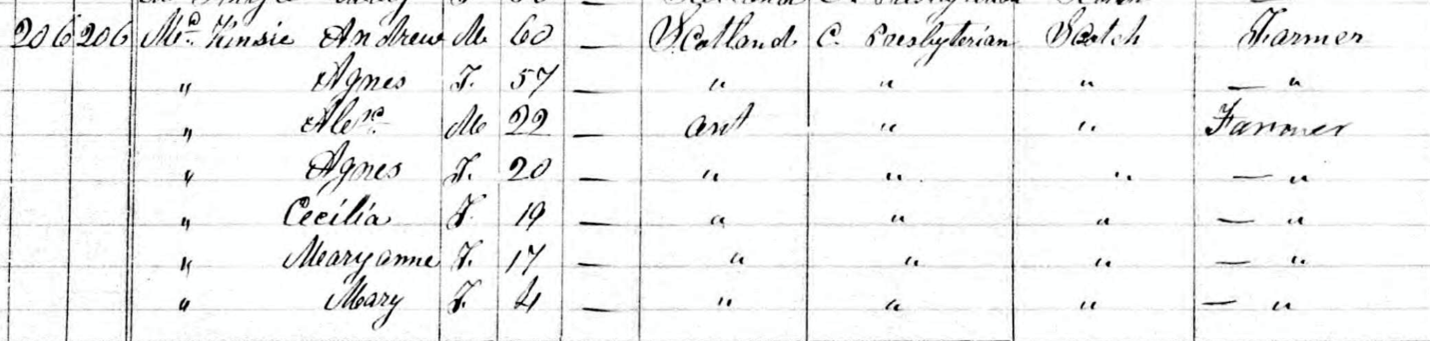
Agnes passed away on February 27, 1875, in Pembroke, Renfrew County, Ontario, leaving Andrew a widower at the age of 64 (why did she die in Pembroke?)
After Agnes passed Andrew then married JANET GRENVILLE TOSHACK on 08 Jan 1877 in Almonte, Ontario. She was the daughter of William and Margaret. She was born about 1821. She died on 15 Nov 1893 in Ottawa, Ontario. Andrew was 66 and Janet was 50. Janet was from Ramsay, Ontario. The witnesses were Alexander Gray (Almonte) and James Snedden (Ramsay). She came from a prominent pioneering family; the Toshacks were involved in local industry, including operating a carding mill on the Indian River, and were early settlers who contributed significantly to the development of Lanark County. Prior to marrying Andrew, Janet had been married previously to Mr. Grenville, a notable figure in the region, highlighting her social prominence. The marriage was witnessed by Alexander Gray of Almonte and James Snedden of Ramsay, both of whom were prominent members of their respective communities. James Snedden came from one of the founding families of Ramsay Township and was involved in early land development, timber, and milling. Their presence highlights the social importance of Andrew and Janet’s union among the pioneering families of the area.
From the Perth Courier, Jan. 19, 1877: McKenzie – Toshack – Married, on the 8th inst., by Rev. Robert Knowles, Mr. Andrew McKenzie of Renfrew to Mrs. Grenville Toshack of Ramsay.
From 1881 census, Ontario, Lanark North, Almonte:
- McKenzie, Andrew male – 71 – Scotland – C. Presbyterian – Retired Farmer – married
- McKenzie, Janet female – 57 – Scotland – C. Presbyterian – married
Later that same year, on 16 Oct 1881, Andrew passed away at the age of 72. His death registration states that he died of lung congestion (likely pneumonia) and suffered from it for at least 10 weeks. His death was reported by R. McKenzie assuming his son, Robert (who was a Farmer). Robert reported that his father was a “Bookseller”. Presbyterian.
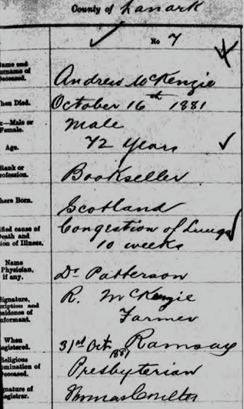
Andrew continued his work as a colporteur, a peddler of devotional literature, ministering to isolated settlers in the Ottawa Valley. His obituary in the Almonte Gazette (October 28, 1881) recalls:
“Another old settler has gone to his last rest. Mr. Andrew McKenzie died of congestion of the lungs at his residence in Almonte on the 17th Oct. 1881, aged 72 years. Mr. McKenzie was for over twenty years a colporteur in the service of the Ottawa Valley Branch Bible Society. In the wintertime he visited the shanties in the Ottawa Valley, selling bibles to the shanty men, and speaking to them of Him who came to seek and save the lost. Dreary and long were the journeys he often took, and many were the hardships he endured, and the dangers he escaped as he passed from shanty to shanty. But his work is done, and we doubt not but he has received his Master’s approval, “Well done, good and faithful servant.” “Blessed are the dead who die in the Lord from henceforth; yea, saith the Lord, that they may rest from their labors; and their works do follow them.”
The Renfrew Mercury (Friday, October 21, 1881) adds:
DEAD – The corpse of Mr. A. Mackenzie, the colporteur, a former resident of Renfrew, was taken through the village on Tuesday, from Almonte, for interment in Admaston.
CECILIA MCKENZIE and GEORGE RICHARDS
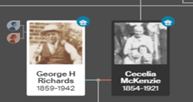
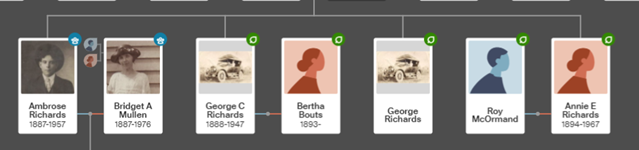
Andrew and Agnes had a daughter named CECILIA MCKENZIE who was born on 09 Dec 1851. She married GEORGE RICHARDS in 1886 in Mattawa, Ontario. George was born on 26 July 1859 in Eardley Township, Quebec, to Ambrose Abraham Richards and Olive Moore. His heritage was Scottish, and his family carried a rich history, with connections to early American colonial lines through his mother’s side. George worked as a farmer and was Presbyterian, a faith that remained central throughout his life.
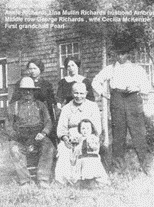
George’s first marriage was to Rosey born around 1862 in Ireland. She appears in the 1881 census, living with George in Unorganized Territory, Renfrew North, District 114, Division 5 (now part of the Mattawa area), where George, 23, is listed as a farmer. Rosey was 19 and also Presbyterian. Tragically, Rosey died young on 15 July 1882, likely during childbirth, as her gravestone notes her age as 19 and the death of an infant son on the same date. She was buried at Pinehill Union Cemetery in Mattawa, Nipissing District, Ontario.
The very next entry on this census is the family of Donald and Agnes Fraser. We find CECELIA MCKENZIE living there, with her sister Agnes – showing she was living in close proximity to George. It is likely that George and Cecelia knew one another for years before marrying, forming a connection within their Scottish Canadian community. In the 1881 census, Cecelia, 29, is listed as a seamstress.
George and Cecelia marry on April 11, 1888, in Mattawa, Ontario. Their son, Ambrose Richards was born in 1887 (according to his baptismal certificate).
Cecelia passed away on 12 September 1921 from “general paralysis.” While a death certificate has not been located, census records and family knowledge confirm her death.
In the 1901 census, I can locate them at the township of Papineau is a municipal township in northeastern Ontario, Canada, in Nipissing District. The township is located on the south side of the Mattawa and Ottawa Rivers along Highway 17.
George lived on until 26 April 1942, dying of a cerebral hemorrhage at the age of 82 years, 9 months, and 1 day. He had retired in 1929 after 50 years as a farmer and had been hemiplegic prior to his death.

Interestingly, George’s daughter, Mrs. Roy McOrmand, was unable to provide full details about her father’s lineage when asked. She listed his parents as “? Richards (born in France) and ? Moore (born in Canada).” While incomplete, she was correct that Olive Moore, George’s grandmother, was born in Canada. This line traces back to early American settlers, reflecting a rich historical background.
To see more on this line and these interesting finds, check out these blogs:
On Genealogy: My Connection to President Lincoln

On Genealogy: My Salem Witch Trial Connection

On Genealogy: Whipped for Baptist Beliefs - My Connection to Rev. Obadiah Holmes

On Genealogy: Say What? I'm Connected to Amelia Earhart!

On Genealogy: MY Relation to Ezra CORNELL - Founder of Cornell University
AMBROSE RICHARDS and BRIDGET ANGELINA MULLEN
AMBROSE RICHARDS was born 12 December 1887 in Mattawa, Ontario, the son of George Richards and Cecelia McKenzie. His birth date is confirmed through his baptismal certificate, which remains the most reliable primary source. He spent his entire life in the Mattawa region and died there in 1957, becoming part of the long, interwoven history of the French, Irish, and Scottish families of the Upper Ottawa Valley.
In the 1911 Census, Ambrose appears as a single young man still living with his parents:
- Residence: Township of Papineau, Nipissing
- Heritage: Listed as Irish (though both parents were Scottish through the Richards/McKenzie lines — this “Irish” notation is likely a census taker error or reflects local usage)
- Religion: Presbyterian
- Occupation: Labourer / Farmer’s son
This census places him in the rural farming and lumbering areas surrounding Mattawa and establishes that he had not yet relocated to Sturgeon Falls.
One of the most striking details in their story is that Ambrose chose to convert from Presbyterianism to Roman Catholicism specifically to marry Lina—a deeply meaningful act in mixed-faith marriages of that era. Godparents: Denis Leaghy & Mary Brown. Just 10 days before marriage — a significant cultural detail showing the influence of Irish Catholic marriage traditions.
He married BRIDGET ANGELINA “Lina” MULLEN on 20 November 1912 at Sacré Coeur Parish, Sturgeon Falls, Nipissing, Ontario. Lina was born 3 January 1887 in Vinton, Québec, a deeply Irish Catholic community in Pontiac County.
Between 1912 and the mid-1920s, Ambrose worked steadily in the growing industrial and lumber economy of Sturgeon Falls.
On 10 February 1916, Ambrose’s occupation is listed as pipe fitter on the birth registration for his son Benjamin (Benny). This places him in skilled industrial work several years before the railway and pulp industry boom accelerated.
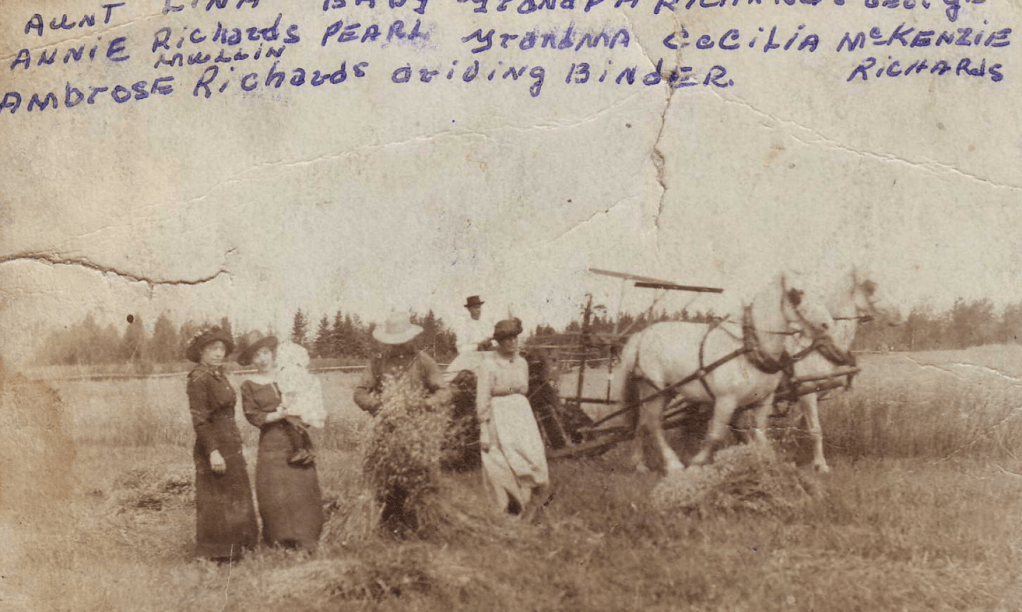
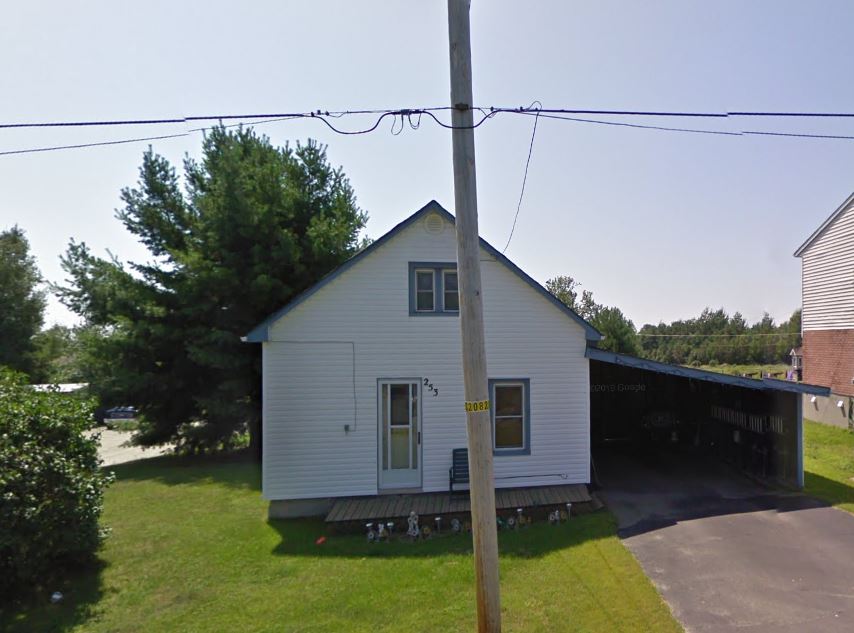
By 1 June 1921, Ambrose and Lina are documented at: 253 Cache Bay Road, Sturgeon Falls, Nipissing County, Ontario. Household included multiple children. Ambrose still working for Abitibi Power & Paper Company, an important employer in the region. Family identified as Roman Catholic This location places them firmly in the early industrial and mill-worker community of Cache Bay.
According to Lina’s obituary, the family moved to Temiscaming in 1928. This aligns perfectly with the expansion of the Canadian International Paper Company (CIP), which recruited heavily from Northern Ontario communities. The move indicates Ambrose’s transition into more stable and specialized mill employment.
By 1931, Ambrose and Lina were well-established. 306 Hill Street, Temiscaming. Working-class mill families commonly lived here. Semi-detached house. Ambrose’s Occupation: Sulphite Cook at the pulp mill (CIP). Annual earnings: $2,695 — a good industrial wage at the time. A skilled, technical position.
Other Notable 1931 Facts: Children at home included: Pearl, Benny, Vera, Carmel, and Gordon. Family owned a radio, a sign of social progress and stability. Mother tongue listed as French (likely reflecting daily use in the bilingual mill town). All family members could read and write.
Ambrose’s Death
- 1957, Verdun Hospital, Verdun, Montréal region, Québec
- Age: 69
- Burial: St. Anne’s Catholic Cemetery, Mattawa, Ontario
- Funeral: Held at St. Anne’s Roman Catholic Church, Mattawa
- Obituary: North Bay Nugget, March 7, 1957
This obituary links him back to Mattawa and confirms the continuity of the Richards line in the Ottawa Valley.
Lina’s Death
- Was living on Ketchen Street, Temiscaming, Québec – typical residential area occupied by longtime mill families.
- 10 April 1976, North Bay, Ontario
- Age: 87
- After a lengthy illness
- Funeral: 13 April 1976
- Burial: St. Anne’s Cemetery, Mattawa (with Ambrose)
Obituary Highlights
- Active parishioner of St. Theresa’s Church
- Member of the Golden Age Club
- Survived by:
- 30 grandchildren
- 42 great-grandchildren
Her obituary confirms her strong community presence and longevity.
BENJAMIN GEORGE RICHARDS and SARAH ANN LEE
BENJAMIN GEORGE RICHARDS (B: Feb 10, 1916 – Sturgeon Falls Ontario, D: June 17, 1977 –Montréal, Québec) m. SARAH ANN LEE (B: Dec 7, 1922 – Meltham Mills, Yorkshire England, D: March 1993 – Verdun, Quebec)
For more info you can refer to my blogs on my LEE family from England or read more about my great Uncle Private George Lee who was killed in action in Flanders in WWII.
You can also read more about my grandpa WWII, Private Benjamin Richards for details about his life in WWII and their life in Témiscaming, Québec.
Owning a Piece of Land in Scotland
Exploring my Scottish roots recently sparked a deep desire to connect with the land of my ancestors—and what better way than to actually own a piece of it?
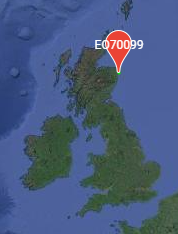
This Christmas, I purchased one square foot of dedicated land on a private estate in Ardallie, Aberdeenshire, Scotland—for my eldest and me. Each of us now owns our own square foot. My intention was simple: to hold a tangible piece of my ancestral heritage and to help preserve and protect Scotland’s beautiful woodland.
Each plot has a unique plot number, and we are the official title holders, complete with a certificate to prove it. The plots are recognized as “souvenir plots”—while typically too small to be registered with the Scottish Land Registry, the company I purchased through maintains meticulous private records and works closely with the estate’s Lords and Ladies to ensure everything is handled properly.
The title packs are inspired by a historic Scottish landownership custom, where landowners have long been called “Lairds” (the Scottish term for Lord) and “Ladies” for women. Most jurisdictions allow you to update your title if you choose. I haven’t done that yet—but I might start small… perhaps with my Costco card first 😉
Where’s my Plot?




 My Tiny World Corner
Leave a comment