
I’ve always thought I was special — a princess, you might say — and now I have a little weight behind it: my 24th great-grandfather was King Louis VIII of France. This discovery has set my whole genealogical journey on a wild new path, linking me all the way back to the Plantagenets, the royal dynasty that ruled England for over 300 years.
I stumbled across this discovery following a line on my father’s paternal side, down the Rancourts (see full lineage below). I was tracing back my great-grandmother Angelina Mullen’s line, and somehow, almost magically, I ended up at Louis VIII — bypassing generations of European royalty. I honestly don’t even remember how I got there, but the feeling of awe was immediate.
Who Was King Louis VIII?
Louis VIII, also known as Louis the Lion (Louis VIII le Lion) (5 September 1187 – 8 November 1226), was King of France for just three short years, from 1223 to 1226. He was born in Paris, the son of King Philip II of France and Isabelle of Hainaut, inheriting the County of Artois from his mother — a young man born into wealth, power, and extraordinary expectations.
Louis was heir to Philip II, a king famed for extending royal influence across France. Even as a frail yet competent prince, Louis played a role in shaping French politics and expanding the crown’s reach.
Marriage and Blanche of Castile
In the summer of 1195, a marriage was proposed between Louis and Eleanor of Brittany, the niece of Richard I of England, to form an alliance between Philip II and Richard. It failed, reportedly opposed by Holy Roman Emperor Henry VI, which also influenced the English succession: Richard eventually named his brother John heir rather than Eleanor’s younger brother Arthur of Brittany.
On 23 May 1200, Louis, then thirteen, married Blanche of Castile, who was only twelve. Blanche was the daughter of King Alfonso VIII of Castile and Eleanor of England, niece of Richard the Lionheart and King John of England. Born on 4 March 1188 in Palencia, Castile, Blanche had extraordinary lineage: her grandfather was Henry II of England, her grandmother Eleanor of Aquitaine, and her uncle John I of England.
In 1215, King John of England was forced to sign the Magna Carta, a landmark document declaring that the king was not above the law and protecting the rights of the people. Today, it is celebrated as one of the foundations of modern democracy. But even after this concession, the English barons remained wary. They feared John might appeal to Pope Innocent III to regain his lost power. When their fears grew, the barons took an extraordinary step: they rebelled in what became known as the First Barons’ War. England needed a strong, capable king — and they looked across the English Channel and found one in Louis VIII.
Louis was the son of Philip II of France, a direct descendant of William the Conqueror, and married to John’s niece. These connections gave him a legitimate, if not perfect, claim to the English throne. More importantly, he had the resources, the military skill, and the reputation of being just, honorable, and courageous — qualities that King John notoriously lacked.
On 14 June 1216, Louis captured Winchester, quickly gaining control of half of England. But fate intervened: in October 1216, King John died of dysentery, and many barons switched allegiance to John’s young son, Henry III, who was only nine years old.
With the Earl of Pembroke as regent, English forces rallied. Louis faced setbacks: he lost at the Battle of Lincoln on 20 May 1217, and his navy was defeated at the Battle of Sandwich on 24 August. Even his attempt to take Dover Castle failed. Eventually, Louis agreed to the Treaty of Lambeth, pledging never to attack England again. In exchange, he received an amnesty for his English supporters and 10,000 marks, formally recognizing that he had never been the legitimate king.
After this dramatic chapter in England, Louis returned to France. There, he dedicated himself to crusading for the Catholic cause, joining forces with Simon de Montfort against Raymond VI and VII of Toulouse and their Cathar followers. Over nearly a decade of battles, victories, and setbacks, Louis extended French royal authority into southern France. His crowning achievement during his brief reign was the conquest of Poitou, previously under English control — a testament to his skill as a leader and general.
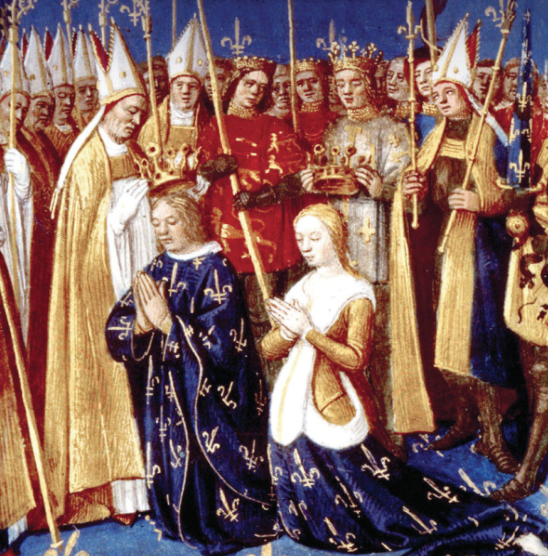
Louis VIII succeeded his father on 14 July 1223, with his coronation held at the cathedral in Reims on 6 August.
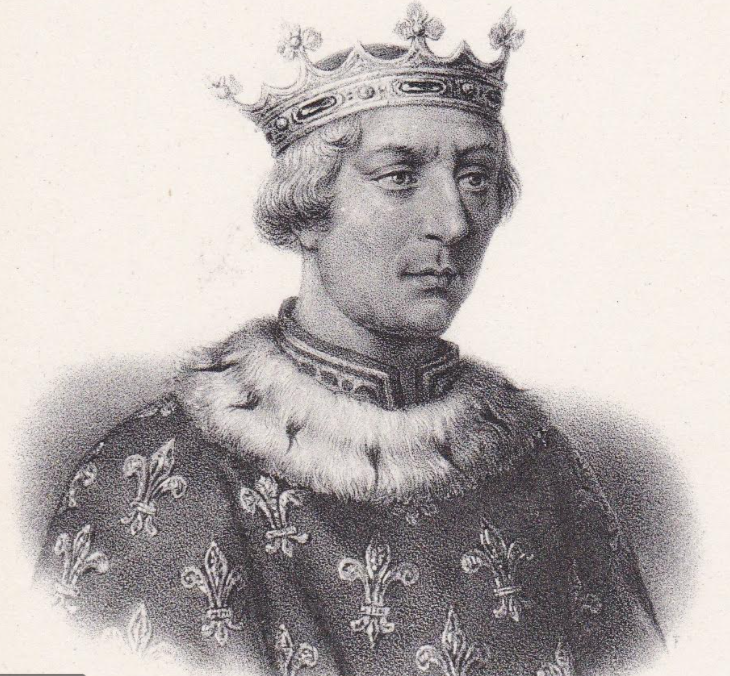
Sadly, his reign was cut short when he fell ill with dysentery and died on 8 November 1226 at Château de Montpensier in Auvergne. He was laid to rest in the Basilica of Saint-Denis, just north of Paris, and his son Louis IX succeeded him, with Queen Blanche completing the southern crusades in 1229.
LOUIS VIII, King of France (1187–1226)
│
└── Robert I, Count of Artois (1216–1250)
│
└── Robert II, Count of Artois (1250–1302)
│
└── Philip I, Count of Artois (1269–1298)
│
└── Marie of Artois (1291–?)
│
└── Marie of Namur (1322–1357)
│
└── Yolande de Bar (c.1343–c.1410)
│
└── Jeanne de Grancey (d.1422)
│
└── Marie de Châteauvillain (1380–1423)
│
└── Robert I de Sarrebruche
│
└── Jeanne de Sarrebruche (1436–1492)
│
└── François de Barbançon, Seigneur de La Ferté
│
└── Marguerite de Barbançon (1490–?)
│
└── François de Joyeuse (1507–1597)
│
└── Jean de Joyeuse (1540–?)
│
└── Louise de Joyeuse (1562–1616)
│
└── Antoinette de Longueval (1581–1639)
│
└── Anne Couvent (1601–1675)
│
└── Mathieu Amiot (1628–1688)
│
└── Catherine Ursule Amiot (1664–1715)
│
└── Marie-Françoise Duquet dit Desrochers (1699–1743)
│
└── Charles Alexandre Rancourt (1729–1774)
│
└── Louis Rancourt (1807–1847)
│
└── Olive Rancourt (1847–1895)
│
└── Bridget Angelina Mullen (1887–1976)
│
└── Benjamin George Richards (1916–1977)
│
└── Patrick James Richards (1954–2014)
│
└── ME
——————————————————————————————
Antoinette de Longueval married Guillaume Couvent before 1601, a man who was non‑armigerous and does not appear in surviving noble records. Because there are no detailed contemporary sources about Guillaume’s background, we don’t know his family’s status or why Antoinette chose (or was arranged) to marry him. It may have been for personal reasons, local alliances, or simply because her family’s circumstances changed during a turbulent period in French history. While this marriage marked the end of Antoinette’s direct line of titled nobility, her royal blood continued through her descendants — and eventually to me.
Louis VIII, King of France (1187–1226)
│
└── Robert I the Good, Count of Artois (1216–1250)
│
└── Blanche of Artois (1248–1302)
│
└── Henry of Lancaster → Joan of Lancaster → John de Mowbray → Eleanor Alianore de Mowbray
│
└── Thomas Welles → John Welles → Thomas Welles → Joane Stockley → Joan Griswold (Stockley)
│
└── Roger Griswold → William Griswold → Roger Griswold → George Griswold → Edward Griswold
│
└── Sarah Pinney → Sarah Moore → Jonathan Moore → Jedediah Moore → Dudley Moore, Sr. → Roger Moore
│
└── Olive Moore
│
└── George Howard Richards → Ambrose Richards → Benjamin George Richards → Patrick James Richards → ME
I also find it insanely interesting that my family lineage forms part of the world’s most renowned plays! To think that William Shakespeare’s play The Life and Death of King John has my actual 24x and 25x great-grandfathers.
I think it may be safe to say that The Life and Death of King John dramatizes the reign of John, King of England, the son of Henry II of England and Eleanor of Aquitaine, and father of Henry III of England.
My Family Tree of Characters in King John includes Blanche of Castile – John’s niece, King Philip II, King of France, and Louis, who is called Louis the Dauphin — ironically, I lived in Dauphin, Manitoba for 2 years.
Synopsis
King John of England faces a serious challenge when an ambassador from France arrives, demanding that he give up his throne in favor of his nephew Arthur, whom King Philip of France believes is the rightful heir.
Meanwhile, back in England, John resolves a land dispute between Robert Faulconbridge and his half-brother, Philip the Bastard, revealing Philip as the illegitimate son of King Richard I. Queen Eleanor, mother to both Richard and John, recognizes the family resemblance and suggests Philip trade his claim for knighthood. John knights him as Richard, setting the stage for future loyalty.
Tensions rise in France when King Philip besieges the English-controlled town of Angers. Austria, believed by many to have killed King Richard, supports Philip. English forces arrive, and Eleanor clashes with Arthur’s mother, Constance. Both kings present their claims to the citizens, but Angers refuses to take sides.
The armies fight, but neither wins decisively. To settle the conflict, Philip’s son, Louis the Dauphin, is married to John’s niece, Blanche. This strengthens John’s claim while giving Louis territory in France. Constance is furious at what she sees as Philip abandoning Arthur, but the marriage goes ahead.
Cardinal Pandolf arrives from Rome, excommunicating John for defying the Pope. He pledges his support to Louis, convincing King Philip to align with the Church’s interests. War breaks out: Austria is executed by the Bastard for his father’s death, and both Angers and Arthur fall to the English. Eleanor is left in charge of English territories in France, and the Bastard collects funds from monasteries. John orders Hubert to kill Arthur, but Hubert cannot carry it out.
Confusion and heartbreak follow: nobles urge John to release Arthur. Hubert announces Arthur is dead, leading nobles to defect to Louis’ side. Arthur ultimately dies jumping from a castle wall—whether accidental or deliberate remains uncertain. The nobles, believing John responsible, continue their rebellion. John attempts to make peace with Pandolf, but war continues.
The Bastard leads the English army against France. Battles rage on both sides with heavy losses, including Louis’ reinforcements drowned at sea. Some English nobles return to John’s side after learning of Louis’ ruthless plans. Eventually, John is poisoned by a disgruntled monk.
As John dies, his nobles swear allegiance to his son, Prince Henry. The Bastard reflects that England’s internal divisions proved as dangerous as foreign threats, teaching a hard lesson about loyalty, power, and the consequences of disunity.
——————————————————————————————
My mind is completely blown! Never in my wildest dreams did I imagine tracing my heritage back to a king—let alone a whole line of historically significant royals on both sides of the channel. My family is steeped in such rich history, spanning the courts of France and England, crusades, dynastic marriages, and legendary figures.
I cannot wait to dive deeper. There’s King Philip II, King Louis VIII, and the fascinating lineage of Blanche of Castile. And then there’s her extended family: King Alfonso VIII of Castile and Princess Eleanor Plantagenet of England. Eleanor’s grandfather was Henry II of England, her grandmother was Eleanor of Aquitaine, and her uncle was John I of England. The connections are staggering, and I feel like I’ve just opened a door into a world I never knew I had a direct link to.
(photo header: King John of England in battle with the Francs (left), Prince Louis VIII of France on the march (right). (British Library, Royal 16 G VI f. 385)



 My Tiny World Corner
Leave a comment