A while back, I published a blog titled On Genealogy: My Quaker Connection; Descendant of John Milk, British Colonial America, 1662, which traced my family line back to early colonial America. As I continued researching this branch, I suspected it would intersect with broader historical events—and it did. One of the earliest and most sobering discoveries was a direct family connection to the Salem Witch Trials.
Puritan Society and Belief: The World Behind the Trials
To understand the Salem Witch Trials and my family’s place within them, it is necessary to understand the society in which they occurred. In the late 17th century, the Massachusetts Bay Colony was governed by Puritan religious principles that shaped both civil law and daily life. Puritans believed salvation was predestined by God, and they viewed the world as a constant battleground between divine order and Satanic influence. Sin was not merely a personal failing; it was a communal threat.
Social conformity was essential. Deviations in behavior, belief, reputation, or religious observance, particularly among women, could raise suspicion. Women were expected to be pious, obedient, and centered on household order. Those who fell outside these expectations were more vulnerable to scrutiny, especially during periods of illness, social tension, or fear.
Puritan leaders believed the Devil could act directly in the world through witches, individuals who had allegedly entered into pacts with Satan. This belief underpinned both religious doctrine and legal practice, setting the stage for the events that unfolded in 1692–1693.
Religion, Law, and Spectral Evidence
Religion was inseparable from the legal system in Puritan New England. Courts relied not only on physical testimony but also on what was called spectral evidence, claims that the spirit or specter of an accused person appeared to torment or afflict someone, even when the accused was not physically present.
At the time, spectral evidence was considered admissible and credible. A person’s claim to have seen an apparition was sufficient to prompt arrest, examination, and imprisonment. As accusations multiplied, this practice accelerated the spread of hysteria and made it nearly impossible for the accused to defend themselves.
By late 1692, however, ministers such as Increase Mather and others began to publicly question the legitimacy of spectral evidence, arguing that it could not be reliably distinguished from illusion or deception. This shift in thinking contributed directly to the collapse of the trials.
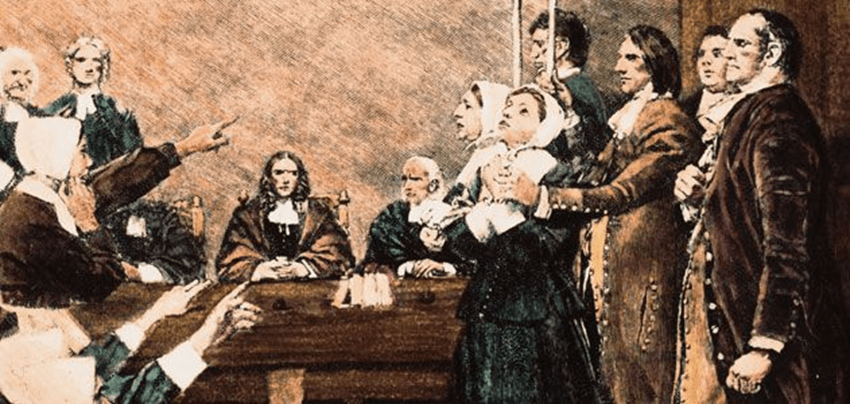
The Salem Witch Trials: February 1692 – May 1693
The Salem Witch Trials formally began in February 1692 and continued until May 1693. During that time, more than 150 individuals were accused of witchcraft across the Massachusetts Bay Colony, not only in Salem Village but also in surrounding towns such as Andover, Reading, Topsfield, and Wenham. Twenty people were executed, fourteen of them women.
While commonly remembered as a single episode centered in Salem, the trials were regional in scope. Accusations often arose from local disputes, longstanding tensions, or fear amplified by rumor. The legal machinery of the colony—magistrates, courts, juries—treated these accusations as matters of public safety and religious duty.
“He wondered at the atrocities humankind was capable of committing. The majority of those housed below were ill, mentally or physically, not witches. Most were poor victims—the outcasts of society, or the opposite, people so blessed, others coveted their lives.”
— Brynn Chapman, Where Bluebirds Fly
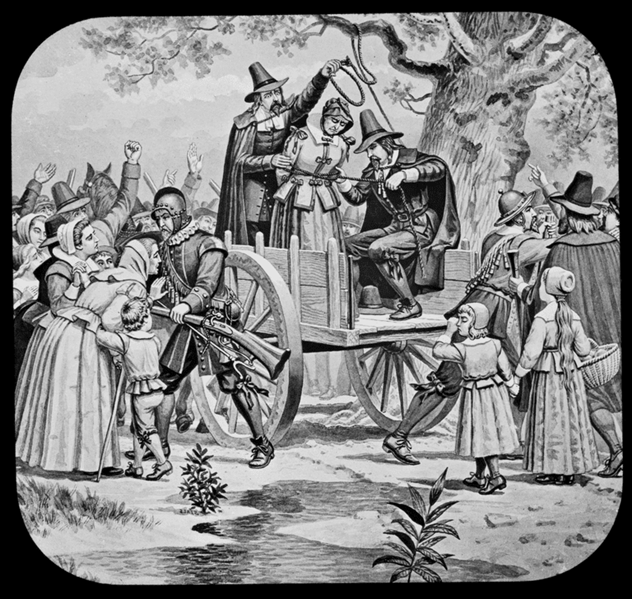
The Afflicted
The term “afflicted” refers to individuals who claimed to be tormented by witchcraft and whose testimony was used in examinations and trials. Not all afflicted persons accused others, and not all accusations resulted in convictions.
Afflicted individuals included:
Alice Booth — Unknown
Elizabeth Booth — Salem Village
Sarah Bridges — Andover
William Brage — Salem Town
Mary Brown — Reading
Sarah Churchill — Salem Village
Johanna Dod — Marblehead
John Doritch — Unknown
Mary Fitch — Gloucester
Rose Foster — Andover
Goodhall — Probably Salem Village
Benjamin Goodwin — Boston
John Goodwin Jr. — Boston
Martha Goodwin — Boston
Mercy Goodwin — Boston
Mary Herrick — Wenham
Mary Hill — Salem Town
Elizabeth Hubbard — Salem Village
John Indian — Salem Village
Elizabeth Knapp — Groton
Mary Lacey Jr. — Andover
Mercy Lewis — Salem Village
Mary Marshall — Reading
Abigail Martin — Andover
Elizabeth Parris — Salem Village
Hanna Perley — Topsfield
Sarah Phelps — Andover
Bethshaa Pope — Probably Salem Village
Ann Putnam Jr. — Salem Village
Ann Putnam Sr. — Salem Village
Margaret Rule — Boston
Susannah Sheldon — Salem Village
Mercy Short — Boston
Martha Sprague — Boxford
Tituba — Salem Village
Rebecca Towne — Topsfield
Peter Tufts’ maidservant — Charlestown
Sarah Vibber — Wenham
Mary Walcott — Salem Village
Mary Warren — Salem Village
Elizabeth Weston — Reading
Rebecca Wilkins — Salem Village
Abigail Williams — Salem Village
Note: Reading was an inland Middlesex County town, founded in 1644 by settlers who came overland from coastal communities. It was not geographically the same as Salem (a coastal Essex County town), where the witchcraft hysteria began, but accusations extended into towns like Reading during the trials.
The Afflicted: Elizabeth Weston
As I traced my family history further, I uncovered a direct connection to the Salem Witch Trials through my ancestor Elizabeth Weston of Reading, Massachusetts. Elizabeth was among those identified as afflicted during the trials. She was the daughter of John Weston, a well-established member of the Reading community.
Elizabeth accused Sarah Dustin, daughter of Lydia Dustin, of tormenting her through witchcraft. This accusation led to the arrest and examination of both Sarah and her mother in 1692, illustrating how local disputes and testimony could escalate into life-altering legal proceedings.
The Accused: Lydia and Sarah Dustin
Lydia Dustin and her daughter, Sarah Dustin, were residents of Reading. Sarah, an unmarried woman, was arrested and examined for allegedly afflicting Elizabeth Weston. The case against her proceeded to trial.
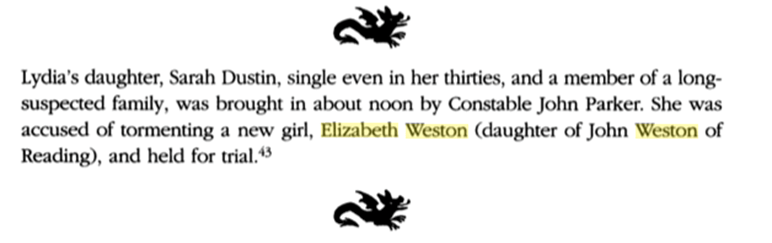

Summary of the Court Case: The Trial of Sarah Dustin (1693)
In 1692, Sarah Dustin (also spelled Dastin) of Reading, Massachusetts, was formally accused of practicing witchcraft against Elizabeth Weston, daughter of John Weston of Reading. The indictment alleged that Sarah had used “detestable arts called witchcraft and sorcery” to afflict and torment Elizabeth over a period of time.
Sarah Dustin was arrested and examined during the height of the witchcraft hysteria and was later brought before the Superior Court of Judicature, the highest court in the Massachusetts Bay Colony. She pleaded not guilty and placed herself upon trial “by God and the country,” meaning judgment by a jury of her peers.
The court heard the indictment, the testimony presented by the prosecution, and Sarah Dustin’s defense. A jury of twelve men, led by Samuel Hunting, deliberated on the evidence. After consideration, the jury returned a verdict of not guilty, acquitting Sarah Dustin of the charge of witchcraft.
Despite her acquittal, Sarah was not immediately freed. As was customary at the time, she was ordered released only after paying her jail fees, which covered the costs of her imprisonment.
Readers interested in the full primary source can view the complete court record online, including the original indictment and verdict.
Summary of the Court Case: The Trial of Lydia Dustin (1693)
Lydia Dustin (also spelled Dastin), a widow from Reading, Middlesex County, was formally accused of witchcraft during the fevered period of the Salem Witch Trials in 1692. According to surviving indictment records, she was charged with using “detestable arts … witchcraft and sorceries” against one or more alleged victims, including Mary Marshall of Malden, Massachusetts.
A warrant was issued for her arrest on May 2, 1692, ordering her to be brought before justices for examination. She, along with several others from Reading, including her daughter Sarah Dustin, was taken into custody and subsequently transported under guard for trial before the Superior Court of Judicature.
Lydia was tried in early 1693, a period when the court had shifted away from earlier reliance on spectral evidence and many defendants were being acquitted. In Lydia’s case, the jury returned a not guilty verdict. However, as was customary at the time, she could not be released until she paid the jail fees owed for her imprisonment. Because she was unable to pay these fees, she remained in custody and died in jail on March 10, 1693.
This tragic outcome, acquittal in court but death in custody, illustrates one of the harshest aspects of the trials: legal exoneration did not always guarantee freedom or survival.
Readers interested in the full primary source can view the complete court record online, including the original indictment and verdict.
My Lineage
I traced my roots further back and discovered a direct line of ancestors that connects me to this troubling chapter of history. Here’s a look at my lineage:
Elizabeth WESTON
9th great-grandaunt
John Weston 1631-1729
Father of Elizabeth WESTON
Sarah Weston 1656-1684
Daughter of John Weston
John Milk Jr 1668-1720
Son of Sarah Weston
Job Milk I 1694-1778
Son of John Milk Jr
Job Milk II 1725-1804
Son of Job Milk I
Sarah Milk 1749-1830
Daughter of Job Milk II
Roger Moore 1775-1860
Son of Sarah Milk
Olive Moore 1821-1898
Daughter of Roger Moore
George Howard Richards 1859-1942
Son of Olive Moore
Ambrose Richards 1887-1957
Son of George Howard Richards
Benjamin George Richards 1916-1977
Son of Ambrose Richards
Patrick James Richards 1954-2014
Son of Benjamin George Richards
The Aftermath and Legacy
Looking back on the Salem Witch Trials, what hits me hardest isn’t the statistics or the sensational headlines; it’s the human cost. It’s the fact that words, spoken in fear or anger or even in desperation, could shape lives so completely. Accusations were not abstract; they were real, and the consequences were devastating.
As I follow my family history through this period, I feel the weight of those words. My ancestor Elizabeth Weston’s testimony played a role in what happened to Lydia Dustin and her daughter Sarah. Reading the records, I can’t help but feel the human toll behind the names in the court books.
I want to take a moment to acknowledge and apologize to Lydia Dustin and her descendants. What happened to her, the imprisonment, the loss, the death in custody, was wrong. Even centuries later, I feel the responsibility to recognize that injustice and to honor her story.
This part of history reminds me that words have power. They can heal, and they can also harm. And while we can’t change what happened, we can remember, we can reflect, and we can speak with care and conscience today.
References & Sources
- Rosenthal, Bernard (ed.). Records of the Salem Witch-Hunt. Cambridge University Press.
- Roach, Marilynne K. The Salem Witch Trials: A Day-by-Day Chronicle of a Community Under Siege.
- University of Virginia, Salem Witch Trials Documentary Archive and Transcription Project.
- Massachusetts Archives, Early Court Records & Witchcraft Proceedings.
- Mather, Increase. Cases of Conscience Concerning Evil Spirits.
- Massachusetts Bay Colony Court of Oyer and Terminer records (1692–1693).
- Massachusetts Superior Court of Judicature, April 25, 1693 (Sarah Dustin ruling).
- Record of the Trial of Lydia Dustin, Salem Witch Trials Documentary Archive and Transcription Project, University of Virginia.
- Warrant for the Arrest of Lydia Dustin, Salem Witchcraft Papers (Mittimus), Massachusetts Archives Digital Repository.
- Salem Witch Trials Chronology, Salem Witch Museum confirms death in prison due to inability to pay fees.



 My Tiny World Corner
Leave a comment